Every new employee needs access to the right systems from their first day. When an employee leaves, the IT team must remove that access on time. At LS Technologies, this process involved five legal entities, each with its own Microsoft 365 tenant. The team had to manage several manual steps across different systems, making account creation, access changes and offboarding difficult to track.
GoML built an automated onboarding and offboarding platform on AWS that connects Jira with Microsoft 365. The team also set up the DevOps processes to manage infrastructure, automate deployments, handle failures and secure credentials across all five tenants. The new platform also allowed LS Technologies to move away from its existing process in stages without disrupting ongoing operations.
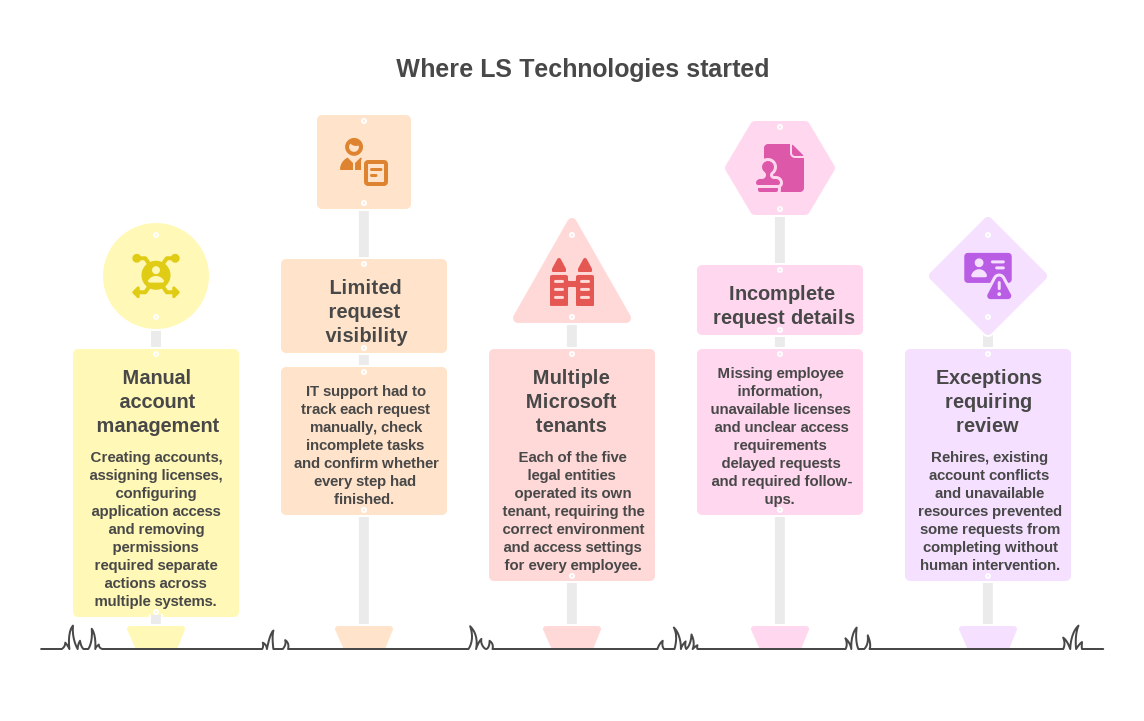
Where LS Technologies started
Employee onboarding and offboarding involve several connected IT tasks. Before the new platform, these tasks required manual coordination across different systems.
Five issues shaped the project:
- Manual account management: Creating accounts, assigning licenses, configuring application access and removing permissions required separate actions across multiple systems.
- Limited request visibility: IT support had to track each request manually, check incomplete tasks and confirm whether every step had finished.
- Multiple Microsoft 365 tenants: Each of the five legal entities operated its own tenant, requiring the correct environment and access settings for every employee.
- Incomplete request details: Missing employee information, unavailable licenses and unclear access requirements delayed requests and required follow-ups.
- Exceptions requiring review: Rehires, existing account conflicts and unavailable resources prevented some requests from completing without human intervention.
These issues pointed to a need for better workflow orchestration, request tracking, credential handling and failure recovery. GoML addressed each area in the platform design.
The engineering decisions behind the platform
GoML began by examining how requests moved through the existing IT process, where manual hand-offs occurred and which tasks needed human oversight.
The team used GoML's AI Matic platform to support the solution development, bringing together the required AI capabilities, AWS services and enterprise integrations. The AWS DevOps use-case fit and calibration review helped establish the technical requirements for the build.
These decisions shaped the platform's architecture and the way LS Technologies would manage it after launch.
Workflow architecture: AWS Step Functions at the center
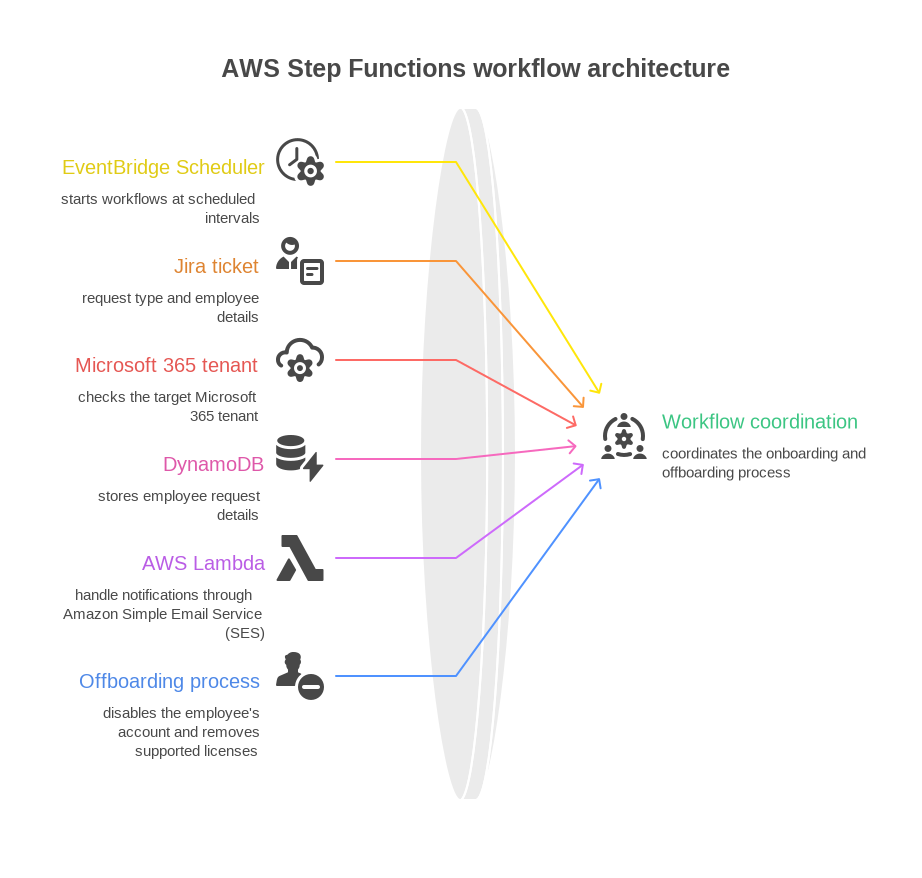
AWS Step Functions coordinates the onboarding and offboarding process. Amazon EventBridge Scheduler starts workflows at scheduled intervals, after which Step Functions executes each request in order.
The workflow reads the Jira ticket, identifies the request type and employee details, checks the target Microsoft 365 tenant, and carries out account and access changes through Microsoft Graph. It then updates the request status in Jira.
Amazon DynamoDB stores employee request details and tracks the status of each workflow step. AWS Lambda functions handle notifications through Amazon Simple Email Service (SES). These include welcome emails, offboarding confirmations, review requests and error alerts. Jira remains the main interface for IT support. The workflow updates each ticket as tasks progress, so support teams can check request status without switching between systems.
Offboarding follows a controlled process. The platform disables the employee's account and removes supported licenses, group memberships, collaboration access and enterprise application roles. It retains the account record for audit purposes.
This gives LS Technologies a way to revoke access without losing the account history associated with the employee.
Infrastructure as code with AWS CDK
GoML used AWS CDK v2 and TypeScript to define the platform's infrastructure. The codebase is divided into five modular stacks, each responsible for a separate part of the system.
This structure lets the team deploy or update individual components without redeploying the entire platform.
For example, a change to workflow logic does not require a new deployment of the data layer. AWS CDK also keeps infrastructure configuration consistent across environments and gives engineers a version-controlled record of infrastructure changes.
One CI/CD pipeline for every change
GoML implemented GitLab CI/CD to automate testing, builds and deployments across the platform. Every change follows the same release process, whether it affects workflow logic, access rules or infrastructure defined through CDK.
This matters for an identity management system because access rules determine which employees can enter which systems. A change to these rules needs the same review and testing as a code or infrastructure update.
By managing both through one pipeline, LS Technologies gets a consistent release process, fewer manual deployment steps and a record of changes to employee access permissions.
Designing for failures and exceptions
The platform connects Jira, Microsoft 365 and AWS services. GoML accounted for failures in external API calls and built recovery steps into the workflow.
The system uses several controls:
- Retries with backoff: AWS Step Functions retries failed API calls with increasing wait times between attempts. This helps recover from temporary service interruptions without sending repeated requests too quickly.
- Human-review escalation: If a request continues to fail after retries, the workflow sends it to Jira for human review rather than leaving it incomplete without notice.
- Resume after resolution: When a request needs manual intervention, the workflow pauses and SES notifies the support team. Once the Jira issue is resolved, the workflow checks the request again and continues from the point where it stopped, where possible.
- Duplicate-safe notifications: The platform tracks sent emails so that workflow retries do not send the same notification multiple times.
- Checks before account changes: The workflow checks license availability, group configuration and application access requirements before making changes. Requests with unresolved requirements are flagged for review.
- Automatic capacity management and recovery: AWS Lambda adjusts to incoming request volume, while DynamoDB uses on-demand capacity. Point-in-time recovery protects stored request data.
These controls help prevent incorrect account changes and incomplete access removal, two outcomes that can create serious problems for IT teams.
Security and tenant isolation
An identity management platform holds credentials that control access to several enterprise systems. GoML designed the security model around credential separation, restricted permissions and encryption.
LS Technologies uses one shared workflow across all five legal entities, but each entity retains its own Microsoft 365 connection and credentials.
This allows the IT team to manage one platform while keeping access to each tenant separate.
Monitoring for engineers and IT support
GoML designed monitoring around the needs of two groups: engineers responsible for the platform and IT support teams handling employee requests. Engineers use Amazon CloudWatch to monitor workflow errors and performance. SES error alerts notify them when a failure requires attention.
IT support gets request-level visibility through DynamoDB and Jira. Each completed workflow step updates the stored request status, and the latest status is written back to the Jira ticket.
This gives support teams a clear view of which requests are complete, which are still running and which need their attention. Engineers can monitor the system without requiring IT support to interpret technical logs.
Testing and staged migration
GoML did not move LS Technologies to the new platform in one step.
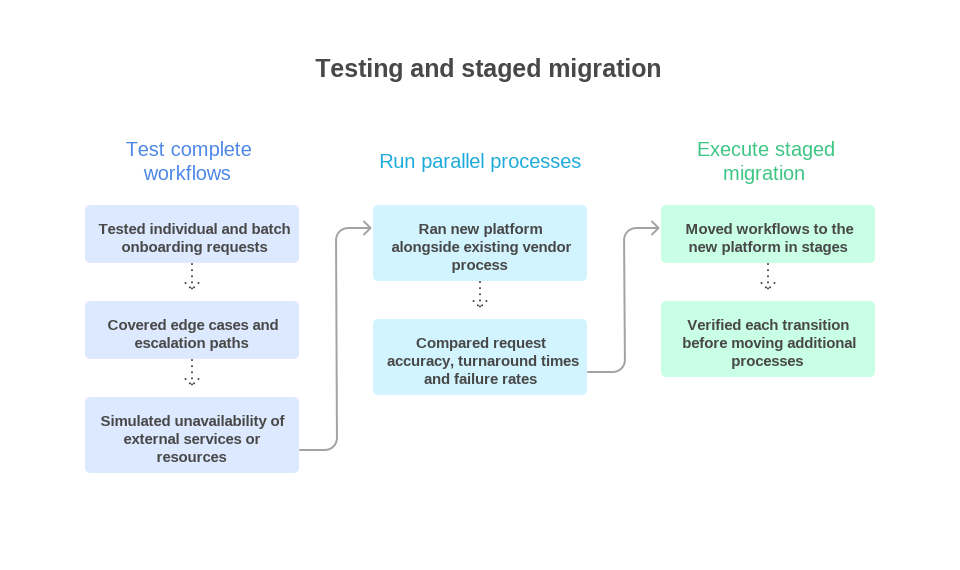
Before launch, the team tested complete workflows across connected systems. Testing covered individual and batch onboarding requests, edge cases, escalation paths and situations where external services or required resources were unavailable.
The new platform then ran alongside the existing vendor process. This parallel run allowed the team to compare request accuracy, turnaround times and failure rates using actual requests.
After reviewing the results, LS Technologies moved workflows to the new platform in stages. This gave the team a chance to verify each transition before moving additional processes.
Production handover and team ownership
Automating employee access changes also changes the responsibilities of the IT team. Routine account tasks move to the workflow, while support staff focus more on exceptions, request reviews and platform monitoring.
GoML's delivery process accounted for this shift by reviewing the existing operating model, identifying affected teams, defining future responsibilities and preparing staff through training.
The nine-week engagement ended with a production handover package that included:
- Architecture and integration documentation.
- A user guide for platform monitoring.
- Runbooks covering common issues and escalation procedures.
The runbooks give LS Technologies' team instructions for handling routine failures, resolving common issues and escalating problems that need further engineering support.
This allows the internal team to manage the platform after handover rather than depending on GoML for every operational issue.