CPGRAM (Centralized Public Grievance Redress and Monitoring) is a government platform that handles public grievances. Complaints come through WhatsApp, chatbots, mobile apps, web forms and physical letters. Each complaint contains personal information that needs protection.
GoML partnered with CPGRAM to build a modular platform that automates the grievance process, from complaint intake to resolution tracking. Since the platform handles sensitive citizen data at national scale, we designed its infrastructure with security, reliability and data protection in mind from the start.
This post covers the engineering decisions behind the platform, including database reliability, identity management, encryption, storage security and testing.
The challenge of managing grievances at a national scale
Before automation, grievance teams processed complaints manually. Citizens submitted complaints in different formats and through multiple channels. Staff had to identify the complaint type, location and urgency before assigning it to the right department.
Tracking complaints across departments also required manual effort. Limited visibility made it harder to identify recurring issues. As complaint volumes increased, these processes led to delayed responses and unresolved cases, affecting public trust.
CPGRAM needed a platform that could handle large volumes of complaints, protect citizen information and maintain a clear record of every grievance from submission to resolution.

How we designed the platform
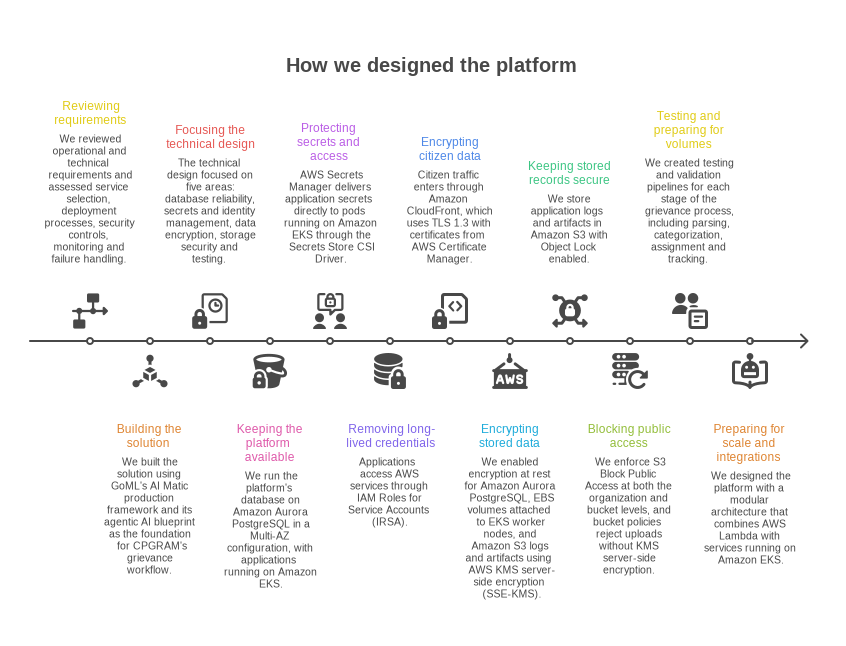
We started by reviewing the operational and technical requirements. Our AWS DevOps use-case fit and calibration review helped us assess service selection, deployment processes, security controls, monitoring and failure handling.
We built the solution using GoML's AI Matic production framework and its agentic AI blueprint as the foundation for CPGRAM's grievance workflow. This gave our engineers tested patterns for integration, monitoring and governance.
The technical design focused on five areas: database reliability, secrets and identity management, data encryption, storage security and testing across the grievance lifecycle.
1. Keeping the platform available
A database that stays available during zone failures
What we built: We run the platform's database on Amazon Aurora PostgreSQL in a Multi-AZ configuration, with applications running on Amazon EKS.
Why it matters: Citizens need to submit and track grievances without service interruptions. Multi-AZ configuration keeps the database available if an Availability Zone fails, reducing the risk of a single-zone outage affecting the platform.
2. Protecting secrets and application access
Keeping secrets out of application configuration
What we built: AWS Secrets Manager delivers application secrets directly to pods running on Amazon EKS through the Secrets Store CSI Driver.
Why it matters: Storing credentials in Kubernetes ConfigMaps or environment variables can expose them through incorrect configurations, debug output or application logs. Delivering secrets directly from Secrets Manager keeps them separate from application configuration.
3. Removing long-lived AWS credentials
What we built: Applications access AWS services through IAM Roles for Service Accounts (IRSA).
Why it matters: IRSA assigns each workload its own short-lived permissions. Applications do not need permanent AWS access keys, reducing the risk of credentials being exposed or accidentally committed to source code.
4. Encrypting citizen data
Protecting data as it moves between services
What we built: Citizen traffic enters through Amazon CloudFront, which uses TLS 1.3 with certificates from AWS Certificate Manager. The Network Load Balancer also uses TLS 1.3. Application pods connect to the database over SSL, and outbound internet traffic through NAT uses TLS 1.3.
Why it matters: Data passes through several services before reaching its destination. Encrypting traffic across these connections protects citizen information during transmission, including communication between internal services.
5. Encrypting stored data with separate keys
What we built: We enabled encryption at rest for Amazon Aurora PostgreSQL, EBS volumes attached to EKS worker nodes, and Amazon S3 logs and artifacts using AWS KMS server-side encryption (SSE-KMS).
Each service has its own customer-managed KMS key, with envelope encryption and automatic annual key rotation. Key policies also separate key administration from key usage.
Why it matters: Separate encryption keys limit the impact of a security issue involving one service. Separating key administration from usage also prevents application workloads from having unnecessary control over encryption settings.
5. Keeping stored records secure
Protecting logs and artifacts from changes
What we built: We store application logs and artifacts in Amazon S3 with Object Lock enabled.
Why it matters: Object Lock helps prevent stored objects from being modified or deleted. This protects the grievance audit trail and keeps records available for later reviews and verification.
6. Blocking public access and unencrypted uploads
What we built: We enforce S3 Block Public Access at both the organization and bucket levels. Bucket policies also reject uploads that do not specify KMS server-side encryption.
Why it matters: These controls reduce the risk of accidental public exposure and prevent unencrypted files from entering storage. Security rules apply to every upload rather than depending on individual configuration choices.
7. Testing and preparing for higher volumes
What we built: We created testing and validation pipelines for each stage of the grievance process, including parsing, categorization, assignment and tracking. These pipelines cover both synthetic and real-world scenarios.
Why it matters: Complaints arrive in different formats. A change that works for web forms may cause problems with WhatsApp messages or physical letters. Testing different inputs at every stage helps catch these issues before they affect users.
8. Preparing for scale and external integrations
What we built: We designed the platform with a modular architecture that combines AWS Lambda with services running on Amazon EKS. Container images are stored in Amazon ECR.
The architecture targets a user base of more than 100 crore people and over 10 lakh grievances each year. We also planned integrations using Open API standards, allowing platforms such as UMANG, NGOs and research organizations to connect with CPGRAM.
Why it matters: A modular architecture allows individual components to scale and receive updates without requiring changes across the entire platform. Open API support also makes it easier to connect other public-sector platforms as integration needs grow.
What other government platforms can learn from CPGRAM
Building secure government platforms with GoML
Government platforms handle large volumes of citizen information across departments and communication channels. Their infrastructure needs to support reliable access, controlled data handling and clear records of every action.
CPGRAM shows how GoML brought these requirements into the platform's AWS architecture, from database availability and identity controls to encryption, storage security and testing.
If your organization is building or updating a public-sector platform, GoML can help with its architecture and DevOps requirements.