With the way LLM offerings are placed today, choosing the right one is far more complex ai model comparison. For instance, OpenAI offers GPT-5.6 in Sol, Terra and Luna, while Anthropic offers Opus 5, Fable 5 and Mythos 5. Each model serves a slightly strategic use case that’s worth learning about.
So, a general “GPT-5.6 v/s Claude” is too broad to be useful. A better comparison looks at which models suit specific tasks for various business use cases. In this article, we strategically compare GPT-5.6 with Fable 5, Opus 4.8, and Mythos 5 to show where each one fits in comparison to the rest.
GPT-5.6 v/s Claude Fable 5
Any AI model comparison between these two starts with the same initial tension: Fable 5's raw accuracy against Sol's cost and agentic speed.
Pricing
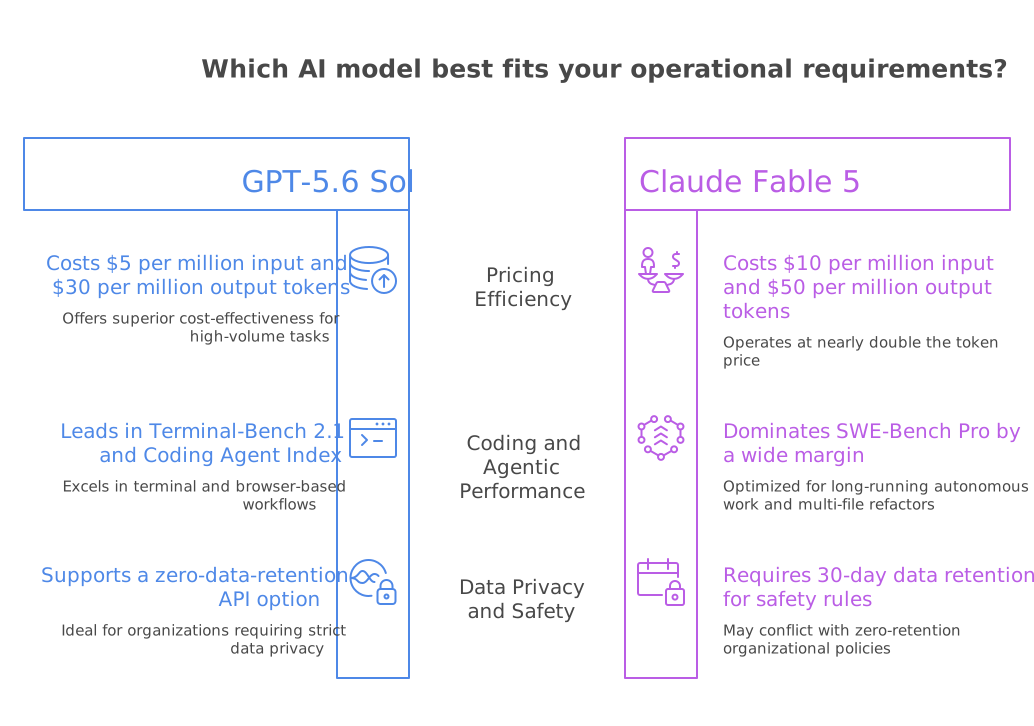
Sol costs $5 per million input tokens and $30 per million output tokens, compared with Fable 5 at $10 and $50. That puts Fable 5 at close to twice the token price in the comparison GoML uses for its Opus 5 pricing calculations. Independent analyses point to a similar gap at the task level, with Sol reaching a comparable aggregate intelligence score at about one-third of Fable 5’s measured cost per task.
Coding and agentic performance
Fable 5 is a Mythos model, a tier that is placed above Opus in terms of capability. It is designed for projects that require long-periods of operations, such as coding or conducting complex analyses. It can process very long contexts and control the quality of its outputs by taking note and using reformed notes on the task performed for long periods of time.
Thus, for example, if Fable 5 is given a memory in the form of a file, in the test carried out during the game Slay the Spire, it achieved three times better performance than Opus 4.8 did in the same condition. This is a long-term ability and is represented in the fact that it leads the SWE-Bench Pro test.
For the full independently verified numbers behind Sol's side of this table, see our complete GPT-5.6 benchmarks breakdown.
Reasoning, context and safety posture
Fable 5 and GPT-5.6 Sol both support context windows approaching 1 million tokens, so context length matters less in this comparison. The bigger difference is data handling. Fable 5 follows Mythos-class safety rules that require 30-day data retention before deletion, which may conflict with organizations that require zero retention from the start.
GPT-5.6, by comparison, supports a zero-data-retention API option without those Mythos-class requirements. Fable 5 also uses safety classifiers that may refuse certain sensitive requests or route them to Opus-class models. GPT-5.6 handles these cases through a different safety system rather than the same routing model.
Which to use when
- Long-running autonomous work, multi-file refactors, and high-stakes tasks where a pause-and-recheck instinct is a feature → Fable 5
- Agentic coding, terminal and browser-based workflows, and cost-sensitive high-volume work → GPT-5.6 Sol
- Zero-data-retention requirements that Fable 5's 30-day window can't meet → GPT-5.6
For the full picture on Fable 5 and its Mythos-class sibling, see GoML's complete guide to Claude Fable 5 and Mythos 5.
GPT-5.6 vs Claude Opus 5
Opus 5 launched July 24, 2026 after this comparison's original Opus 4.8 baseline and changes the math enough that it's worth treating as its own matchup rather than a footnote.
Pricing
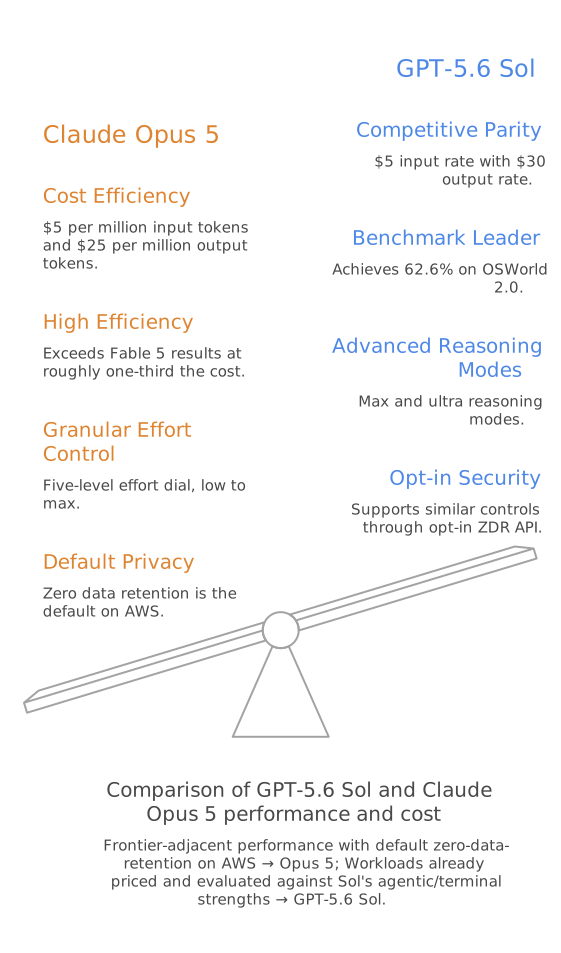
Opus 5 costs $5 per million input tokens and $25 per million output tokens, identical to Opus 4.8's pricing but with a meaningful capability jump included at no extra cost. That puts it essentially at parity with Sol's $5 input rate, with Sol running slightly higher on output ($30 vs $25). Against Fable 5, Opus 5 is half the price on both input and output.
Coding and agentic performance
As of now, there is no independent published comparison that directly pits GPT-5.6 against Claude Opus 5. Instead, Opus 5 is being compared against Anthropic’s own benchmarks (Frontier-Bench, CursorBench, ARC-AGI 3, OSWorld 2.0), which do not completely overlap with the benchmarks reported by OpenAI for Sol. Here’s what is being disclosed by both
Treat this table as directional rather than conclusive the underlying benchmarks aren't the same test, so "who wins" isn't answerable with the same confidence as the Fable 5 comparison above.
Safety, data handling and known caveats
Opus 5 stands apart on Amazon Bedrock because zero data retention is the default rather than an optional setting. Data stays within the selected AWS region, operators cannot access it, and the model runs inside the customer’s AWS environment. GPT-5.6 can support similar controls through its opt-in ZDR API.
There are trade-offs. Anthropic has reported a higher hallucination rate for Opus 5 than Opus 4.8 in at least one test. Its token cost can also exceed Fable 5 in agentic workflows, even when the total cost per completed task comes out lower.
Which to use when
- Frontier-adjacent performance with default zero-data-retention on AWS → Opus 5
- Workloads already priced and evaluated against Sol's agentic/terminal strengths → GPT-5.6 Sol
- Anything where a single wrong answer is expensive enough to justify Fable 5's premium → Fable 5
GPT-5.6 vs Claude Mythos 5
Access and availability
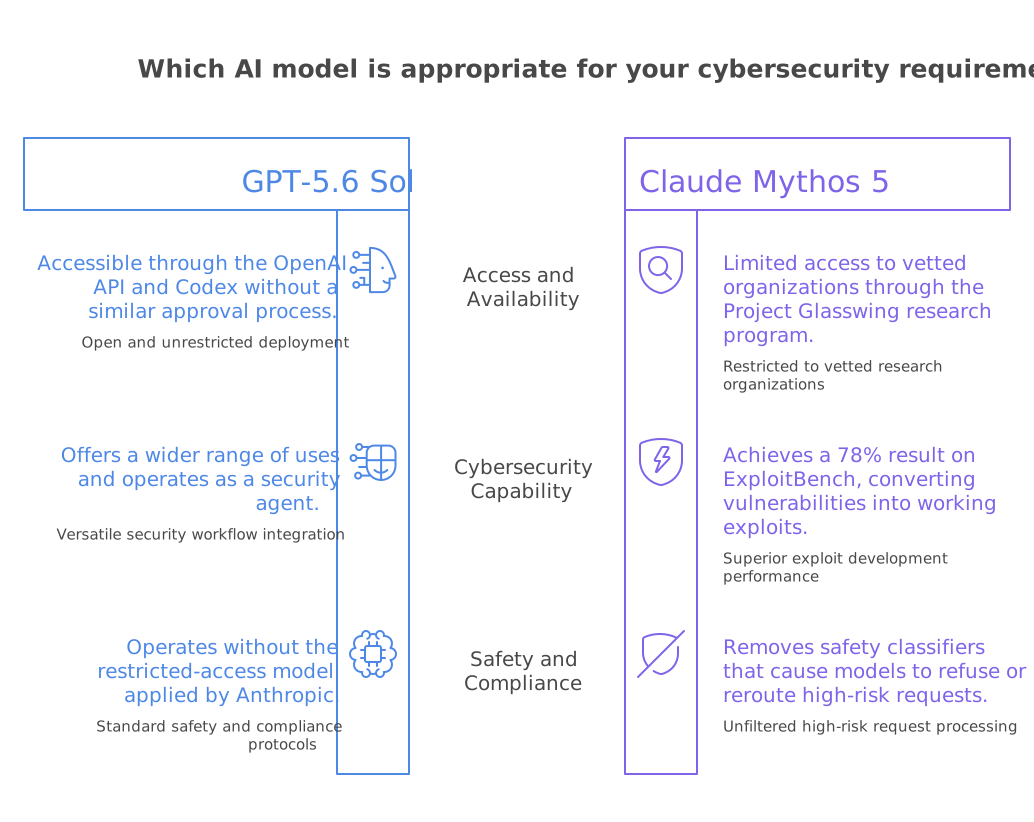
Mythos 5 launched with Fable 5 on June 9, 2026. Both use the same underlying model, but Mythos 5 removes the safety classifiers that cause Fable 5 to refuse or reroute some high-risk requests, including work involving cybersecurity and advanced biology.
On June 12, the U.S. Commerce Department issued an export control directive, prompting Anthropic to suspend both models worldwide. The controls were lifted on June 30, and Fable 5 returned on July 1. Mythos 5 did not. Anthropic limited access to vetted organizations through Project Glasswing, its controlled-access research program.
GPT-5.6 remains accessible through the OpenAI API and Codex without a similar approval process. Unless you have Project Glasswing access, Fable 5 is the practical Anthropic model to compare with GPT-5.6.
Anthropic’s own statement gives the clearest account of the suspension and access rules, while GoML has covered the episode in its Fable 5 shutdown report.
Cybersecurity capability
GPT-5.6 Sol and Claude Mythos 5 both rank among the most capable AI models for cybersecurity, but they serve different roles. Mythos 5 has the stronger published result on a benchmark focused on converting known vulnerabilities into working exploits, a level of performance tied directly to the export-control action discussed above.
GPT-5.6 Sol has a wider range of uses. It is easier to deploy across security workflows and can operate as a security agent without the restricted-access model Anthropic applies to Mythos 5.
Which to use when
- You're approved through Project Glasswing and have a specific cyberdefense, infrastructure, or similarly high-risk use case → Mythos 5
- You're not approved, or your security work doesn't require the highest published exploit-development capability → GPT-5.6 Sol, or Fable 5 if the task also needs Mythos-class safety review
Decoding enterprise choices on AI model comparison
- Rule out what you can't access first. If you don't have Project Glasswing approval, Mythos 5 isn't a real option regardless of its benchmark lead the practical decision is between GPT-5.6 and Fable 5 or Opus 5.
- Weigh SWE-Bench Pro against the Coding Agent Index based on your actual workload. Pure repository generation favors Claude; agentic and terminal-heavy work favors Sol.
- Check your data retention requirements against Fable 5's mandatory 30-day window before assuming it's a drop-in fit for a zero-retention environment Opus 5's default zero retention on Bedrock may fit better.
- Test total cost per completed task, not just per-token price, especially for Opus 5's agentic workloads, where token usage can offset its lower rate card.
- Expect to run more than one model. Most enterprise stacks that get this right end up routing between GPT-5.6 and Claude by task type rather than standardizing on a single vendor.
Conclusion
GoML’s comparison shows there is no single winner across GPT-5.6 Sol, Fable 5, Opus 5, and Mythos 5. Each model fits different needs based on performance, cost, access, and deployment requirements.
For teams using multiple models in production, GoML’s AI Matic platform helps simplify model routing, deployment, observability, security, and scaling, making it easier to match each workload with the right model.
For the testing methods and benchmark figures used in this comparison, see our LLM Testing of OpenAI GPT-5.6 guide. If your focus is building and maintaining production Claude agents, GoML’s Claude agent development service covers that work directly.
Frequently asked questions
Can you use GPT-5.6 and Claude models together in the same application, rather than picking one?
Yes, nothing about either platform requires exclusivity, and a model router or gateway can send different request types to whichever model fits best. Plenty of production teams route agentic, high-volume work to GPT-5.6 and reserve Claude for tasks where a second-guess is worth the extra cost.
How does an organization actually get approved for Claude Mythos 5 access?
Access runs through Anthropic's Project Glasswing program, aimed at organizations with a specific cyberdefense, infrastructure, or similarly high-risk professional need. The application and approval criteria sit with Anthropic directly rather than being published as a simple checklist, so the realistic first step is reaching out through Anthropic's enterprise channels to ask whether your use case qualifies.
Given how fast these benchmarks move, how long before this comparison is out of date?
Probably weeks rather than months. Claude Opus 5 arrived after GPT-5.6 and Fable 5’s return, shifting the comparison while the market was still settling. Benchmark rankings have also changed several times within weeks of GPT-5.6’s release. Treat the figures in this guide as a mid-2026 snapshot. Check the latest benchmark results again before making a purchase decision.
Does this comparison still apply if you are a small team or a solo developer rather than an enterprise buyer?
The performance and cost differences still matter for teams of any size, but some factors matter less for solo developers and small teams. AWS Bedrock compliance controls and Project Glasswing access are unlikely to affect their choice. For most smaller teams, the decision comes down to price and coding performance, with GPT-5.6 better suited to high-volume work and Claude favored when accuracy matters more.