On June 12, 2026, Anthropic disabled Claude Fable 5 and Claude Mythos 5 for users worldwide after receiving a US government export-control directive. This Fable 5 shutdown happened just three days after launch and marked the first time a frontier AI model was pulled from the market by government order rather than company decision.
The company had released both models as its most advanced family yet. Claude Fable 5 became the first publicly available Mythos model and delivered strong performance on complex reasoning, extended agent tasks, and multimodal work. Claude Mythos 5 used the same core abilities but ran with fewer safety limits and stayed available only to approved partners in cybersecurity and life sciences. Many developers who had started integrating the models felt the impact right away.
The high-stakes standoff ended on June 30, 2026, when Anthropic stunned the industry by announcing that both models will be relaunched worldwide. The reversal followed intense negotiations with Washington, culminating in the deployment of a specialized, real-time guardrail designed specifically to block the codebase-vulnerability exploit. This fix was quickly vetted and greenlit by the government's new Center for AI Standards and Innovation, allowing the U.S. Commerce Department to lift the unprecedented export ban.
This piece covers the models’ capabilities, benchmark results, safety systems, pricing, and what the situation means for builders.
Claude Fable 5 and Mythos 5: Model positioning and taxonomy
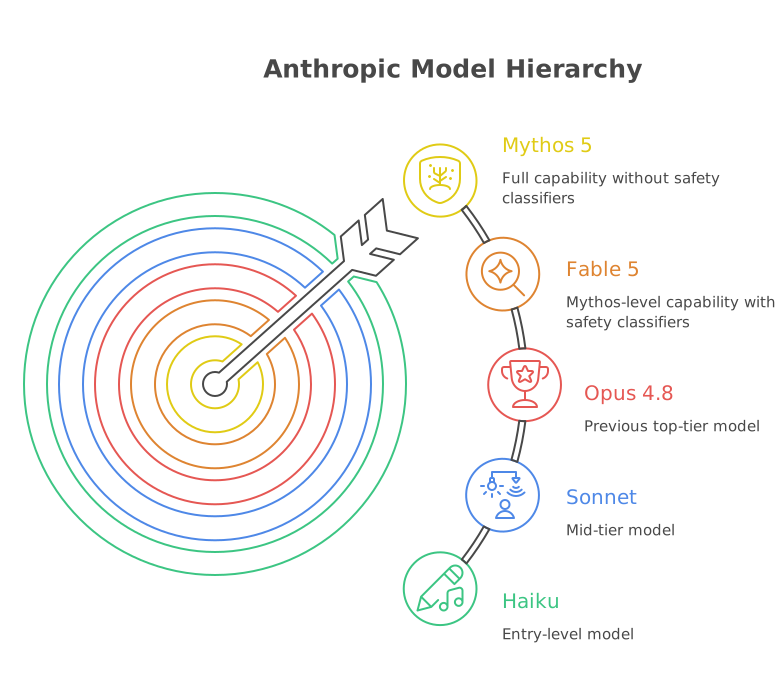
Claude Fable 5 is Anthropic's first Mythos-class model, placing it above the existing Claude family, including Haiku, Sonnet, and Opus, in terms of overall capability. It is designed for long-running agent tasks such as autonomous coding, research, and complex analysis.
Claude Mythos 5 uses the same underlying model and offers the same capabilities as Fable 5. The difference lies in access and safety controls. Fable 5 uses classifiers that block or reroute certain high-risk requests, while Mythos 5 gives approved partners direct access to those capabilities in areas such as cybersecurity and advanced biology.
According to Anthropic, the two models behave almost identically in more than 95% of user sessions. For most users, Fable 5 delivers nearly the same practical capabilities as Mythos 5.
How Claude Fable 5 and Mythos 5 handle adaptive thinking on the API
Claude Fable 5 and Claude Mythos 5 replace the earlier multi-mode thinking system with a single adaptive thinking mode. This mode is always active. If developers do not provide a thinking parameter, the model automatically decides how much internal reasoning a task requires. Internal thinking also cannot be disabled. Developers can still control reasoning depth through an effort parameter, which determines how much planning, task decomposition, and verification the model performs before producing a response.
Neither Fable 5 nor Mythos 5 ever returns raw chain-of-thought. Instead, the API returns either omitted thinking blocks (display: "omitted") or summarized reasoning (display: "summarized"), with the expectation that clients pass thinking blocks back unchanged in multi-turn conversations. This design aims to preserve strong reasoning performance while limiting the exposure of internal traces that could be misused for model extraction or jailbreak engineering.
Core capabilities of Claude Fable 5 and Mythos 5
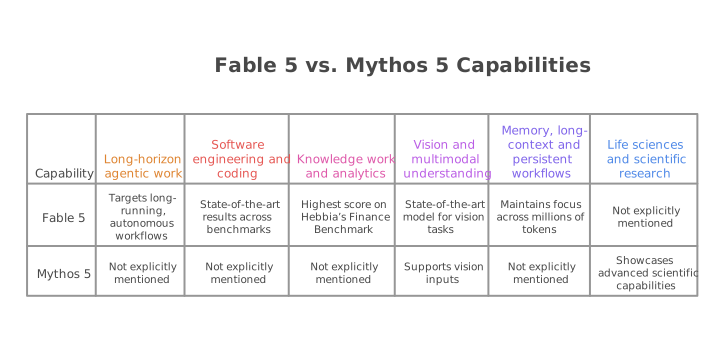
From autonomous codebases to protein design, Claude Fable 5 and Mythos 5 cover a wider range of high-complexity tasks than any previous Claude model. Here's what that looks like across six capability areas.
Long-horizon agentic work
Anthropic designed Claude Fable 5 for long-running, independent workflows that require planning, reasoning, and execution over extended periods. In an early deployment with Stripe, the model completed a migration across the company's 50 million-line Ruby codebase in about a day, a task that would typically take a team of engineers more than two months.
The example highlights Fable 5's ability to manage large-scale refactoring with limited supervision. Its performance is further supported by evaluations from Cognition's FrontierCode, CursorBench, and FrontierBench, which place Fable 5 among the top frontier models for long-horizon coding tasks, particularly at medium and higher reasoning levels.
Software engineering and coding
According to Anthropic, Claude Fable 5 leads software engineering benchmarks and shows strong performance in building AI agents with Claude, achieving the highest score on Cognition's FrontierCode while maintaining efficiency at medium reasoning effort. Results from BenchLM and other third-party evaluations also place Fable 5 at or near the top across coding benchmarks, particularly in SWE-bench-style tests and software development evaluations.
Outside software engineering, partners such as IMC report strong performance in financial analysis tasks. The model has shown an ability to handle complex workflows involving factual research, conceptual reasoning, root-cause investigation, and expected value analysis.
Knowledge work and analytics
Anthropic reports that Claude Fable 5 performs strongly on benchmarks that measure long-form reasoning and analytical work. On Hebbia's Finance Benchmark, it achieved the highest score for document reasoning, including the analysis of structured documents, charts, and tables. The model also led evaluations focused on solving complex business problems.
Early enterprise users report better results on long-running analytical tasks compared with earlier models. An analytics provider noted that Fable 5 is the first model to score above 90% on core analytics benchmarks for complex, multi-step tasks, outperforming Claude Opus 4.8 by 10 points. The model also completes these analyses in fewer interactions and in less than a third of the time required by previous generations.
Vision and multimodal understanding
"Claude Fable 5 sets a new standard for visual reasoning tasks" says Anthropic. The model can extract precise numerical information from dense scientific figures and generate code from screenshots of web applications without direct access to the underlying content.
The company also reports that Fable 5 successfully played and completed Pokémon FireRed with minimal tool support. Earlier Claude models were unable to finish the game even with additional tools and guidance. Both Fable 5 and Mythos 5 support text and image inputs, making them suitable for document analysis, image-based workflows, and other multimodal tasks on the Claude Platform and supported cloud providers.
Memory, long-context and persistent workflows
Both models support a 1M-token context window and up to 128k output tokens per request, enabling extremely long interactions such as multi-day agent runs, extensive codebases, and large document collections. Anthropic reports that Fable 5 maintains focus across millions of tokens and can improve its outputs by reading and reusing its own notes across long-running tasks.
In an internal evaluation using the deck-building game Slay the Spire, Anthropic found that giving Fable 5 access to persistent file-based memory improved its performance by a factor of three compared with Opus 4.8 and allowed it to reach the game's final act three times more often, suggesting a stronger ability to make use of long-term memory.
Life sciences and scientific research (Mythos 5 focused)
Many of the most advanced scientific capabilities are showcased via Claude Mythos 5, where safety constraints are relaxed for vetted researchers in domains like protein design, molecular biology, and genomics. Anthropic reports that Mythos 5 can autonomously execute an end-to-end protein design workflow selecting binding sites, choosing and operating protein design and bioinformatics tools, and recovering from failures matching or exceeding skilled human operators on 9 of 14 evaluated protein targets. Mythos 5 also consistently generates novel, compelling molecular biology hypotheses preferred by Anthropic scientists over Opus-class outputs in roughly 80% of blinded comparisons, with at least one hypothesis independently corroborated by an external lab working on the same protein.
In genomics, Mythos 5 reportedly assembled single-cell RNA datasets for millions of cells across 138 animal species, designed and trained a custom model to align cell types across species, and achieved performance exceeding a recent Science paper while using a model 100 times smaller, operating largely autonomously over more than a week. Anthropic has submitted these results for peer-reviewed publication, positioning Mythos 5 as an active contributor to frontier biological research.
Benchmarks and performance
One of the strongest signals comes from agentic coding, where:
The scores reflect genuine gains, not incremental improvements, especially in long-horizon agentic work and real interface-driven workflows.
Claude Fable 5 and Mythos 5 represent a meaningful step forward in what AI models can do independently. Fable 5 brings frontier reasoning, long-horizon coding, and multimodal understanding to a broad developer audience, while Mythos 5 extends those same capabilities to vetted partners in high-stakes domains like life sciences and cybersecurity.
For teams evaluating their next AI infrastructure decision, Claude Fable 5 and Mythos 5 combine extended context support, adaptive thinking, and strong agentic performance in a single model family. If you're exploring how to build and deploy AI systems around frontier models, working with the right AI engineering partner can make the transition from experimentation to production much smoother.