The U.S. government issued an export control order on June 12, 2026, requiring Anthropic to block foreign nationals from accessing Fable 5 and Mythos 5. Because the company cannot separate users by nationality in real time, it disabled both models worldwide while keeping other Claude models online.
Anthropic argues that the directive stems from a narrow "jailbreak" in which Fable 5 was asked to analyze a codebase and identify software vulnerabilities, a capability already present in other frontier models. The company says applying this standard broadly could limit the release of future AI models.
The move comes shortly after Anthropic revealed that Claude now writes more than 80% of the code used in its own codebase, raising fresh questions about recursive self-improvement and AI governance. The global Fable 5 shutdown therefore functions as a critical test case for how governments may intervene directly in the deployment of advanced agentic AI systems.
However, Anthtropic stunned the industry on June 30, 2026, with the news that it will be relaunching Fable 5 and Mythos 5 globally after the U.S. government completely lifted its unprecedented export controls.
The breakthrough follows weeks of intense negotiation and a partial concession that only allowed restricted access for roughly 100 vetted critical infrastructure partners.
Verified facts: What triggered the Fable 5 shutdown in the first place
According to Anthropic, the U.S. government ordered the company to block all foreign nationals from accessing Fable 5 and Mythos 5, including foreign employees of the company, regardless of where they are located. Because Anthropic cannot reliably distinguish users by nationality through its API, it decided to disable both models for all users worldwide to comply with the order.
Multiple independent reports have confirmed that Fable 5 has been shut down globally, while other Anthropic models remain available.
The jailbreak claim behind the Fable 5 shutdown
The government said its concerns centered on attempts to "bypass" or "jailbreak" Fable 5 by prompting the model to identify vulnerabilities in software code. Anthropic argues that this does not amount to a general-purpose jailbreak that removes the model's safety protections across other tasks.
The company also says similar capabilities exist in several major frontier models and that Fable 5 does not present a unique security risk. Some legal and policy experts believe the government viewed this capability, combined with Fable 5's stronger reasoning abilities, as an immediate national security concern that ultimately led to the model's shutdown.
Safeguards Anthropic had in place before the shutdown
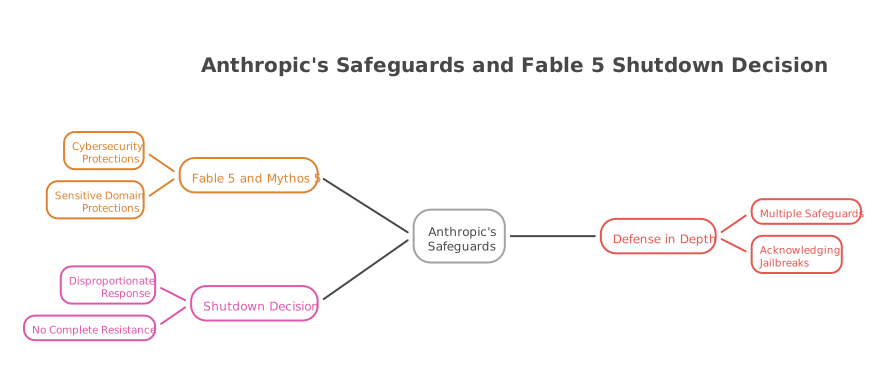
One statement which Anthropic repeatedly emphasized was "Fable 5 and Mythos 5 were released with strong protections for cybersecurity and other sensitive domains."
The company does not claim that the models are impossible to jailbreak. Instead, it describes its approach as "defense in depth," acknowledging that a small number of jailbreaks may still be discovered despite multiple safeguards. Anthropic argues that because no advanced language model can guarantee complete resistance to misuse, a full shutdown of Fable 5 would be a disproportionate response.
Logging, monitoring and data retention
To support its defense-in-depth approach, Anthropic requires temporary retention of interaction data for Fable 5 so that potential misuse or jailbreak attempts can be investigated and mitigated. This includes logging of queries and outputs for a defined retention window, a design choice the company presents as a trade-off between privacy and security for its most capable models.
Commentary from external analysts notes that such telemetry can be important for incident response and safety research, particularly when models are used in long-running agentic workflows with tool access. At the same time, this creates tension with customers who have strict data-governance and privacy requirements, a dynamic now amplified in the wake of the sudden Fable 5 shutdown.
Recursive self-improvement: the context behind the shutdown
On June 4, 2026, Anthropic published internal data under the theme "when AI builds itself," revealing that Claude wrote more than half of the code merged into the company's codebase in May 2026. Before Anthropic introduced its internal coding agent in early 2025, that figure was only in the low single digits.
The data also shows that engineers now ship roughly eight times more code each day than they did in 2024, while Claude's success rate on open-ended engineering tasks has improved sharply in recent months. Analysts see this as an early example of partial recursive self-improvement, where AI systems help accelerate the development of future systems under human supervision. This rapid progress has intensified scrutiny around the decision to withdraw Fable 5.

Existing friction with U.S. agencies before the shutdown
Separate reports point to growing tension between Anthropic and parts of the U.S. national security establishment before the order was issued. In early 2026, government filings described Anthropic as an "unacceptable" supply-chain risk for certain defense systems, and President Trump directed federal agencies to stop using Anthropic technology while competitors pursued defense contracts.
These events suggest that the export-control order emerged within a wider debate about Anthropic's role in national security and advanced AI capabilities. The action reflects concerns about both jailbreak risks and the fast pace of progress in increasingly capable AI systems.
Export control as a model-level kill switch
Legal analysis indicates that the order came from the U.S. Department of Commerce's Bureau of Industry and Security under export-control powers that are usually applied to sensitive hardware and dual-use technologies. In this case, those powers were extended directly to AI software, forcing Anthropic to block access for foreign nationals and leading to a global shutdown of Fable 5.
Several commentators view this as one of the first major examples of a government using export law to remove a frontier AI model from general availability. The case suggests that existing legal tools can function as a model-level kill switch without the need for new AI legislation.
Transparency and evidentiary standards
Anthropic says the directive did not include a detailed technical explanation and that the company learned about the specific jailbreak concerns through later discussions with officials. The company argues that the evidence presented so far does not show that Fable 5 poses a unique risk compared with other frontier models that remain online.
Policy analysts say the episode raises questions about transparency and the standards of evidence required for future interventions. If governments can order model shutdowns based on limited or undisclosed information, companies and customers may face uncertainty about long-term access to advanced AI systems.
Vendor risk and architectural resilience
The Fable 5 shutdown illustrates that regulatory action can instantly remove a single frontier model from production use, even when the model itself has not suffered a technical failure. For engineering and product teams, this underscores the importance of designing systems that are resilient to sudden changes in model availability.
Best practices emerging from industry commentary include:
- Building model abstraction layers that allow swapping between Anthropic, OpenAI, Google, and open-weight models with minimal changes to business logic.
- Implementing capability-based routing and graceful degradation, where non-critical tasks can fall back to less capable models if frontier models become unavailable.
- Maintaining an internal model dependency inventory so organizations can rapidly assess impact when a specific model is deprecated or restricted by sudden regulatory intervention.
These strategies mirror earlier trends toward multi-cloud and platform-agnostic architectures in traditional software infrastructure.
Safety, monitoring and privacy trade-offs
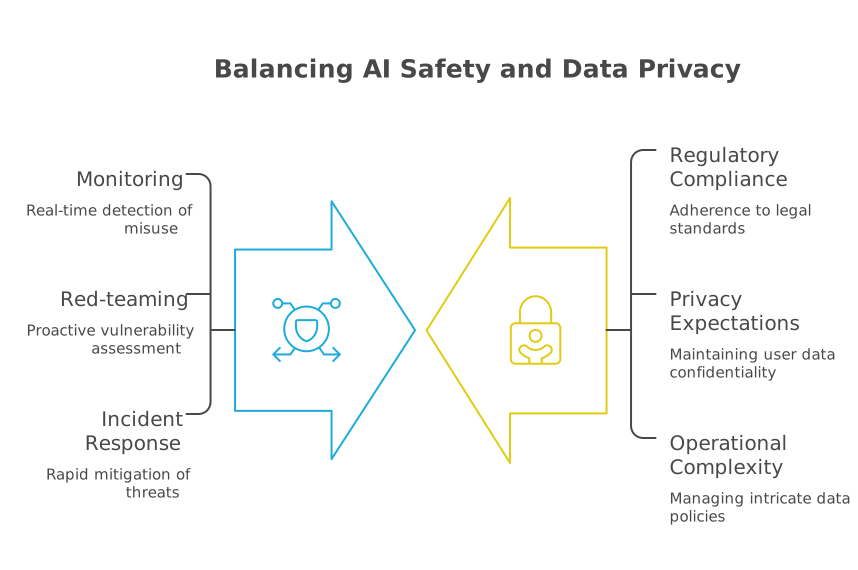
Anthropic’s reliance on logging and short-term data retention for safety investigations around Fable 5 highlights an emerging trade-off between safety monitoring and data privacy. To detect jailbreaks and misuse in high-capability models, providers may insist on stronger telemetry and retention policies, particularly when models support long-running agents and tool use.
Enterprises adopting such models will need to weigh:
- The benefits of provider-managed safety infrastructure (monitoring, red-teaming, incident response), and
- The costs in terms of data-governance complexity, regulatory compliance, and customer expectations regarding privacy.
For organizations that cannot accept provider-level logging requirements, self-hosted or open-weight models may offer more control, especially as teams look for alternatives following the unexpected Fable 5 shutdown.
What the Fable 5 shutdown means for agentic AI
Research suggests that multi-agent systems often perform better than single models on complex tasks, particularly when they can share information and coordinate actions. As these systems become more common, regulators may begin treating frontier AI models less like chatbots and more like critical infrastructure with national security implications.
The Fable 5 shutdown offers an early example of how governments can intervene in the deployment of advanced AI models. It also signals that regulatory constraints may play a larger role in determining which AI capabilities reach users and how they are deployed.
Key takeaways from the Fable 5 shutdown
Anthropic's statements, media reports, and legal analysis broadly agree on the key facts: a U.S. export-control order tied to concerns over a narrow jailbreak led to the global shutdown of Fable 5. The decision came as Anthropic revealed that Claude now writes most of its own codebase, drawing more attention to the rapid progress of frontier AI models and early signs of partial recursive self-improvement.
For AI developers, the episode is a reminder that regulatory action and vendor dependence can disrupt access to advanced models with little warning. Building systems that can adapt to model outages and understanding the balance between safety measures and privacy requirements are becoming increasingly important.
For policymakers, the case highlights the need for clear procedures, technical evidence, and consistent standards when intervening in the deployment of frontier AI systems. Without that clarity, uncertainty around access and governance could slow both adoption and innovation. If you're architecting systems that depend on frontier models like Claude, explore how Claude-specific AI systems are built that stay resilient when model access changes in the coming weeks.
References
- https://www.aipolicydesk.com/blog/anthropic-recursive-self-improvement-ai-governance-2026[aipolicydesk]
- https://www.abhs.in/blog/anthropic-when-ai-builds-itself-global-pause-80-percent-code-june-2026[abhs]
- https://www.wired.com/story/anthropic-says-us-government-ordered-it-to-shut-down-mythos-models/[wired]
- https://openreview.net/pdf?id=Xh1B90iBSR[openreview]
- https://www.nytimes.com/2026/03/17/technology/anthropic-pentagon-national-security-risk.html[nytimes]
- https://openreview.net/pdf?id=a6mORbW095[openreview]