Grok 4.5 is here and it’s doing a number on other models. When run in its high-reasoning configuration, it distinctly stands out as a strong enterprise candidate on cost-to-intelligence grounds. From what we can see, it pairs frontier-level reasoning with a large working context and low operating cost - and the best part is, in the internal pilot it used only a modest share of its available token budget.
Grok 4.5 ranks among the strongest options for enterprise workloads once cost and token efficiency are weighed alongside intelligence. In the pilot, it completed a broad internal-style reconstruction exercise for about $1.86 while using just 29% of its context window - leaving meaningful headroom for larger or repeated workloads. Game changing, to be honest.
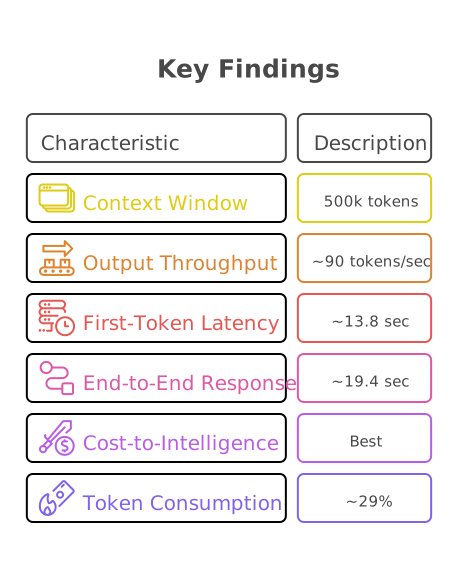
Here are some key findings
- Context window: 500k tokens, sufficient for large multi-file working sets in a single pass.
- Output throughput: Approximately 90 tokens per second, placing the model in the strong-throughput band.
- First-token latency: Approximately 13.8 seconds to first answer token, reflecting reasoning overhead ahead of output.
- End-to-end response: Approximately 19.4 seconds to produce 500 tokens, inclusive of reasoning and output.
- Best cost-to-intelligence signal: Grok 4.5 combines strong reasoning behavior with low effective cost, making it one of the most attractive enterprise options where repeated intelligent execution must remain economical.
- Low token consumption: The internal pilot completed within roughly 29% of the available context window, indicating efficient use of tokens and substantial remaining capacity for larger enterprise workloads.
Model overview of Grok 4.5
Grok 4.5 is a proprietary large language model. The high configuration evaluated here prioritizes reasoning depth, which is reflected in its performance profile: the model invests time before emitting its first token, then sustains a strong output rate through the remainder of the response. A 500k-token context window allows large codebases, specifications, and supporting material to be held in a single session without aggressive truncation.
For enterprise adoption, the key value lies in the combined ratio of intelligence, cost, and token efficiency. Grok 4.5 is especially relevant for code reasoning, large-document analysis, agentic execution, batch evaluation, and repeated internal automation, where a model must reason well without consuming excessive budget or context.
Provider performance profile of Grok 4.5
The figures below summarize third-party API-provider benchmarking for Grok 4.5 (high), measured on a 10,000-token input workload. They describe operational characteristics of the served model and are independent of GoML's internal benchmark in Section 4.
Throughput and latency
Table 1 — Operational throughput and latency for Grok 4.5 (high), provider-benchmarked at 10k input tokens
Pricing
Table 2 — Published pricing components and blended rate for the recommended agentic mix.
The blended rate assumes a general agentic profile weighted toward cache hits, which suits repeated runs over a stable codebase. The 75% cache discount materially lowers effective cost for workloads that reuse a large, mostly static context, which is precisely the shape of GoML's internal benchmark.
This pricing shape matters most when comparing enterprise model choices: Grok 4.5 delivers a strong cost-to-intelligence ratio, with enough reasoning capability for complex internal work at low per-run cost and limited token consumption relative to the available context budget.
Grok 4.5 internal benchmark
GoML used an internal benchmark to approximate enterprise-shaped engineering work, in contrast to isolated coding puzzles. The benchmark is best read as a directional signal: it tests whether a model can reason across a broad, realistic workspace and produce coherent implementation behavior under a fixed harness.
The details are intentionally summarized at a high level in this report. What matters for interpretation is that the same workspace, harness, and public validation flow are held constant, keeping the pilot's focus on the model's practical enterprise behavior instead of benchmark mechanics.
Benchmark shape
At a high level, the exercise starts from a representative internal workspace with implementation details removed while preserving enough structure for the model to infer intended behavior.
The model then has to infer and rebuild behavior across multiple connected areas. This keeps the benchmark close to enterprise use cases without exposing unnecessary implementation detail in the report.
Evaluation scope
The current pilot should be interpreted as a broad public-validation signal; it does not constitute a full production-readiness claim. It is useful for comparing practical model behavior, token efficiency, and operating cost under a consistent enterprise-like workload.
Pilot configuration
Table 4 — Pilot experimental configuration
Pilot results
Table 5 — Aggregate pilot results for Grok 4.5 (high), Run 001.
The public suite was re-executed independently and returned 63 passing tests, confirming the reported outcome.
Cost
The complete pilot run incurred an approximate marginal cost of $1.86. This is the strongest enterprise signal: Grok 4.5 delivered useful reasoning over a realistic internal-style workload at a cost low enough for routine automation, repeated evaluation, and broader model comparison.
Speed
Two speed characteristics apply and should be read separately. Output throughput is strong at roughly 90 tokens per second, so once generation starts, the model produces code quickly. First-token latency is high at roughly 13.8 seconds, reflecting reasoning time before output. For a single-session batch reconstruction of this kind, sustained throughput matters more than first-token latency, and the full public suite verified in about one second of test time.
Context efficiency
The model used 142,901 tokens, approximately 29% of the available context window. For an enterprise-sized task, this is a low consumption profile and leaves substantial unused capacity for larger specifications, longer repositories, or repeated agentic steps.
Analysis and interpretation of Grok 4.5
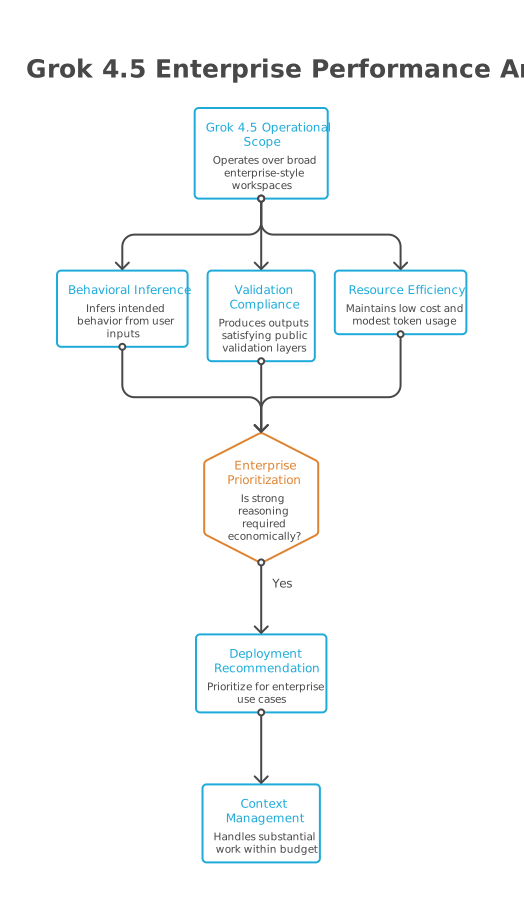
The internal benchmark should be read directionally. It indicates that Grok 4.5 can operate over a broad enterprise-style workspace, infer intended behavior, and produce outputs that satisfy the public validation layer, while doing so with low cost and modest token usage.
Grok 4.5 is worth prioritizing for enterprise use cases where strong reasoning must be delivered economically. Its low token consumption in this pilot strengthens the case, showing it can handle substantial work without exhausting the available context budget.
Conclusion
Grok 4.5 (high) presents a strong enterprise profile: high reasoning capability, a large context window, low blended cost, and efficient token usage. In the internal pilot, it completed a broad enterprise-style evaluation at roughly $1.86 while using only about 29% of the available context window. Grok 4.5 offers one of the best cost-to-intelligence profiles for agentic and enterprise use cases, especially where repeated intelligent execution must stay economical. Broader multi-model comparison remains the next step.
Stay tuned to the GoML blog for the latest updates in the world of AI and ML engineering.