Since its inception, voice assistants have forever struggled to keep up with the natural flow of conversation. You speak, wait for a response, or get interrupted before you've finished your sentence. OpenAI aims to significantly improve that with GPT Live, released on July 8, 2026. The new voice model powers ChatGPT Voice and is designed to make conversations feel more natural, with smoother timing and more human-like responses.
What makes GPT Live different
At the core of GPT Live is a full-duplex voice model that can listen and speak at the same time. Most voice assistants follow a simple pattern - they wait for you to finish, process what you said and then reply. GPT Live works differently. It continuously decides whether to speak, keep listening, pause, or give a short acknowledgment like "mhmm" while you're still talking.
That makes conversations feel much more natural. If you interrupt, stop thinking, change your mind halfway through a sentence, or ask the model to slow down, it adjusts in real time instead of losing track of the conversation or forcing you to start over.
GPT Live handles more than voice conversations
GPT Live is said to be engineered for a lot more than natural conversation. When a request requires web search, advanced reasoning, or a complex task, it passes that work to GPT-5.5 in the background while continuing the conversation. Once GPT-5.5 returns a response, GPT Live uses that information without interrupting the discussion.
OpenAI says this architecture keeps the voice experience consistent while allowing the reasoning model behind it to evolve over time.
The company also claims better benchmark performance than Advanced Voice Mode. GPT Live-1 scored higher on GPQA, which measures expert-level reasoning in biology, chemistry, and physics also BrowseComp, a benchmark that evaluates a model's ability to find difficult information on the web.
Two versions are rolling out
OpenAI is releasing two versions of GPT Live:
- GPT Live-1 for Go, Plus and Pro subscribers
- GPT Live-1 mini for Free users
The rollout covers ChatGPT on iOS, Android and the web. GPT Live is not available through ChatGPT on WhatsApp. OpenAI says it supports multiple languages, although some accents and speech patterns may still affect recognition.
ChatGPT Voice also adds visual cards for weather, stock prices, and sports scores during conversations. Users can search the web and discuss images without leaving the chat. Video calling and screen sharing are planned for a later release.

Safety measures
OpenAI published a companion document describing the safety testing completed before GPT Live launched. GPT Live-1 and GPT Live-1 mini use the same safety system as OpenAI's larger models, including requests routed to GPT-5.5 for reasoning or web search.
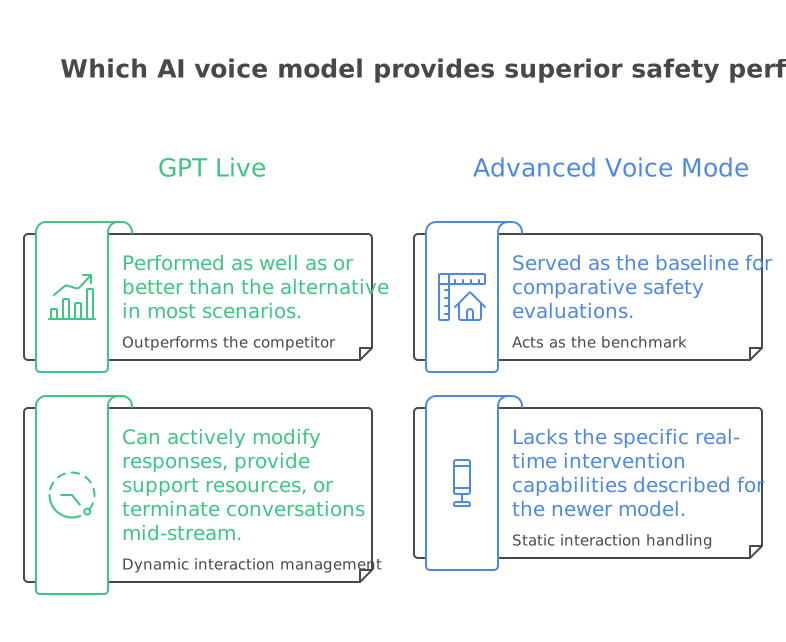
The company compared GPT Live with Advanced Voice Mode across scenarios including child voice detection, impersonation, self-harm, emotional engagement and scam prevention. According to OpenAI, GPT Live performed as well as or better than Advanced Voice Mode in most tests.
Since GPT Live processes speech in real time, it can change its responses during a conversation, provide information about available support resources when appropriate, or end a conversation if necessary.
OpenAI's Safety Advisory Group also reviewed GPT Live and GPT Live mini before release. The group concluded that neither model met the company's "High" risk threshold for biological and chemical risks, AI self-improvement, or cybersecurity.
To reduce misuse, GPT Live offers a limited set of pre-approved voices and includes safeguards that help prevent imitation of real people's voices.
GPT Live API availability
GPT Live is currently available only inside ChatGPT. OpenAI has opened a waitlist for developers and businesses interested in API access, although it has not announced a release date.
GoML has been engineering voice-assistants for clients
GoML has been building enterprise voice assistants using a similar approach, separating real-time conversation from deeper reasoning so each layer can handle the tasks it's best suited for.
Take the automotive work as an example. GoML built an AI-native voice interaction system for Olympian Motors' next-generation electric vehicles, part of the company's broader Olympus OS platform. Rather than sitting on top as an add-on feature, the assistant lives inside the vehicle's operating system itself, reading sensor data, driver input, and vehicle signals together so that navigation, climate, and in-cabin controls can run through spoken commands instead of dashboard menus. Olympian's platform was built to be modular and OEM-ready from day one, which meant the voice layer had to hold up under actual driving conditions rather than a controlled demo.
SurePeople's case looks nothing like that on the surface but runs on the same logic. GoML built the company a voice AI life coach around its existing psychometric coaching framework, giving users real-time, personalized guidance on communication, leadership, and workplace relationships whenever they need it, not just during a scheduled session with a human coach. The system handled 92% of interactions without human support, delivered personalized responses in 78% of sessions, and reduced coaching costs by 63%. Building voice AI for these situations also requires careful attention to tone, emotional engagement, and user safety.
Making systems like this work at scale depends on more than the model itself. Deployment tools, compliance controls, and reusable components often determine whether a prototype becomes a reliable production system.
Where GPT Live leaves voice assistants
GPT Live introduces a new way to build voice AI by separating real-time conversation from deeper reasoning. If this approach continues to perform well across more users and use cases, it could influence how future voice assistants are designed.
GoML follows a similar approach for enterprise AI through its AI Matic framework, helping businesses move AI applications from pilot to production with pre-built accelerators, compliance controls, and deployment tools.
Stay tuned to the GoML blog for the latest updates on AI and machine learning engineering.
FAQs
Does GPT Live replace Advanced Voice Mode?
OpenAI describes GPT Live as the new default voice experience. The company has not announced when Advanced Voice Mode will be retired, so both may remain available during the rollout.
Does GPT Live become slower when it uses GPT-5.5?
OpenAI has not shared latency details. GPT Live continues the conversation while GPT-5.5 processes more demanding requests in the background.
What about the safety findings in the system card?
OpenAI says the differences it observed, including emotional engagement, were not statistically significant. The company says it will continue monitoring these areas as GPT Live becomes available to more users.