Hiswai is a knowledge management company focused on transforming how organizations create research reports across finance, policy, technology, and emerging industries. Research teams often spent days collecting information, organizing documents, validating sources, and preparing reports manually. Hiswai partnered with GoML to build a report generation system that automates the complete research workflow, from document ingestion to structured report generation, enabling faster, consistent, and scalable research production.
Why Hiswai needed a report generation software, not just search
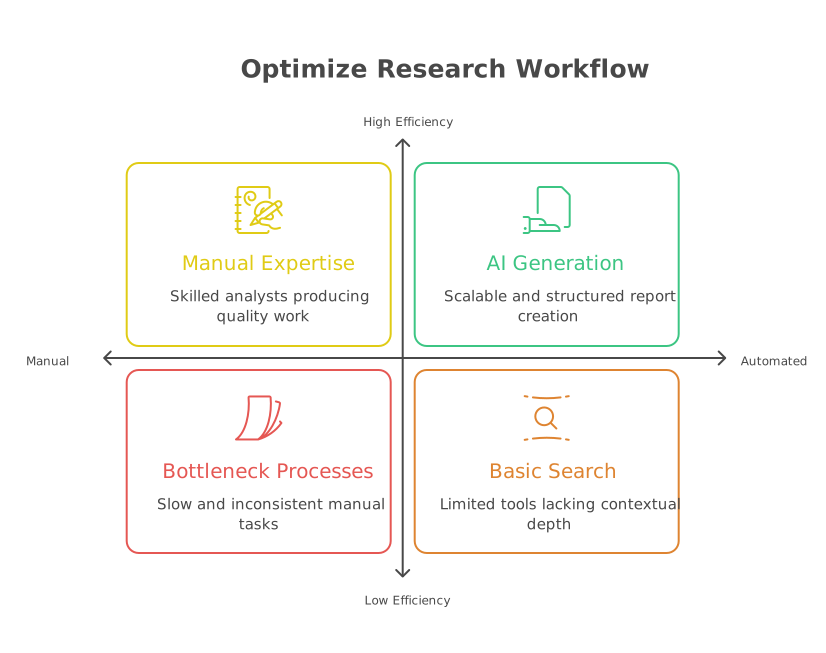
Enterprise research teams manage large collections of reports, articles, whitepapers, and market intelligence spread across multiple sources. Without an AI report generation system, analysts spent significant time identifying relevant documents, extracting information, organizing findings, and writing reports manually.
The manual process created inconsistent report quality, delayed decision making, and limited the number of reports teams could produce. Existing tools offered document search but lacked contextual retrieval, structured report planning, and reliable long-form content generation. Research teams also struggled with duplicate content, inconsistent report structures, and weak traceability between generated content and source documents. These challenges reduced confidence in AI-generated reports and prevented organizations from scaling knowledge generation efficiently.
Why GoML was the right partner to build Hiswai's report generation software
GoML built an enterprise report generation system that automates the complete report creation lifecycle using Amazon Bedrock, OpenSearch, vector search, and an Agentic AI blueprint. The platform ingests enterprise knowledge, retrieves relevant context, generates structured report outlines, writes complete chapters, and validates every output before final assembly.
In a recent episode of goLive, Vaclav Vincalek, Founder of Hiswai, spoke with Rishabh Sood, Founder and CEO of GoML, about the collaboration behind the platform. Vaclav explained that Hiswai defined the research goals and user experience, while GoML designed the architecture, built the AI workflows, and refined the system through continuous iterations until it was ready for production. The team worked within tight timelines and budget constraints while keeping the focus on building a reliable research platform.
What was built into Hiswai's report generation software pipeline
GoML used its Agentic AI blueprint, accelerated through the AI Matic framework, to build an enterprise report generation software on Amazon Bedrock, OpenSearch, and vector search.
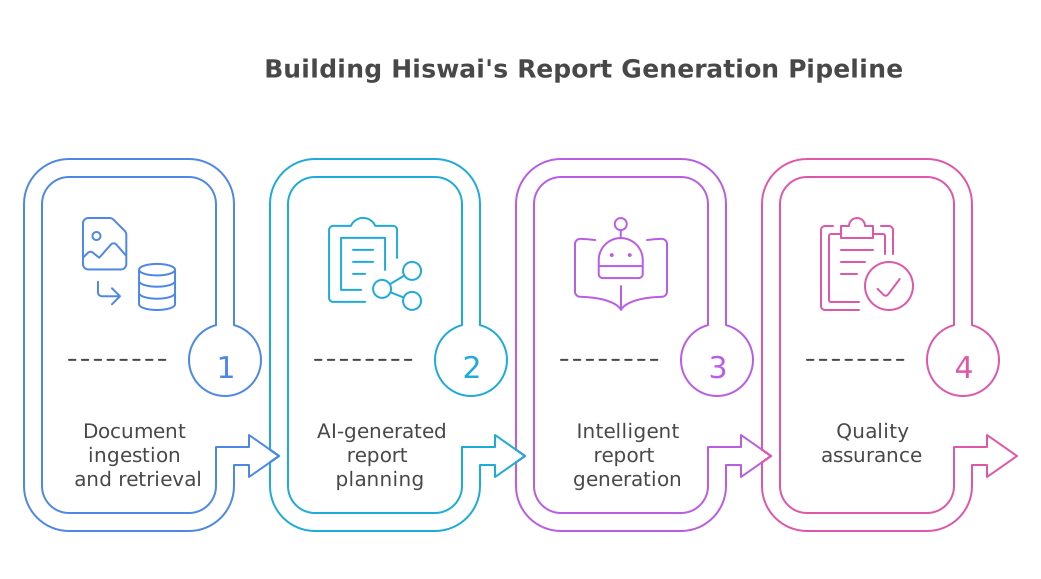
Document ingestion and intelligent retrieval: The report generation system prepares enterprise knowledge for retrieval. FastAPI APIs trigger automated report generation, with documents ingested from Amazon S3 and automatically cleaned and deduplicated. Vector embeddings are generated using Amazon Bedrock, and OpenSearch indexes power semantic retrieval through hybrid search that combines keyword and vector search, backed by automated retry and validation mechanisms.
AI-generated report planning: Instead of creating reports directly, the report generation system first designs an optimized report structure, an LLM-generated table of contents, dynamic chapter and section creation, topic-specific report organization, schema validation for consistent formatting, and source metadata attached to generated sections. This produces structured reports grounded in enterprise knowledge instead of generic AI output.
Intelligent report generation: The report generation system creates complete reports through parallel AI workflows, concurrent generation of chapters and subsections, automatic content expansion to target report length, anti-repetition logic across sections, fallback generation for failed responses, and source-aware report synthesis. The result is a complete enterprise research report produced automatically while maintaining consistency across every chapter.
Quality assurance: Validation focused on report quality and production reliability, including hybrid search accuracy testing, table of contents validation, end-to-end report generation testing, duplicate content detection, fallback workflow validation, and source grounding verification.
Tech stack: Amazon Bedrock, Amazon OpenSearch Service, Amazon S3, FastAPI, AWS Lambda, Vector Embeddings, and CloudWatch, deployed globally.
Results
- 80% faster report generation
- 100% consistent report structure across every output
- 2x reduction in analyst effort per report Faster access to structured business insights across industries
"With a report generation software, Hiswai transformed fragmented research into structured enterprise reports delivered faster with consistent quality." ~Vaclav Vincalek, Founder of Hiswai.
Watch the full goLive episode featuring Vaclav and Rishabh Sood to hear how Hiswai worked with GoML to build a source-grounded, scalable report generation software.
The picture of success with Hiswai's report generation software
With the report generation system in production, Hiswai now creates structured research reports across finance, policy, technology, and emerging industries much faster, while keeping every report linked back to its original sources. The system processes large collections of enterprise documents, organizes the information into a consistent report structure, and produces reports with source-backed references throughout. This has allowed Hiswai's research team to handle a much larger volume of work without compromising report quality.
Research teams planning a similar report generation system should build document ingestion as the first step, combine semantic and keyword search to improve retrieval accuracy, define the report structure before content generation begins, and verify every generated response against the supporting source documents.
Stay updated with the latest AI and machine learning engineering stories on the GoML blog.