Recent IDC research reveals that 88% of AI proofs-of-concept fail to reach production deployment, with enterprises launching 33 pilots for every 4 that succeed. Amazon Bedrock AgentCore addresses scaling failures, security gaps, memory issues, and absent observability that plague enterprise AI implementations.
What is Amazon Bedrock AgentCore?
AgentCore is Amazon Bedrock's managed platform for building, deploying, and operating enterprise-grade AI agents. It abstracts infrastructure challenges, bridging the gap between proof-of-concept demonstrations and production reality by providing comprehensive managed services that handle complex infrastructure requirements.
Key Capabilities
Latest innovations from AWS re:Invent 2025
AWS re:Invent 2025 introduced three game-changing features addressing critical production blockers.
AgentCore policy
Set agent boundaries using plain language. AgentCore Gateway enforces rules at scale, handling thousands of requests per second with millisecond policy checks. The system automatically converts natural language policies into Cedar, eliminating custom authorization logic. This removes a major production blocker enterprise can enforce rules like "agents can only access customer data during business hours" without custom code.
Policy evaluation
13 built-in evaluators continuously assess agent behavior for correctness, helpfulness, safety, and tool-selection accuracy. Real-time quality scoring with CloudWatch integration removes the burden of creating in-house evaluation frameworks.
Episodic memory
"At the heart of what makes agents truly intelligent is memory and context," stated Dr. Swami Sivasubramanian. Episodic memory allows agents to retain and reference past interactions, building coherent understanding over time.
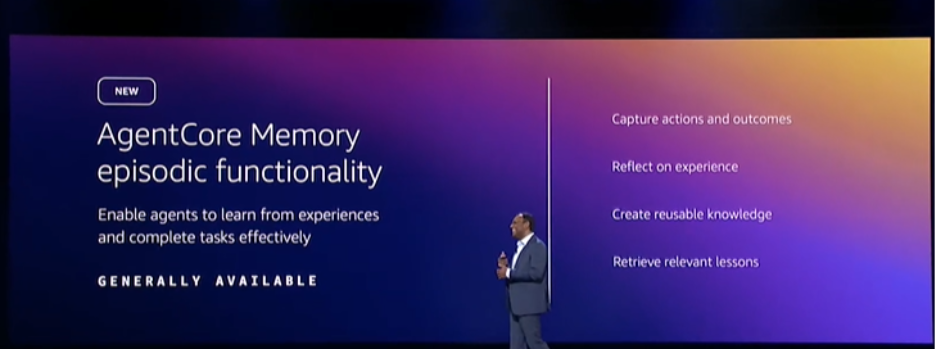
The system operates through extraction (analyzing episodes), consolidation (compiling into coherent episodes), and reflection (generating insights across episodes). Enterprise use cases include customer support, personalization, and troubleshooting where historical context adds significant value.
Amazon Bedrock AgentCore vs Competitors
AWS commands 30% cloud infrastructure market share versus GCP's 13%, providing broader ecosystem integration. Amazon Bedrock AgentCore emphasizes operational maturity with production-focused design including automatic scaling, comprehensive tracing, native IAM integration, and managed memory services.
Open-source frameworks like AutoGen, CrewAI, and LangChain provide building blocks but require significant work for production deployment. AWS Bedrock AgentCore delivers a complete platform handling deployment, scaling, monitoring, security, and observability.
Deploying Amazon Bedrock AgentCore
Organizations working with specialists achieve 85% faster production deployment. Critical expertise areas include:
- RAG Architecture with multi-agent patterns optimizing performance and cost
- Security and compliance implementation for governance requirements
- Production operations with CloudWatch integration and memory management
- Framework integration for LangChain, LangGraph, and AutoGen
Real-world AgentCore implementations
Amazon Bedrock AgentCore's production-ready capabilities enable enterprises to deploy sophisticated agentic AI systems at scale. These real-world implementations demonstrate how AgentCore's managed infrastructure, episodic memory, and governance features solve critical production challenges:
Case study: Autonomous order processing for StockyAI
StockyAI deployed an agentic AI order processing engine that leverages AgentCore's serverless runtime and memory capabilities to autonomously manage retail operations from order receipt through fulfillment.
AgentCore features utilized:
- Serverless auto-scaling: Handles variable order volumes during peak periods without manual infrastructure management, scaling from hundreds to thousands of requests per minute.
- Episodic memory: Retains customer interaction history and order preferences across sessions, enabling personalized processing decisions and exception handling based on past behavior.
- Policy enforcement: Uses AgentCore's natural language policies to enforce business rules like "prioritize premium customer orders" and "validate international shipments against compliance requirements."
- CloudWatch observability: Deep traces reveal exactly where processing bottlenecks occur, enabling rapid optimization of fulfillment workflows.
Business impact: The system runs 24/7 with consistent accuracy, managing inventory, payments, and shipping automatically. AgentCore removed months of custom development needed to build the same capabilities.
Case study: Multi-agent sales analytics 85% faster insights
A multi-agent analytics system built with AutoGen on Amazon Bedrock AgentCore demonstrates how framework-agnostic support enables sophisticated agent orchestration while maintaining production-grade reliability.
AgentCore features utilized:
- Native AutoGen integration: AgentCore's framework-agnostic runtime supports AutoGen's multi-agent patterns without custom deployment code, enabling rapid iteration on agent collaboration strategies.
- Agent specialization with memory: Data extraction agents, analysis agents, and reporting agents each maintain episodic memory of their specialized tasks, improving performance through learned patterns.
- Built-in evaluators: AgentCore's 13 continuous evaluators assess agent correctness and tool selection, catching issues before they impact business decisions.
- IAM-based security: Each agent operates with least-privilege access to CRM data, ensuring compliance with data governance requirements without custom authorization logic.
Production benefits: AgentCore delivered an 85% analytics speed boost by parallelizing workloads with managed memory. Tasks that once needed custom orchestration, scaling, and monitoring now run on a managed platform.
Case study: Government grievance management at scale CPGRAM
The Centralized Public Grievance Redress and Monitoring System (CPGRAM) deployed a conversational AI grievance management engine on Amazon Bedrock AgentCore to handle citizen grievances across India's government departments, demonstrating AgentCore's capabilities in high-stakes public service environments.
Critical AgentCore features:
- Governance and compliance: AgentCore's policy framework enforces strict data access rules "agents can only access grievances assigned to their department" and "sensitive citizen information requires additional authorization"critical for government operations.
- Episodic memory for context: The agent maintains complete interaction history with each citizen, enabling coherent multi-turn conversations and accurate status updates even when grievances involve multiple departments.
- Real-time evaluation: Built-in evaluators continuously assess response quality for correctness, helpfulness, and safety essential when communicating with citizens about sensitive government services.
- Scalable infrastructure: AgentCore's serverless runtime handles massive volume fluctuations as grievances surge in response to policy changes or public events, scaling from baseline to peak loads automatically.
Government-scale impact: CPGRAM handles thousands of multilingual grievances daily. AgentCore removed the need for custom infrastructure, security, and monitoring, meeting strict government reliability needs with limited development resources.
Case study: Enterprise HR Analytics at Bosch 80% Faster Insights
Bosch deployed a conversational AI system for workforce analytics on Amazon Bedrock AgentCore, demonstrating how enterprise organizations leverage managed agentic infrastructure to deliver business value while maintaining strict security and governance requirements.
Enterprise AgentCore implementation:
- Private networking integration: AgentCore operates within Bosch's VPC, accessing sensitive HR systems through private endpoints without exposing employee data to public networks.
- Semantic and episodic memory combination: The agent maintains semantic knowledge of HR policies and organizational structure while using episodic memory to remember each manager's past queries and preferences, enabling increasingly personalized analytics.
- Complex policy enforcement: Natural language policies like "HR business partners can access all department data; managers can only access their direct reports; executives can access aggregated organization-wide metrics" are enforced automatically without custom authorization code.
- Comprehensive observability: CloudWatch integration provides Bosch's IT team with complete visibility into agent behavior, query patterns, and system performance critical for enterprise governance and optimization.
Enterprise value: The 80% analytics speed gain freed HR teams to focus on workforce planning instead of data extraction. AgentCore removed the need to build and maintain custom memory, policy, and monitoring infrastructure.
Transforming prototypes into production
Amazon Bedrock AgentCore addresses the persistent gap between AI proof-of-concept and production deployment through managed infrastructure, intelligent memory systems, and production-ready capabilities. The latest innovations of AWS natural language policy enforcement, built-in evaluation frameworks, and episodic memory make enterprise AI agents practical and scalable.
Episodic memory, in very broad terms, is the agent choosing and creating its own knowledge base. Think of it as its own journal. Along with AWS's launch of Nova 2 Omni and Nova Forge, this functionality reiterates the fact that AWS is moving towards AGI.
This article is part of our comprehensive guide to AWS AI. Explore the guide to know more about AWS AI tools and why AWS AI infrastructure is the best way to build agentic AI solutions that can scale in production.
Ready to transform your AI prototypes into production reality?
Partner with GoML to accelerate the development of production-ready AI systems with AI Matic and scale reliable AI solutions across enterprise environments.