CPGRAMS (Centralized Public Grievance Redress and Monitoring System) is a government platform designed to manage public grievances efficiently. The system leverages conversational AI to process complaints submitted through WhatsApp, Physical letters, Chatbots, Mobile and Web forms, dealing with both structured and unstructured actionable records.
Problem: Challenges in grievance management
Before implementing AI-powered systems, public grievance teams relied on manual workflows to handle complaints from multiple channels. Citizens submitted messages in inconsistent formats, making it difficult to identify key details such as complaint type, location, and urgency.
Manual categorization and assignment slow response times. Tracking resolution across departments was cumbersome, and recurring issues were hard to identify due to limited visibility.
As grievance volumes grew, these inefficiencies resulted in delayed responses, unresolved complaints, and reduced public trust, highlighting the need for government workflow automation.
Solution: Agentic AI grievance processing engine for government workflow automation
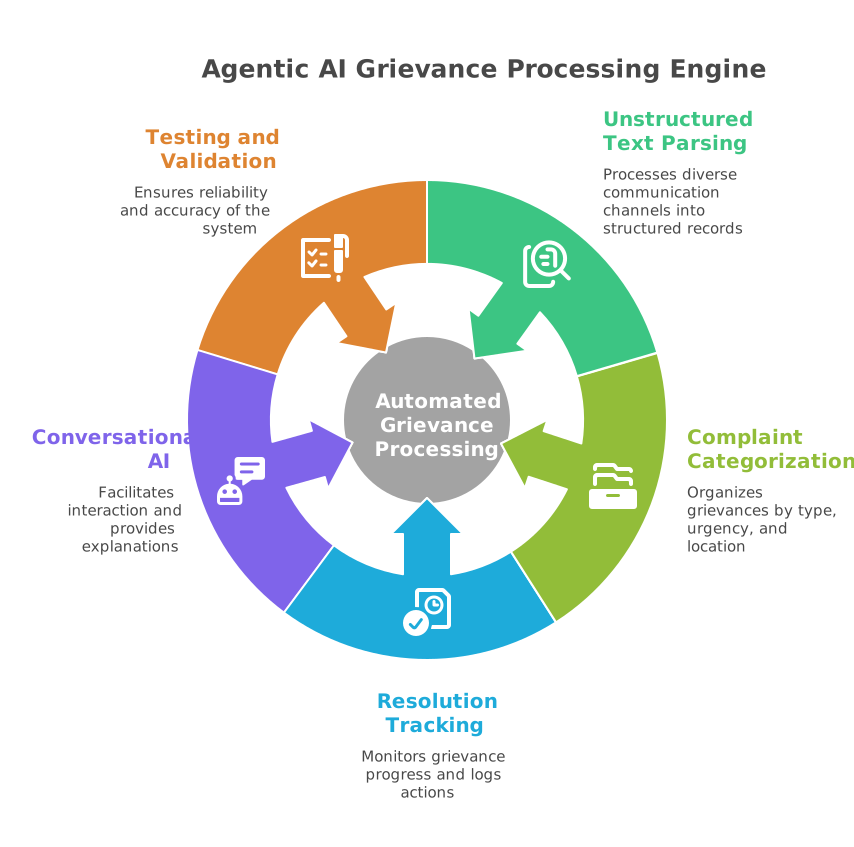
CPGRAMS partnered with GoML to build a modular, Agentic AI system that automates the complete grievance lifecycle from intake to resolution tracking. The solution intelligently converts unstructured citizen complaints into structured, actionable records, automatically categorizes grievances, and assigns them to the appropriate departments. It continuously tracks resolution progress using explainable AI outputs, ensuring transparency and accountability at every stage.
Built on a highly scalable, serverless architecture, the platform is capable of supporting 100+ crore users and processing over 10 lakh grievances annually. Additionally, it is designed for future-ready integrations through Open API standards, enabling seamless connectivity with platforms such as UMANG, NGOs, and research organizations.
1. Unstructured text parsing engine
Large language models process incoming messages from SMS, WhatsApp, email, and web forms. The parsing engine transforms free-form text into structured grievance records the foundation of government workflow automation.
2. Complaint categorization and assignment
Parsed grievances are categorized by complaint type, urgency, and location. The system automatically assigns them to the relevant department, ensuring faster and more accurate resolution.
3. Resolution tracking module
Once assigned, grievances are tracked throughout their lifecycle. Status updates, actions taken, and deadlines are automatically logged, creating an auditable, end-to-end record that reinforces government workflow automation.
4. Conversational AI layer
Citizens and staff can interact with the system for updates and clarifications. The AI explains categorization, assignment logic, and escalations, enhancing transparency and trust.
Example Interaction:
- Citizen: “Hello, I want to report frequent water supply issues in Sector 12, Delhi.”
- AI Action: Parses the message, categorizes it as a “Public Utilities” complaint, assigns it to the municipal department, and generates a tracking ID.
5. Testing and validation suite
Robust testing pipelines validate parsing accuracy, categorization, assignment, and tracking. Both synthetic and real-world scenarios ensure reliability across diverse grievance formats, supporting scalable government workflow automation.
Impact of the AI grievance management engine
- 95% accuracy in parsing citizen grievances across multiple channels
- 92% success rate in correct department assignment
- Significant reduction in manual effort
About
Before agentic AI vs after agentic AI
“With CPGRAMS' AI agentic system, grievance management became faster, more reliable, and fully transparent. Government workflow automation ensures timely handling of citizen complaints while reducing manual workload.” - Prashanna Rao, Head of Engineering, GoML
DevOps and security built into delivery
CPGRAM handles sensitive citizen data at a national scale, so GoML built reliability and data protection into the platform from the start. We built security into the infrastructure, secret management and storage to protect sensitive data and maintain service availability.
DevOps practices
- Reliable database setup: The platform uses Amazon Aurora PostgreSQL in a Multi-AZ configuration. This helps keep the database available if one Availability Zone fails.
- Secure secret management: Applications run on Amazon EKS, with secrets delivered directly from AWS Secrets Manager through the Secrets Store CSI Driver. This avoids storing secrets in Kubernetes ConfigMaps or environment variables.
- No static AWS credentials: Pods use IAM Roles for Service Accounts (IRSA) to access AWS services. This removes the need to store long-lived access keys in the application environment.
- Protected logs and files: Application logs and artifacts are stored in Amazon S3 with Object Lock, which helps prevent them from being changed or deleted.
Security practices
- Encryption during data transfer: Citizen-facing traffic passes through Amazon CloudFront using TLS 1.3 certificates from AWS Certificate Manager. The Network Load Balancer also uses TLS 1.3, application pods connect to the database over SSL within the VPC, and outbound internet traffic through NAT uses TLS 1.3.
- Encryption for stored data: Amazon Aurora PostgreSQL, EBS volumes on EKS worker nodes, and S3 storage for logs and artifacts are encrypted at rest. S3 uses server-side encryption with AWS KMS (SSE-KMS).
- Separate encryption keys: Each service has its own customer-managed AWS KMS key, with envelope encryption and automatic annual key rotation. Key policies keep key administration separate from key usage.
- Restricted S3 access: S3 Block Public Access is enforced at both the organization and bucket levels. Bucket policies also reject uploads that do not specify KMS server-side encryption.
Lessons for government platforms
Common pitfalls to avoid:
- Relying on manual intake and assignment
- Treating grievance management as purely administrative
- Deploying AI without explainability or operational monitoring
Tips for product and engineering teams:
- Begin with a focused proof of concept covering parsing, categorization, and tracking
- Use tested frameworks to accelerate delivery without compromising reliability
- Ensure AI agents are explainable, action-oriented, and production-ready
- Plan for Open API integration to allow external platforms like UMANG, NGOs, and research bodies to leverage grievance data
Ready to modernize grievance management?
Partner with GoML to accelerate the development of production-ready AI systems with AI Matic.