
HealthIntellix is best described as GoML’s hyper-efficient layer of agentic AI for healthcare. It sits flush on the systems healthcare organisations already have, enabling intelligence and automation along with security and compliance. Taking into account the sensitivity of healthcare data, one must ensure these systems are also sovereign by design, allowing healthcare orgs to have control over their software and data rather than escrowing them away to a random vendor. HealthIntellix enables this for its users.
Existing health systems (even legacy ones) can leverage HealthIntellix depending on what they need immediate assistance with. HealthIntellix offers a host of ready-made clinical workflows, like for example the claims appeal management, front desk clearance or preauthorization for a plug-and-play setup. By the end of this article, you shall leave with a thorough understanding of these workflows and how they can work best for you.
The big bottleneck of healthcare
Hospital staff spend much of their day gathering information that lives in different systems. For instance, a big revenue stream for any hospital is insurance and claims management. A single claims appeal could mean pulling patient records, diagnosis codes, lab results and clinical notes – all sitting on different systems. Staff then need to check that evidence against the payer’s latest policy, establish medical necessity, find the gaps and compile the appeal. After all that, there’s still no guarantee the payer pays.
When it comes to rule-based automation, it works fine only when every input looks the same. Healthcare inputs seldom look anything like each other. Almost always, a script that clicks through a payer portal breaks when the payer changes a screen. And a rule that sorts denials by age treats a recoverable denial the same as a lost cause.
The claims appeal management workflow by HealthIntellix uses agentic AI for healthcare to handle all that variation with all nuances intact. The system is capable of reading unstructured notes and policies. It doesn’t flinch when a payer updates its portal and can also rank work by expected value instead of arrival order. Rule-based checks then verify what the agents produce before anyone sees it.
Ready-made clinical workflows with agentic AI for healthcare
Each workflow follows the same pattern. Your team switches it on, the agents prepare the work and the designated person in-charge approves it.
Claims appeal management
The claims appeal workflow handles denials after they happen, and it runs as a closed loop of four systems. Worklist prioritization scores every denial on arrival by recovery probability and dollar value, so the team works the highest-value cases first. For each case, grounded appeal generation then reconciles five sources: claim data, chart documentation, payer policy, coding guidelines and contract terms. It goes on to draft an appeal in which every assertion cites its source, and a specialist approves the packet before it’s filed and sent out.
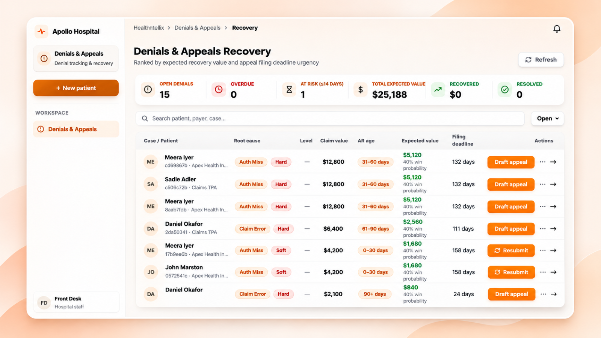
Once the specialist approves it, payer interface automation submits the appeal and learns from whatever ends up happening. Every outcome, whether paid, denied again or partly recovered, feeds back into the worklist scores. Payer-behavior intelligence runs alongside the loop. It watches how each payer adjudicates claims and flags new denial patterns as they emerge.
Front desk clearance + pre-authorization
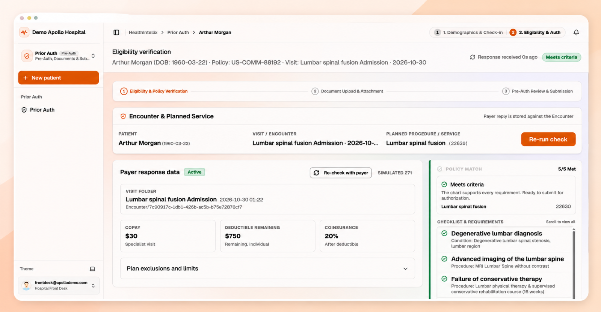
Front desk clearance gets each patient cleared before the visit. It checks eligibility live with the payer at scheduling and flags stale IDs, date-of-birth mismatches and coordination-of-benefits conflicts. It then pre-fills five clearance steps for staff to sign off: guarantor, coordination of benefits, encounter triage, point-of-service estimate and consents. The pre-authorization workflow follows the same pattern. Agents prepare each request, and a person approves it before it goes to the payer.
GoML has also built agentic AI for healthcare providers, and these systems run in production today. In the case of Atria’s risk-prediction platform, the system brings each patient’s history, prescriptions, scans and test results into one store and surfaces early warning signs, and it improved diagnostic accuracy by 35%. NewVue’s radiology platform by GoML does the same kind of work for imaging. It analyzes imaging data and turns it into structured clinical insights.
Others help clinicians follow a patient across their journey/timeline in the system. Atria’s PHA Generator brings lab tests, prescriptions and doctors’ notes into one view of each patient. It gives doctors a summary before or during the visit and sends real-time alerts through tools like Slack when a patient’s data changes sharply. It also cut the time spent on manual data analysis by 60%. Max Healthcare’s clinical copilot by GoML gives clinicians the same longitudinal view at the point of care, connected to the hospital’s existing systems.
On the administrative side, WizTherapy’s intake automation system by GoML reads intake forms that arrive as PDFs, Word files and scanned images and turns them into structured digital forms that staff review. It cut manual intake effort by 80%.
People stay in control of agentic AI for healthcare
HealthIntellix puts the designated person in the loop wherever a mistake would be costly or hard to undo – or even wherever the system’s confidence is low.
Consequential actions wait for approval. A specialist approves every appeal packet before it’s filed, and clinical decisions stay with clinicians.
Low-confidence work is sent back to a person immediately. When an agent can’t find enough evidence, it stops and returns a reason code that tells the reviewer why it didn’t go through. When two records might belong to the same patient but the match is uncertain, they go to a review queue, because a wrong merge would corrupt every answer built on it.
There are many further safety parameters, for instance, your team decides how cautious the system is. A stricter confidence threshold gives more reliable answers but sends more work back to people, so you set it with the people who bear the cost of a wrong answer.

Privacy, compliance and ownership
GoML is HIPAA compliant and ISO 27001 certified. Beyond certifications, a compliance team asks three questions of any agentic AI for healthcare that touches patient data: who can see what, where the data goes and whether every action can be reconstructed afterward.
HealthIntellix by GoML answers the first by applying each user’s access rules before any results exist, so restricted records never reach an answer. Roles without access to individual records see only totals, and caps on result size limit bulk extraction.
On the second, patient identifiers are masked before the AI model sees any data, and you choose where the model runs. A self-hosted model keeps prompts inside your network while a hosted model runs under a business associate agreement (BAA).
For the third, every request writes a record that can’t be overwritten. It logs who asked, which access rules applied, which data was used, which model answered and what the checks found, so a reviewer can trace any answer back to the source record.
You also own the entire system outright, which is vital in healthcare ops. GoML hands over the code and IP, and you keep your data instead of escrowing it to a third-party vendor.
Time and revenue recovered
The return on investment from agentic AI for healthcare comes pouring in primarily from the assembly work the agents take off your team, and in claims appeals that time turns into revenue the team couldn’t reach before. HealthIntellix builds one appeal in 20 to 45 minutes, against 1.5 to 4 hours for a typical claims team. The time from remittance to a filed appeal drops from 5 to 40 days to 1 to 5 days, while the payer’s own 30 to 90 days to pay an appeal stays the same.
Faster preparation changes which denials are worth working – and how many of them get worked too. When an appeal takes minutes instead of hours, your team can pursue the recoverable denials it used to leave untouched.
HealthIntellix states every improvement against a named baseline, with a 95% confidence interval and the sample size. Time studies count after-hours work, so a reported saving means work removed rather than work moved to the evening. Absolute claims come from a test set built on your own data, with answers reviewed by clinicians.

Next steps
Start with the workflow that costs your team the most time. Claims appeal management, front desk clearance and prior authorization each switch on inside your existing systems and your staff approve every consequential action.
Book a HealthIntellix demo to see where agentic AI for healthcare fits in your health system. We’re currently building out all possible clinical workflows, so reach out to us in case you need more info on a specific one.
Stay tuned to the GoML blog for the latest in healthcare AI and engineering.


