
Impact Soccer operates an AI-powered soccer video analytics platform that converts match footage into detailed team and player intelligence. Users can upload footage or submit a video link to generate match statistics, player analysis, off-the-ball movement insights, and automatically clipped highlights. Its Impact IQ™ score measures player influence away from the ball, extending analysis beyond traditional event statistics. The platform serves soccer programs ranging from academies and colleges to professional clubs, broadcasters, camera partners, and institutional customers.
Problem: Soccer video analytics could not scale efficiently with match volume
Impact Soccer's soccer video analytics platform was delivering advanced computer vision analysis, but its infrastructure was reaching a performance and cost ceiling as customer demand increased. The platform was moving from single-digit match volumes toward more than 100 matches per day. A one-hour match required roughly 2 hours and 45 minutes of GPU processing. YOLOv8 detection, DINOv2 appearance embeddings, BoT-SORT tracking, event detection, and video-output processing ran through a compute-intensive pipeline, with several workloads executing sequentially.
This created five major constraints. Processing was too slow for future live-match use cases. GPU resources were not fully utilized. SageMaker accounted for close to 60% of infrastructure spending without clear per-match cost visibility. Failed jobs required manual investigation across AWS services. Tracking quality across long match sequences had not been formally documented. Impact Soccer needed to make soccer video analytics faster, less expensive, easier to operate, and easier to monitor without changing the statistics that coaches and analysts already trusted.
Solution: Scalable soccer video analytics with GPU optimization and AWS
GoML delivered a phased modernization of Impact Soccer's soccer video analytics infrastructure using its AI Data Analytics blueprint, adapted for computer vision and high-volume sports video analytics. The solution combined AWS infrastructure modernization, GPU optimization, scalable analytics processing, production observability, operational automation, and long-sequence validation.
GoML retained Impact Soccer's existing event-driven architecture while optimizing the platform's most compute-intensive components to support higher match volumes, faster processing, and more efficient soccer video analytics at scale.
AI model optimization for soccer video analytics
GoML optimized the GPU inference pipeline running on Amazon SageMaker Processing Jobs with NVIDIA T4 GPUs on ml.g4dn.2xlarge instances.
The optimized soccer video analytics pipeline included:
- TensorRT inference where compatible optimized engines were available
- Frame-stride processing with hold-forward geometry
- YOLO pre-track ball detection
- Improved GPU memory management
- CPU and GPU workload overlap
- NVIDIA NVENC video encoding
- high_accuracy and fast processing profiles
The high_accuracy profile remained the production default, while customers requiring greater throughput could use fast mode.
TensorRT acceleration for soccer video analytics
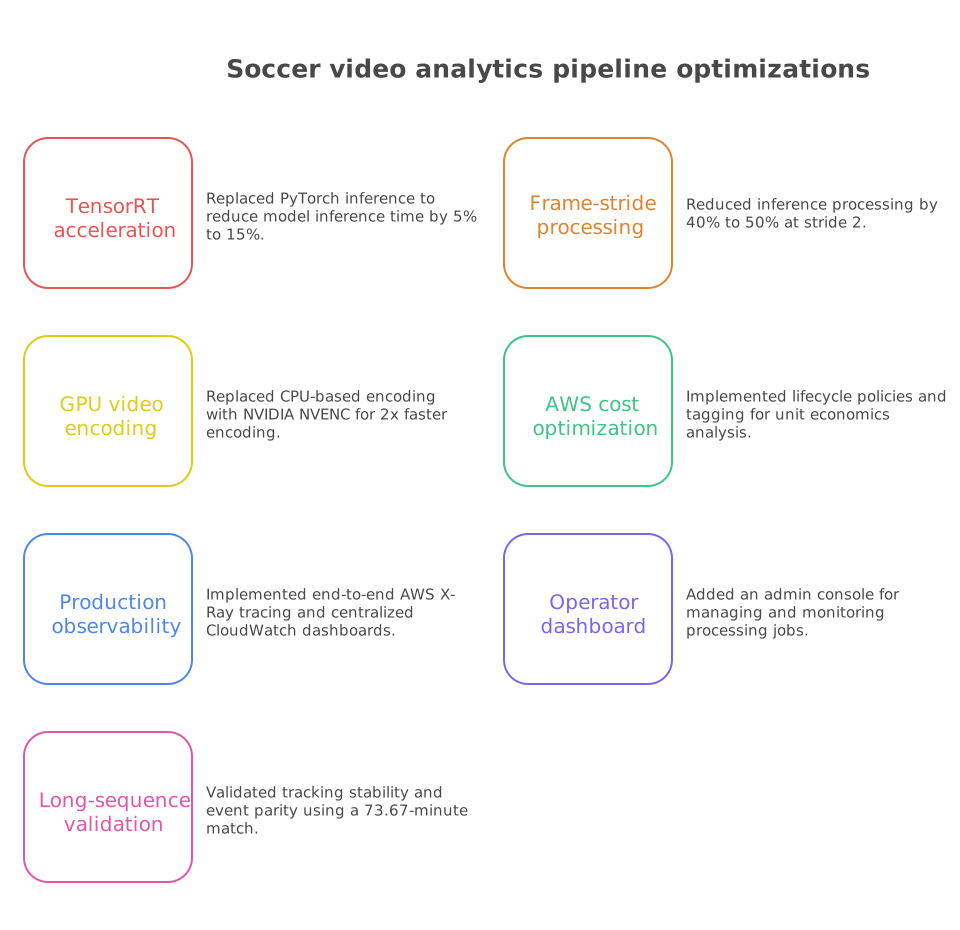
TensorRT replaced PyTorch inference where an optimized engine was available.
- Reduced model inference time by approximately 5% to 15%, depending on the processing stage.
- Optimized model loading and GPU execution to reduce unnecessary processing overhead.
- Improved NVIDIA T4 resource utilization to complete more inference work efficiently.
Frame-stride optimization for soccer video analytics
GoML introduced frame-stride processing to reduce unnecessary inference.
- Fast mode runs full object detection only on selected frames.
- Detected geometry is carried forward between processed frames.
- At stride 2, inference processing decreased by approximately 40% to 50%.
- Faster processing improved soccer video analytics throughput.
- high_accuracy mode remained available for workloads where maximum statistical consistency was the priority.
GPU video encoding for soccer video analytics
Video encoding was another processing bottleneck.
- GoML replaced CPU-based encoding with NVIDIA NVENC and released GPU memory before the encoding phase.
- The team also overlapped selected CPU and GPU operations instead of waiting for each stage to complete sequentially.
- NVENC delivered roughly 2× faster video encoding on long clips while reducing pressure on CPU resources.
AWS cost optimization for soccer video analytics
GoML optimized infrastructure costs surrounding the soccer video analytics pipeline.
The cost optimization work included:
- S3 lifecycle policies across all four video buckets
- Standard-IA and Glacier storage transitions
- Object expiration policies
- Incomplete multipart-upload cleanup
- CloudWatch Log Group retention
- Amazon ECR lifecycle policies
- Environment-level cost allocation tagging
- SageMaker job-level cost tagging
- Daily AWS account-cost metrics in CloudWatch
Environment costs can now be associated with CloudFormation stack-name tags.
Production observability for soccer video analytics
GoML implemented end-to-end AWS X-Ray distributed tracing across the soccer video analytics pipeline.
Tracing covers:
- Amazon API Gateway
- AWS Lambda
- Amazon SageMaker
- Amazon RDS for PostgreSQL
- Amazon ElastiCache for Redis
- Amazon S3
- Downstream services
Trace context propagates through the x-amzn-trace-id header so individual requests can be followed across the application and processing infrastructure.
GoML also developed a centralized Amazon CloudWatch dashboard that reports:
- End-to-end latency
- Latency percentiles
- GPU utilization
- System utilization
- Processing failures
- Queue depth
- Daily AWS cost
Three CloudWatch alarms use the same metrics shown on the dashboard, keeping operational monitoring and alerting aligned.
Operator dashboard for soccer video analytics jobs
GoML extended Impact Soccer's React frontend and FastAPI backend with an admin-only Operator Dashboard.
The soccer video analytics operations console allows administrators to:
- View SageMaker Processing Jobs
- Search processing jobs
- Filter jobs by status
- Navigate paginated job history
- View job details
- Review processing stages
- Inspect instance information
- See failure reasons
- Open CloudWatch logs
- Review S3 input and output locations
- Preview generated output
- Stop active jobs
- Retry failed jobs
A dedicated AWS Lambda function receives SageMaker Processing Job state-change events through Amazon EventBridge.
Long-sequence validation for soccer video analytics
Improving processing speed could not come at the expense of player tracking or event statistics.
GoML therefore validated both high_accuracy and fast modes using a 73.67-minute match containing 132,481 frames.
Long-sequence soccer video analytics validation included:
- Player tracking stability
- Player ID behavior
- ID switches
- Tracking drift
- Ball continuity
- Event parity
- Team-label consistency
- Ten-minute quality buckets
The testing showed no end-of-match tracking collapse and zero team-label flips on long tracks.
GoML also documented failure modes and recommendations, giving Impact Soccer a defined quality envelope for extended match processing.
Quality assurance for the soccer video analytics operator dashboard
GoML completed 57 functional test cases across the Operator Dashboard.
Testing covered:
- Navigation
- Monitoring metrics
- Job listing
- Search
- Status filters
- Pagination
- Job details
- CloudWatch logs
- Output preview
All 57 functional test cases passed.
Impact
- 59.6% lower soccer video analytics processing time
- 58% faster soccer video analytics inference
- 64% faster soccer video anlytics pass analysis and tracking
- Approximately 60% lower SageMaker GPU cost per match, from approximately $2.60 to $1.05 in fast mode
- Faster-than-real-time soccer video analytics processing
- 100% operator dashboard functional test pass rate
- 268 distributed traces successfully verified
- Improved soccer video analytics security
About
Before Gen AI and after Gen AI
“With GoML’s AI and computer vision optimization, Impact Soccer can process soccer video analytics 2.47× faster while reducing GPU costs by approximately 60%, creating a scalable foundation for higher match volumes and future live analytics.”
Prashanna Rao, Head of Engineering, GoML.
Key takeaways for soccer video analytics platforms
Common challenges
- Computer vision pipelines can become expensive as match volume increases
- Sequential AI processing can leave GPU resources underutilized
- Faster inference has limited value if tracking and event statistics regress
- Aggregated cloud bills make per-match profitability difficult to measure
- Processing failures become harder to manage without a centralized operations console
- Short-video testing does not establish tracking quality across complete matches
- Faster soccer video analytics requires optimization across inference, tracking, encoding, infrastructure, and operations
Practical guidance
- Benchmark the complete soccer video analytics pipeline rather than measuring model inference alone
- Maintain a high-accuracy processing profile when introducing aggressive performance optimizations
- Use TensorRT where model compatibility allows it
- Evaluate frame-stride processing when every-frame inference is unnecessary
- Use GPU-native encoding such as NVENC for video-heavy computer vision pipelines
- Add environment-level and job-level cost tags before scaling match volume
Ready to scale soccer video analytics?
Partner with GoML to build faster, scalable soccer video analytics with optimized AWS infrastructure and GPU processing using AI Matic platform.


.avif)


