The typical AI marketing automation playbook includes conversational chatbots that require constant prompting and human babysitting. Incentivio, a restaurant marketing platform needed a better system that solved sales analysis, audience segmentation and promo activity - all with AI. So our team engineered Vio Agent Hub for Incentivio.
Built on our proprietary AI Matic platform, this solution orchestrates three specialized autonomous agents via an advanced MCP data plane. It brought in a fully autonomous intelligence layer over Incentivio’s existing database infrastructure to ensure an otherwise static system turns hyper-dynamic.
The challenge of siloed data
The big challenge for Incentivio was turning static data into a dynamic, intelligent system within its existing infrastructure, without moving that data to an external AI platform. For instance, in their existing infrastructure, a question about sales might point to a specific customer segment and then to a targeted offer. Each step needs live/current data, the accurate merchant scope and a clear record of what the system read or proposed (for explainability).
The build also had to handle different types of work. Analytics calls should read data and report its source with details on when it was created. Audience creation checks available attributes, data access, offer drafts to consider past campaigns, audience size, overlap and expected results. A person must review every action before an offer is published or if guest data changes.
What made this AI powered marketing automation build unique
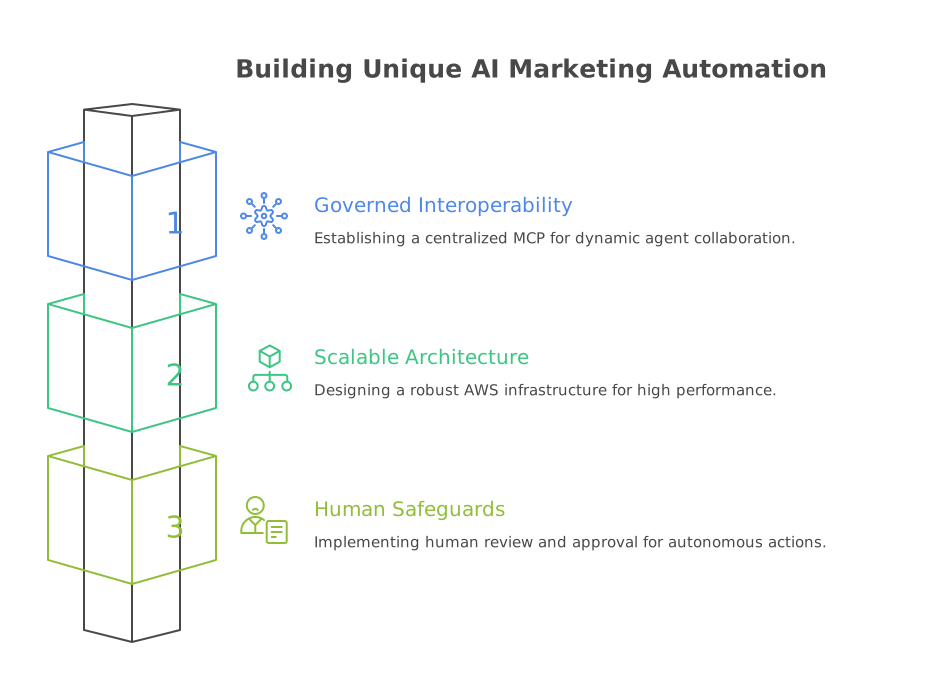
Building an agentic loop capable of intelligent, autonomous collaboration while strictly maintaining multi-tenant isolation required solving three hard engineering challenges:
1. Governed multi-agent interoperability via MCP
Instead of maintaining point-to-point API connectors for each agent, we built out a centralized MCP read-server layer running on Amazon ECS Fargate.
- Dynamic Orchestration: If the Offers Agent needs a customer cohort that does not exist, it delegates in-flight to the Tagger Agent to create a draft audience, previews size and overlap, and hands back the parameters - all within a single execution cycle.
- Concurrent Execution: Complex offer drafts require 8 to 10 distinct tool calls. Single validation checks execute asynchronously in parallel, pulling live performance metrics, checking brand guidelines and projecting sales lift simultaneously before assembling the final asset.
2. High-performance, scalable AWS architecture
- Agent Core: Orchestrated using Amazon Bedrock AgentCore and Bedrock LLM endpoints for agent decision engines and conversational intake via Open Copilot.
- Microservices and Compute: Data tooling, prediction microservices and MCP gateways deployed as containerized tasks on Amazon ECS Fargate.
- Event Choreography and Storage: Event-driven automation handled via Amazon EventBridge, with campaign artifacts and analytical report packs offloaded to Amazon S3.
- Zero-Data Drift: Integrates directly with Incentivio’s existing Amazon RDS instances without mutating production systems of record.
3. Human-in-the-Loop safeguards and stateful drafting
Autonomous agents generate actionable drafts that strictly require permission to execute. Incomplete cohorts and unverified offers are trapped in a draft state, routing directly to Incentivio’s native offer builder for an actual marketer to sign-off on before dispatch.
The novelty of how we approached this challenge
GoML used its AI Matic platform in building Incentivio's Vio Agent Hub, which accelerated AI system development and delivery. The platform provided all the necessary composable building blocks for specialist agents, approved tools and human review mechanisms to fit into one workflow. For this build, GoML FDEs adapted AI Matic code to connect the Analyst, Tagger and Offers agents to the restaurant marketing platform, while keeping each agent’s data access and actions within its assigned role.
As part of the AI Matic platform, GoML applied its Agentic AI solution blueprint to get a head start on this build. The system design connects the Analyst, Tagger and Offers agents through a controlled data layer. It also adds offer forecasting, scheduled tasks - all while keeping marketers in control of publishing.
GoML planned the first phase across five sprints, covering the Analyst, Tagger, Offers, forecasting, refinement also user testing. The design reuses Incentivio’s existing data layer, offer builder, customer groups and analytics flow, reducing new development and giving marketers one place to review AI-created work. The files show the planned schedule, but do not confirm the actual completion date.
- Shared data layer: An MCP read server connects all three agents to approved Incentivio data and tools. It checks all the details on every call and logs the results and failures.
- Analyst agent: Answers questions about sales, orders, loyalty and campaign results. It flags missing or old data instead of showing it as current.
- Tagger agent: Creates customer groups from marketer requests checks available customer data also previews the group size.
- Offers agent: Creates offer drafts using brand rules, past campaigns, audience size, overlapping offers plus sales forecasts.
- Agent handoff: If an offer needs a new customer group, Offers asks Tagger to create a draft group during the same task. The group stays as a draft until a person saves it.
- Offer workflow: An offer draft uses around 8 to 10 tool calls. Single checks can run at the same time before the offer is drafted and sent for forecasting.
- Human review: The draft goes to Incentivio’s existing offer builder, where a marketer reviews it before publishing.
- Open Copilot: Asks for missing details and sends complete questions to the Analyst agent. Simple questions do not start analytics runs.
“The idea behind Vio Agent Hub was to develop an AI system to power a dynamic marketing automation workflow that connects existing infra - everything from analytics, customer groups and offer creation all in one place. Enabling convenience with accuracy required applied AI engineering where each AI agent has the right data while keeping marketers in control of every offer before it is published”. - Prashanna Hanumantha Rao, Co-Founder and CTO, GoML
How this system automated marketing operations for Incentivio
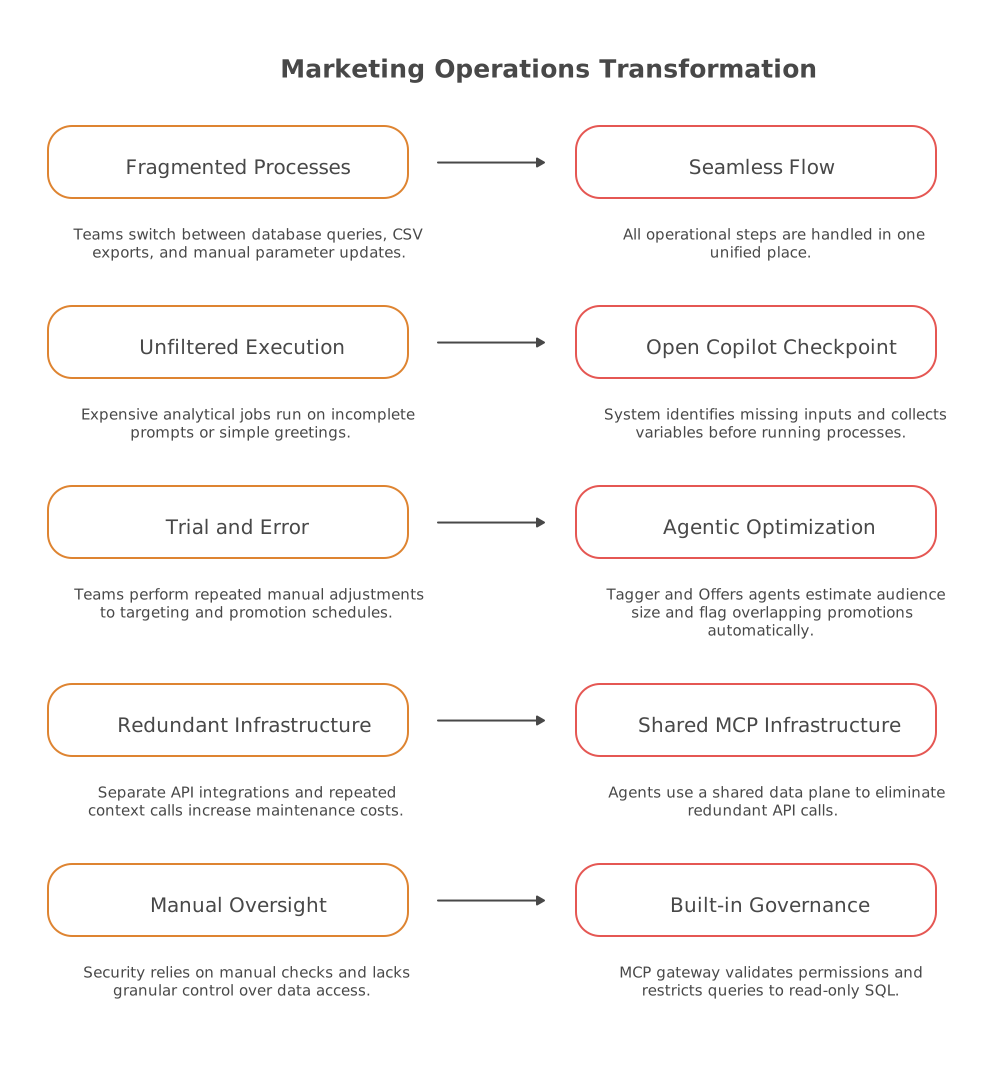
Operational velocity drastically improves when fragmented work/data/tools become accessible in one seamless flow. Instead of switching between database queries, CSV exports and manual parameter updates, teams can handle these steps in one place.
Open Copilot acts as the first checkpoint. It checks the user’s request, identifies missing inputs and collects the variables needed to run a process. This prevents expensive analytical jobs from running on simple greetings, incomplete prompts or for that matter even minor follow-up questions.
Campaign preparation also takes less manual work. The Tagger agent estimates audience size before a segment is saved, so teams can adjust targeting without repeated trial and error. At the same time, the Offers agent checks each proposal against the live marketing calendar. It flags overlapping promotions before they reach review, helping teams avoid campaign conflicts and cannibalization.
The system also reduces unnecessary compute and maintenance costs. All three agents use a shared MCP infrastructure and the same data plane. This removes the need for separate API integrations and repeated context calls.
The system also controls how and when expensive models run. Forecasting engines are triggered only when inputs that affect the economics of a campaign change, such as discount percentages or spending thresholds. Changes to copy or creative assets do not trigger these workloads. Fine-grained telemetry separates chat token usage from analytical jobs, giving administrators a clear view of where compute is being used.
Security and compliance are built into each transaction. The MCP gateway checks tenant, merchant, and user permissions before an agent can access a backend service. Analytical queries use read-only SQL and are limited to approved data dictionaries. This prevents database writes and keeps data isolated across restaurant brands.
Every agentic action is also logged. Tool calls, agent runs and API failures are linked to the request that initiated them and stored in a persistent audit trail. This gives teams a clear record of what happened across every interaction.
AI powered marketing automation outcomes
- 50% less time to get an answer to a marketer’s question, with a clear data source.
- 70% less time to prepare customer cohorts and offer drafts.
- 3x lower cost for each approved offer, including marketer time and AI usage.
How GoML delivered the system in record time
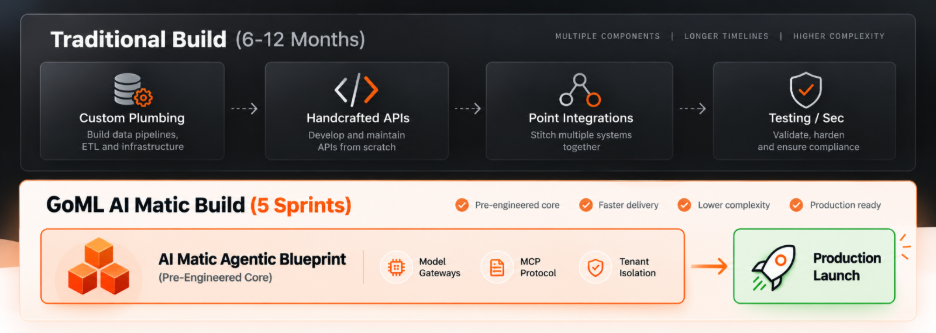
The one-line answer is: our team used AI Matic - built specifically to achieve this. Enterprise AI projects often slow down because teams must build the same foundational components for AI systems development from scratch. That includes data pipelines, model abstraction, guardrails, evals, multi-tenant security, agent handoffs, and orchestration engines.
AI Matic brings these building blocks to every enterprise AI build.
Explore other novel, production-grade AI systems built by GoML in our AI case studies section, or reach out to our experts to get started on your AI roadmap today.