New Path Consulting developed AccountBridge, an automation platform that connects Wild Apricot with QuickBooks for nonprofit organizations. Wild Apricot manages membership revenue, donations, events, and online store transactions, while QuickBooks manages accounting records, expenses, and historical financial data.
Problem: Limited trust slowed financial report software adoption
Generating financial reports from structured accounting data was not the main challenge for AccountBridge. The larger issue was proving that AI-generated reports were accurate, explainable, and reliable enough for nonprofit organizations to use. Small nonprofits with less than $5 million in revenue currently spend between $10,000 and $15,000 annually on accounting and bookkeeping services. AccountBridge aims to reduce this cost by 10 times while maintaining or exceeding the quality of manually prepared reports.
Financial reporting depends on complete transaction records, correct expense categorization, applicable tax rules, and reliable historical data. Missing information or incorrect account classifications can reduce report accuracy. AccountBridge needed financial report software that could generate reports, compare outputs with historical benchmarks, calculate realistic confidence scores, explain each score, and identify data issues requiring human attention.
Solution: Financial report software with confidence scoring and explainability
GoML built a financial report software layer that connects Wild Apricot and QuickBooks data, applies accounting and tax rules, and generates cash flow reports, balance sheets, and nonprofit tax returns. Each output includes a confidence score, diagnostic feedback, and an explanation of missing data or categorization issues, so nonprofits can judge whether an AI-generated report matches or exceeds a manually prepared one.
AI Matic delivery
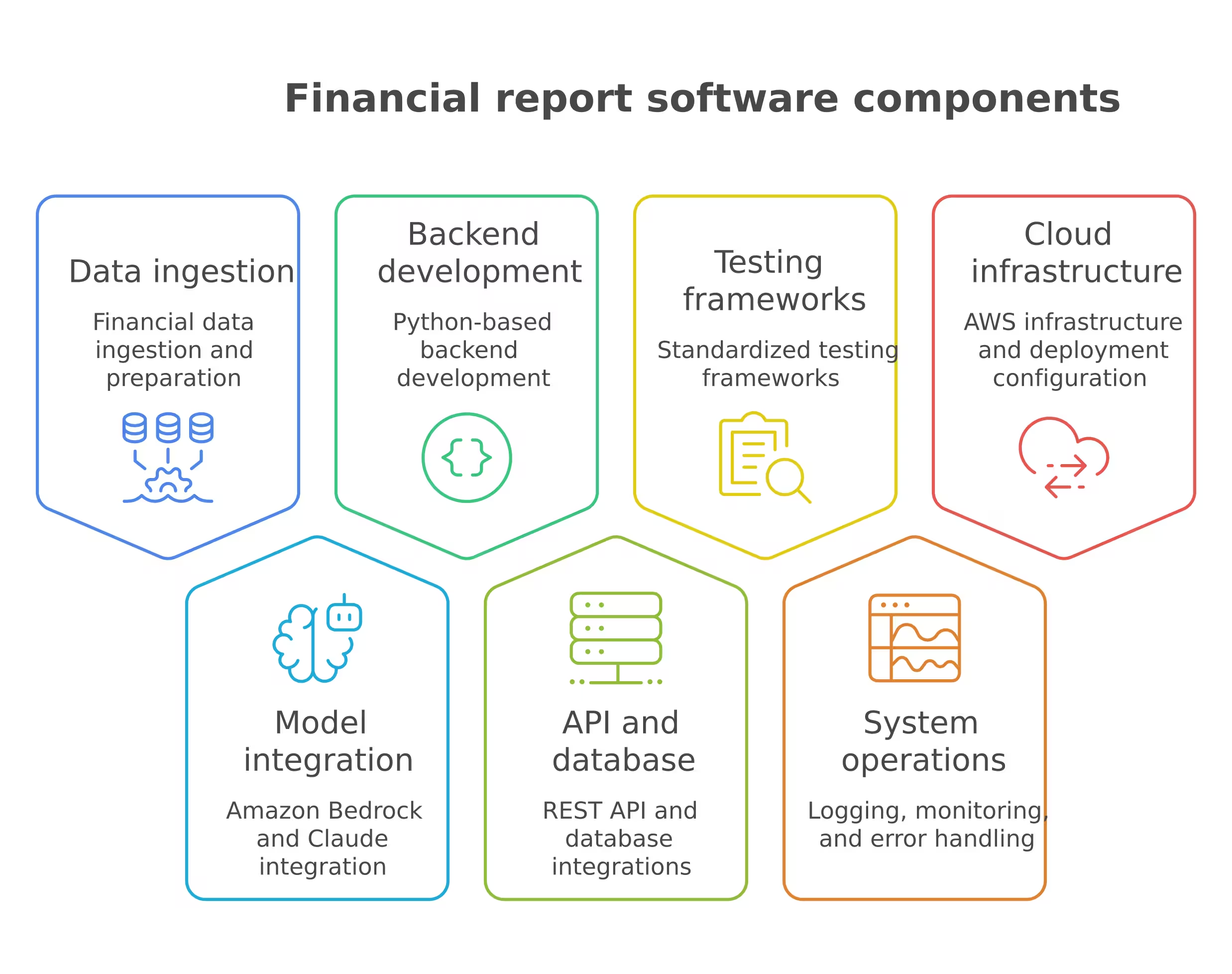
GoML used the AI Matic Content Generation blueprint as the delivery foundation for AccountBridge’s financial report software. The blueprint supported financial data ingestion, report generation, backend development, API integrations, testing, monitoring, and AWS deployment, while the implementation added nonprofit accounting logic, tax-rule mapping, confidence scoring, benchmark comparison, and explainable diagnostic feedback.
The AWS AI infrastructure includes Amazon Bedrock with Claude for financial report generation, Amazon Textract for document processing, AWS Lambda and Amazon ECS Fargate for compute, Amazon RDS and DynamoDB for structured data, Amazon S3 for storage, Amazon API Gateway for APIs, and Amazon CloudWatch for monitoring.
AI Matic delivery metrics
- Average TTFV: 21 days
- Average person-days saved: 8 days
Secure Wild Apricot and Quickbooks Integration
The financial report software connects to customer Wild Apricot and QuickBooks accounts through secure authentication and data retrieval mechanisms.
Wild Apricot data includes:
• Membership dues
• Donations
• Event revenue
• Online store transactions
• Customer and member information
QuickBooks data includes:
• Chart of accounts
• Expense transactions
• Account balances
• Historical categorization
• Financial transaction history
The data pipeline prepares this information for report generation without replacing AccountBridge’s existing integration capabilities.
Customer financial context preparation
The system combines transaction records with organization-level financial context.
The context layer may include (when available):
- Organization size
- Nonprofit classification
- Revenue sources
- Historical financial reports
- Filed tax returns
- Applicable tax rules
- Expense categorization guidelines
This context helps the financial report software interpret transactions according to the organization’s structure, reporting history, and regulatory requirements.
AI-assisted report generation and context injection
The solution uses historical customer accounting data and filed tax returns (when available) to provide contextual information during report generation.
The AI layer supports:
- Financial transaction interpretation
- Account and expense classification
- Tax rule application
- Context-aware report generation
- Report-level explanation generation
The solution uses Amazon Bedrock Claude with prompt engineering and contextual data injection
Rule-based accounting and tax intelligence
The financial report software applies predefined accounting validation rules and tax guidance to improve report generation and validation.
The rule framework supports:
- Expense categorization validation
- Revenue classification
- Asset and liability validation
- Tax line-item mapping
- Nonprofit accounting guidance
The Proof of Concept remains limited to one or two selected state and federal policy frameworks. Broader jurisdiction coverage remains available for future phases.
Automated cash flow report generation
The financial report software generates monthly or quarterly cash flow reports using validated source data.
The cash flow workflow includes:
• Revenue and receipt identification
• Expense and payment classification
• Operating cash flow calculation
• Source data validation
• Missing transaction detection
• Confidence score generation
• Diagnostic feedback
The system connects each report value with the underlying financial data, helping users review uncertain or incomplete entries.
Automated balance sheet generation
The solution generates balance sheets by classifying financial data into assets, liabilities, and equity or net asset categories.
The balance sheet workflow supports:
• Account balance extraction
• Asset classification
• Liability classification
• Equity and net asset categorization
• Account reconciliation checks
• Missing account identification
• Confidence scoring
The output explains classifications and data issues that reduce confidence in the generated balance sheet.
Nonprofit tax return generation
The financial report software generates nonprofit tax return documents with line-item population for IRS Form 990 or equivalent supported forms.
The tax return workflow includes:
• Revenue line-item mapping
• Expense category mapping
• Deduction rule validation
• Missing information detection
• Compliance gap identification
• Confidence calculation
• Line-item explanation
The Proof of Concept compares generated tax return values with previously filed returns. An accountant or bookkeeping subject matter expert validates report accuracy during testing.
Confidence scoring framework
Confidence scoring is the central component of the AccountBridge Proof of Concept.
The framework evaluates:
• Source data completeness
• Transaction categorization quality
• Agreement with historical benchmarks
• Tax rule coverage
• Missing account information
• Report line-item consistency
• Variance from manually prepared reports
Each report includes a confidence score based on configurable validation criteria such as:
- Source data completeness
- Validation rule coverage
- Transaction categorization quality
- Comparison with available historical reports
- Missing or inconsistent financial information
- The report also explains the primary factors contributing to the confidence score.
Benchmark comparison engine
The benchmark engine compares outputs from the financial report software with historical reports prepared by accountants or bookkeepers.
The comparison process includes:
• Report-level accuracy checks
• Line-item comparisons
• Variance identification
• Historical tax return validation
• Missing value detection
• Confidence calibration
• Diagnostic reporting
This gives AccountBridge a measurable way to determine whether AI-generated reports match or improve upon the existing manual process.
LLM explainability and diagnostic feedback
The explainability layer helps users understand the generated report and the factors influencing its confidence score.
The system identifies:
• Missing financial information
• Incomplete expense categorization
• Unmapped transactions
• Account classification gaps
• Tax rule conflicts
• Non-compliant expense entries
• Differences from historical reports
It then generates actionable feedback to help nonprofit users improve their accounting data and reporting practices.
Review-ready financial report outputs
The solution produces reports in formats suitable for review, comparison, and further analysis.
Supported output options include:
• PDF reports
• Excel workbooks
• Structured data outputs
• API-ready report payloads
Each output includes:
• Generated financial report
• Confidence score
• Confidence calculation rationale
• Diagnostic feedback
• Missing data summary
• Benchmark comparison
• Recommended corrective actions
The interface remains minimal during the Proof of Concept because the primary focus is financial accuracy, confidence scoring, and diagnostic transparency.
Quality assurance
Testing focuses on report accuracy, confidence score reliability, benchmark alignment, and diagnostic quality.
The validation process includes:
• End-to-end testing with real customer data
• Cash flow report validation
• Balance sheet validation
• Tax return validation
• Comparison with manually prepared reports
• Comparison with filed tax returns
• Confidence score calculation testing
• Missing data detection testing
• Expense categorization validation
• Explainability review
• Accountant or bookkeeper review
Impact
- 50% less manual effort in preparing nonprofit financial reports
- 40% faster generation of cash flow statements, balance sheets, and tax returns
- 30 to 40% faster identification of missing or inconsistent accounting data
- 60% greater reporting transparency through confidence scoring and explainable AI-generated reports
About
Before Gen AI and after Gen AI
“With financial report software, AccountBridge can transform integrated accounting data into transparent financial reports with confidence scores, benchmark comparisons, and actionable diagnostic feedback.”
Prashanna Rao, Head of Engineering, GoML.
Key takeaways for financial report software providers
Common challenges
- Generating financial reports does not automatically establish user trust
- Incomplete accounting data reduces report accuracy
- Expense categorization errors affect financial statements and tax returns
- High confidence scores are meaningless without transparent calculations
Practical guidance
- Start with a limited number of report types and customer datasets
- Connect report values with their underlying source data
- Compare AI-generated reports with filed returns and historical statements
- Use realistic confidence scores instead of assigning high ratings by default
- Explain the factors that increase or reduce report confidence
- Flag missing data and categorization gaps before finalizing reports
Ready to build financial report software?
Partner with GoML to build secure financial report software with integrated accounting data and explainable report generation using AI Matic.