Semtech, a leading semi-conductor manufacturer takes 18 to 30 months to design an analog chip. Typical visibility for a future product design is usually less than 12 months ahead in the market. That means Semtech has to commit engineers before it knows which way the market will go. A wrong start costs them roughly $15 million. A missed opportunity can cost a whole product generation.
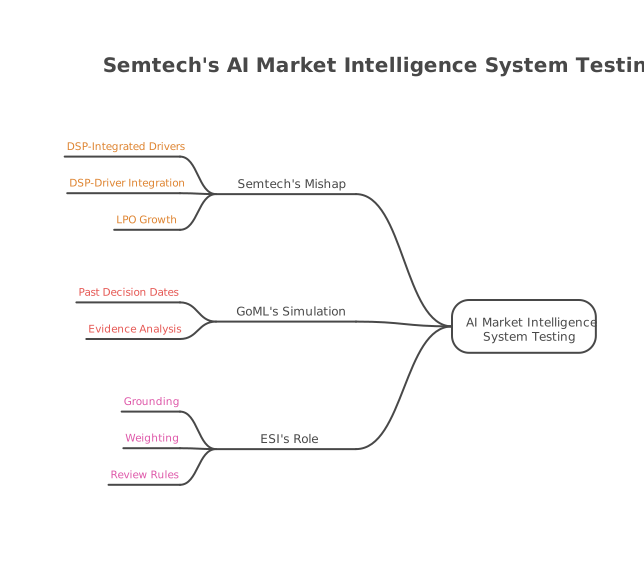
And this mishap already took place once. For 800G laser drivers, Semtech assumed laser drivers would get built into DSP chips and thus largely stayed out of the 800G generation. An assumption was made that was only partially right. Integrated designs took an estimated 40% of market share, and the rest of it still used separate laser drivers. That's an estimated loss in revenue of $150M to $340M for them.
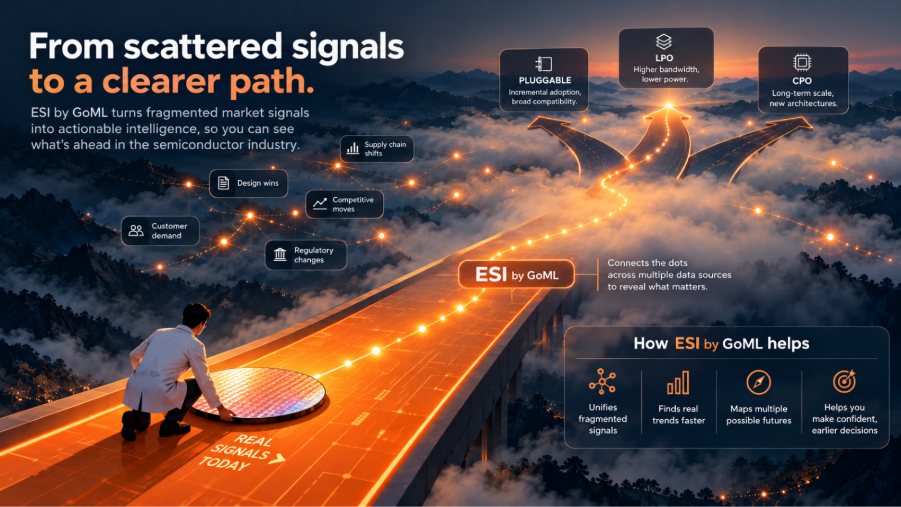
To solve this, GoML built an Early Signal Intelligence (ESI) system for Semtech. This AI market intelligence system collects market evidence and offers data-backed recommendations that Semtech's product teams can reliably act on.
Here’s why conventional research fell short
In spite of plenty of market intelligence, the team couldn't leverage them for insights as they lived in several disconnected silos. Every new attempt at building a business case had stakeholders building things from scratch - also eliminating the possibility of re-evaluating if the assumptions made previously held true.
The industry itself demands agility, as often times a single hyperscaler can redirect opportunity across a whole platform generation. Conventional research tends to catch these shifts 12 to 18 months late.
The advantage of forecasting at the decision layer
This helped the GoML team frame the core challenge as a decision problem rather than a research limitation. The ESI system applies AI market intelligence to market sockets at one interface generation in one specific platform context. Therefore, every forecast, probability and recommendation in ESI ties back to the same source.
Each week, ESI's AI market intelligence pipeline pulls documents from Semtech's top 10 to 15 sources, including standards bodies, conferences, licensed research, earnings calls, patents and job postings. AI reads those documents and pulls outdated claims, and each claim links to the exact passage it came from. A Bayesian model then updates the odds of five scenarios across one-, two- and three-year horizons. A Monte Carlo simulation runs more than 10,000 draws to turn those odds into ranges for demand and timing.
Building an AI market intelligence system that engineers could argue with
The earlier assessment failure happened as a result of the team mistaking a partial shift for a total one. With a system like ESI which allows model coexistence, a 30 to 40% integration probability is shown as a distribution rather than a binary “yes or no”.
Evidently, high-stakes decisions that could lead to laarge potential losses always need to survive any skepticism from product leaders. For AI market intelligence to earn that trust, every data point and recommendation needed to be highly explainable and traceable
Testing the system against Semtech’s own mishap
Before Semtech relied on a single live forecast from its new AI market intelligence system, GoML ran a simulation, testing it on the 800G laser-driver decision. Semtech had already traced the miss to three causes:
- DSP-integrated drivers weren't good enough for some applications, which partner and customer feedback pointed to at the time.
- Not every DSP integrated a driver - which competitor datasheets showed.
- Linear Pluggable Optics (LPO) which bypasses power-heavy digital signal processors to lower latency and power—grew faster than expected, a shift already reflected across market intel, standards activity, and conference papers.
GoML tested the evidence at each past decision date so the model could only see what Semtech could have known then. We then asked a simple question - “Would ESI have challenged the integration assumption early enough to change the decision?”
The answer rested on a fact Semtech had already established: the signals behind all three failure points existed before the decision was made. Partner feedback, competitor datasheets and LPO standards activity were all on record at the time. The backtest tested whether ESI, applying the same grounding, weighting and review rules it uses today, would have turned that scattered evidence into a signal strong enough to move the decision.
How GoML delivered ESI in 21 weeks
Initial phases covered the Signal Integrity (SI) and System Protection/Photonics (SPP) business lines, analyzing architecture shifts across traditional pluggables, Linear Pluggable Optics (LPO) and Co-Packaged Optics (CPO) across three strategic accounts.
The team also kept the forecasting core independent of any vendor. Data capture and modeling ran while Semtech evaluated Palantir Foundry, a custom build and specialist intelligence tools, so the platform decision never held up the work. GoML finished the build in 19 weeks and reserved the last two for Semtech's own user testing.
This rapid turnaround was powered by AI Matic. Instead of engineering data pipelines and decision engines from scratch, GoML utilized AI Matic’s battle-tested solution blueprints to accelerate foundational development by months. By providing a ready-to-adapt architectural backbone for agentic data collection, Bayesian synthesis and governance, AI Matic enabled the team to go from concept to a production-grade system with speed and certainty.
ESI is now an ongoing capability that Semtech's analysts own and run after final deployment with GoML’s Ninja FDEs.
Conclusion
Semtech had the signals it needed before it skipped 800G laser drivers, and the potential cost of that call ran to $150M–$340M in revenue. An AI market intelligence system like Early Signal Intelligence by GoML changes how leaders decide with strong data points. Every recommendation now arrives with its evidence traced to source, a confidence level tied to a clear action and a track record scored against real outcomes.
Leaders can now commit a platform-class engineering budget knowing how much weight the forecast can bear. GoML built this AI market intelligence into the governance forums Semtech already runs, so it sharpens existing decisions without adding a new process to manage.
If you’re looking to explore an AI use case for your organization, reach out to our experts at GoML today. And check out more of our case studies built with the latest in AI engineering.
.avif)