Claythis is an AI 3D character generator platform that transforms 2D character images into fully animated 3D models for gaming, animation, and creative applications. The platform automates character creation, including mesh generation, texturing, rigging, motion application, and animation retargeting. Users can generate production-ready 3D characters in approximately seven minutes through an automated workflow running on AWS infrastructure.
Problem: Slow processing limits AI 3D character generator performance
Claythis automated the complex process of converting 2D images into animated 3D characters. As platform usage increased, users expected much faster turnaround times. While the system could generate high-quality assets in approximately seven minutes, creators increasingly wanted results within three to four minutes.
The existing infrastructure faced several challenges. Sequential processing stages created bottlenecks that slowed generation. GPU resources were not fully utilized across different stages of the workflow, and scaling mechanisms struggled to respond efficiently to changing demand patterns. Cold starts added delays during processing, while static resource assignment made it difficult to adapt to varying workloads.
Solution: Infrastructure acceleration for an AI 3D character generator
GoML applied its AI Content Generation blueprint to improve the Claythis AI 3D character generator. The blueprint focused on accelerating AI-driven asset creation by improving how generation jobs were processed, GPU resources were managed, and workloads were distributed across the pipeline.
The solution combined GPU tuning, workload orchestration, intelligent scaling, and monitoring systems to reduce processing times across the AI 3D character generator pipeline while maintaining consistent output quality.
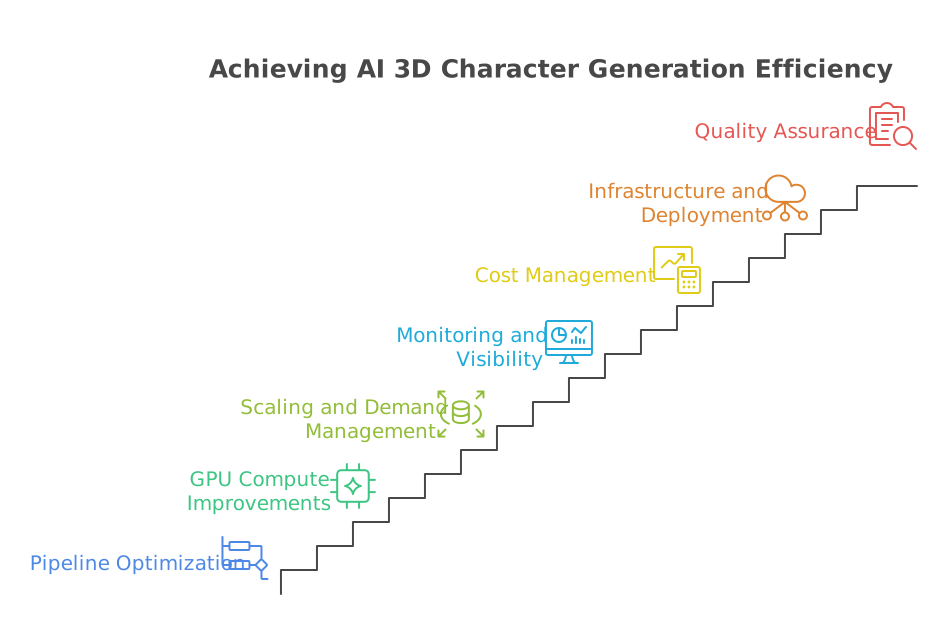
Pipeline optimization and workload orchestration
Example workflow:
2D Image → T-Pose Generation → Background Removal → Mesh + Texture (Tripo3D) → Multi-view Screenshots → Front-Facing Detection → Joint Estimation → Rigging → Motion Retargeting → Optional Rendering → Animated 3D Character
Key improvements:
- Stage-wise bottleneck analysis
- Parallel execution of independent tasks
- Reduced waiting time between processing stages
- Workload-aware compute assignment
- Intelligent routing of generation jobs
- Faster character generation while maintaining output quality
GPU compute improvements
The system improved GPU usage across the platform:
- Evaluation of multiple GPU instance families
- GPU memory tuning for higher processing capacity
- Batch processing for concurrent requests
- Shared GPU usage for lighter workloads
- Continuous monitoring of GPU performance
Scaling and demand management
- The platform introduced intelligent scaling capabilities:
- Queue-depth-based scaling policies
- Predictive scaling for traffic spikes
- Automated scale-up and scale-down actions
- Compute pool tuning for workload demands
- Load balancing during peak request periods
This allowed the AI 3D character generator platform to process larger request volumes while maintaining consistent performance.
Monitoring and visibility
The platform introduced detailed monitoring across every stage:
- Real-time processing dashboards
- Stage-level performance tracking
- Infrastructure utilization monitoring
- Cost-per-request visibility
- Automated performance alerts
- Operational logging and diagnostics
Cost management
The system balanced processing speed and infrastructure spend through:
- Usage-based forecasting
- Compute utilization tracking
- Spot instance evaluation
- Budget monitoring
- Cost versus performance benchmarking
Infrastructure and deployment
The platform uses a scalable cloud architecture:
- AWS ECS and EC2 for compute orchestration
- GPU-enabled AWS infrastructure
- AWS Lambda for event-driven processing
- Amazon S3 and EBS for storage
- Python-based backend services
- CloudWatch for monitoring
Quality assurance
Validation focused on speed, stability, and scale:
- Pipeline bottleneck testing
- Load testing under changing demand
- Concurrent request validation
- Scaling policy verification
- End-to-end processing benchmarks
- Infrastructure stability testing
- Cost projection validation
Impact
- 60-75% reduction in end-to-end processing time
- AI 3D character generator processing time reduced from approximately 7 minutes to 3-4 minutes
- 30% or higher improvement in GPU utilization
- 70% higher concurrent processing capacity
- Improved scalability during peak demand
- Faster delivery of animated 3D characters
- Stable infrastructure performance at larger workloads
About
Before Gen AI and after Gen AI
"By improving infrastructure, GPU performance, and scaling strategies, Claythis reduced character generation times and expanded the capacity of its AI 3D character generator platform."
Prashanna Rao, Head of Engineering, GoML
Key takeaways for AI 3D character generator platforms
Common challenges
- Long character generation workflows
- High GPU infrastructure costs
- Processing delays during demand spikes
- Balancing generation speed with infrastructure spend
Practical guidance
- Measure performance at every stage of the generation pipeline
- Address infrastructure bottlenecks before modifying AI models
- Use predictive scaling for changing workloads
- Track cost per generated asset
- Match GPU resources to workload requirements
Ready to build AI 3D character generator platforms
Partner with GoML to build scalable AI 3D character generator systems that accelerate character creation, support larger workloads, and reduce processing times using Gen AI with AI Matic.