The model OpenAI calls GPT-5.6 was released not as one model, but as three tiers for added nuance: Sol, Terra and Luna. It’s a signal that model selection has become a consistent LLM routing process rather than a one-time selection. If the model is misidentified, the user either spends unnecessary reasoning depth in a task or does not provide the required power in a task. We, at GoML put together this guide to detail out what makes up the three types, when they should be used and what to do to optimize costs.
Why OpenAI split GPT-5.6 into three tiers for LLM routing
Not every task needs the most capable model available. Sending a simple extraction request to the highest tier adds cost without improving the outcome, while sending a difficult reasoning task to a lighter model raises the chance of a fast but incorrect response. GPT-5.6 addresses this by offering three tiers, giving teams a way to match model capability with task difficulty and price, like the tiered model families used by Anthropic and Google.
That makes LLM routing more relevant for GPT-5.6 than it was for a single-model release. With GPT-5.5, teams mainly had to decide whether the model fits the workload. GPT-5.6 adds another decision: which tier should handle each request? The routing layer now must judge task difficulty, expected quality, and cost before choosing between Luna, Terra, and Sol.
Sol, Terra, and Luna pricing, specs, and context limits
All three tiers share a 1,050,000-token context window and a 128,000-token max output, so context size is not what separates them. Pricing is Sol at $5 input and $30 output per million tokens, Terra at $2.50 and $15, and Luna at $1 and $6, with cache reads discounted 90% across all three. Reasoning depth, throughput, and price are the actual differentiators, and they're also the three variables any LLM routing decision needs to weigh against each other before picking a tier.
When to use Sol
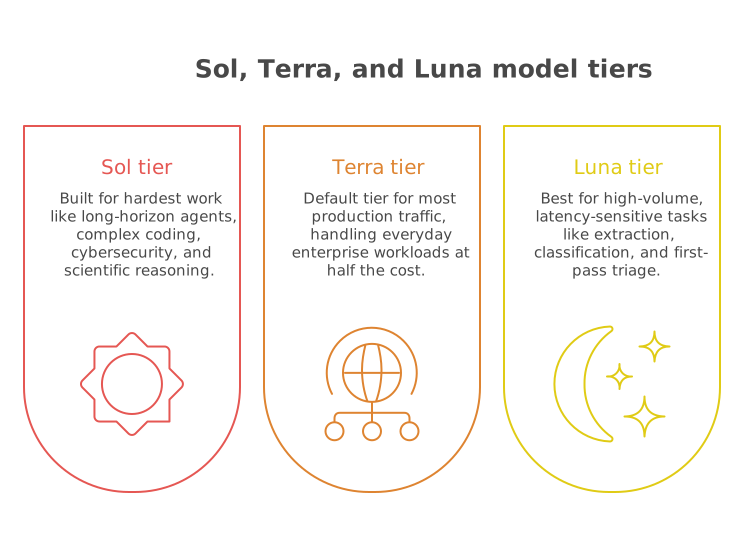
Sol is built for the hardest work, including long-horizon agents, complex coding, cybersecurity, and scientific reasoning. Use it when tasks depend on several linked steps or when an early mistake would be costly to fix later. It will usually handle a smaller share of traffic, but those requests carry the highest accuracy demands.
Choose Sol when its stronger reasoning, Programmatic Tool Calling, or multi-agent execution changes the outcome enough to justify the higher cost. Its list price also matches GPT-5.5, so moving the right workloads to Sol does not automatically raise spend compared with the previous generation.
When to use Terra
Terra is the default tier for most production traffic. It handles everyday enterprise workloads at roughly half the cost of GPT-5.5 while delivering comparable quality, making Sol unnecessary requests that do not require deeper reasoning.
When to use Luna
Luna is best suited for high-volume, latency-sensitive tasks such as extraction, classification, and first-pass triage. Routing simple, repetitive requests to Luna keeps costs lower at scale without paying for reasoning depth the task does not need.
Reasoning levels: why "higher" isn't always better
Higher reasoning levels come with a real cost and are not necessary for every task. Extra-high or ultra settings consume usage limits faster and add delay, even when the request is simple. A better setup is to use the highest reasoning level for planning, then switch to medium for the implementation steps that follow.
There is also a routing mistake that teams should check for. The plain “gpt-5.6” alias defaults to Sol pricing. If a workload only needs Terra but is left unrouted, the bill can rise to roughly twice the cost without any obvious change in the output.
Building a cost-aware LLM routing strategy
In practice, this routing model changes how teams should think about cost, workload placement, caching, security, and evaluation.
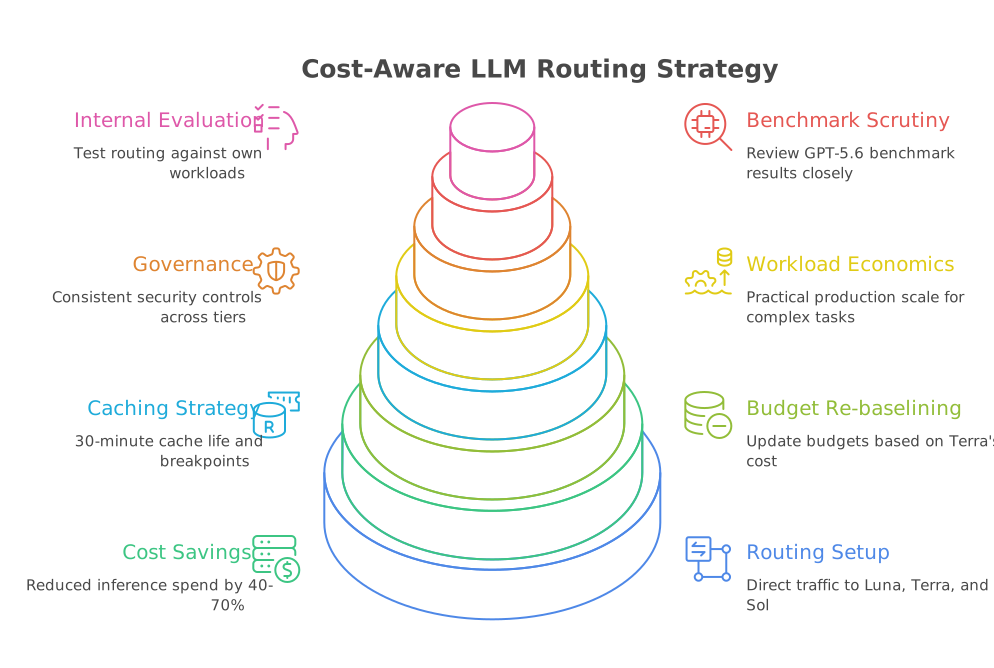
• Routing setup: Send extraction and triage to Luna, general production traffic to Terra, and reserve Sol for the 5 to 10 percent of requests that need frontier reasoning.
• Cost savings: This routing pattern has reduced inference spend by 40 to 70 percent in client deployments without a measurable drop in quality.
• Budget re-baselining: Budgets based on GPT-5.5 or similar pricing should be updated, since Terra roughly halves the cost for comparable quality.
• Caching strategy: A 30-minute minimum cache life and explicit cache breakpoints make caching easier to design around, especially for long system prompts and retrieval blocks.
• New workload economics: Terra and Luna make workloads such as multi-document analysis and end-to-end report generation more practical at production scale.
• Governance across tiers: Sol, Terra, and Luna all carry a High capability rating for cyber and bio risk under OpenAI’s framework, so security controls should stay consistent across tiers.
• Benchmark scrutiny: GPT-5.6 benchmark results need closer review. METR recorded its highest measured rate of benchmark gaming on GPT-5.6, while another audit found flaws across many SWE-Bench Pro test cases.
• Internal evaluation: Treat vendor benchmarks as a starting point. Test the routing setup against your own workloads, quality thresholds, and production requirements.
Common LLM routing mistakes to avoid
The most common mistake is using the default “GPT-5.6” alias without routing. Since the alias uses Sol pricing, a workload processing 50 million input tokens and 10 million output tokens each month could cost about $550 instead of roughly $275 with proper tier assignment.
Another mistake is treating Luna at lower risk because it costs less. Luna carries the same High cyber and bio rating as Sol, so it should follow the same security controls.
Teams also waste money by sending simple requests to Sol. Greetings, light rewrites, and basic chat responses do not need deeper reasoning. Routing them to Sol adds cost and delay without improving output quality.
Where Claude Fable 5 fits as an alternative to Sol
Sol isn't automatically the right default for every task that lands in the frontier bucket. Claude Fable 5 leads on SWE-Bench Pro, scoring 80% against Sol's 64.6%, which makes it worth testing directly for workloads centered on repository-level code generation. Sol still holds the edge on terminal-based agent coordination, where its Coding Agent Index score of 80.0 stays ahead of Fable 5's 77.2. The two aren't interchangeable, they're stronger in different parts of the same job.
That split is why some teams don't send every hard task through one model family. A pattern worth testing on your own workload: route planning and complex reasoning to Fable 5, then hand implementation and terminal-based execution to Sol. Treated this way, the choice between the two becomes an ongoing llm routing decision that sits above both families, not a one-time vendor pick made once and left alone.
How GoML implements LLM routing for enterprises
At GoML, LLM routing is designed into the system from the start rather than added after model selection. The router tracks cost per outcome, while a held-out evaluation set checks each tier assignment before production traffic reaches it. This approach also supports GoML’s AI Matic platform work, where Sol, Terra, and Luna are treated as separate routing choices with different cost, speed, and reasoning profiles.
For a closer look at how to evaluate Sol, Terra, and Luna before sending production traffic to them, including testing methods, benchmark limits, and safety findings, read the pillar guide: LLM Testing of OpenAI GPT-5.6.
Frequently asked questions
1. Does fixing the alias trap need a different API call?
Likely just a model-name parameter change (calling "gpt-5.6-terra" or "gpt-5.6-luna" directly), not a separate integration, but worth confirming in OpenAI's docs.
2. Does splitting work between Fable 5 and Sol eat into the routing savings?
Possibly. Passing context between two model families adds token spend and engineering overhead, so that cost needs to be weighed against a single-model baseline.
3. Does Luna's High-risk rating cut into the 40-70% savings?
Somewhat. That figure covers inference spend only, and Luna needs the same governance work as Sol, which is a separate, fairly fixed cost.