Claude watermarking is starting to get attention as Anthropic prepares to add watermarks to text generated by future Claude models. The change is tied to transparency rules under the EU AI Act, and Anthropic is one of around 190 companies that signed the EU Code of Practice on Transparency of AI-Generated Content.
When people utilize Claude in production work, they typically start off by asking whether this impacts the output, costs or timing of Claude’s delivery. In accordance with Anthropic’s publications, the answer is no.
How the Claude watermarking works
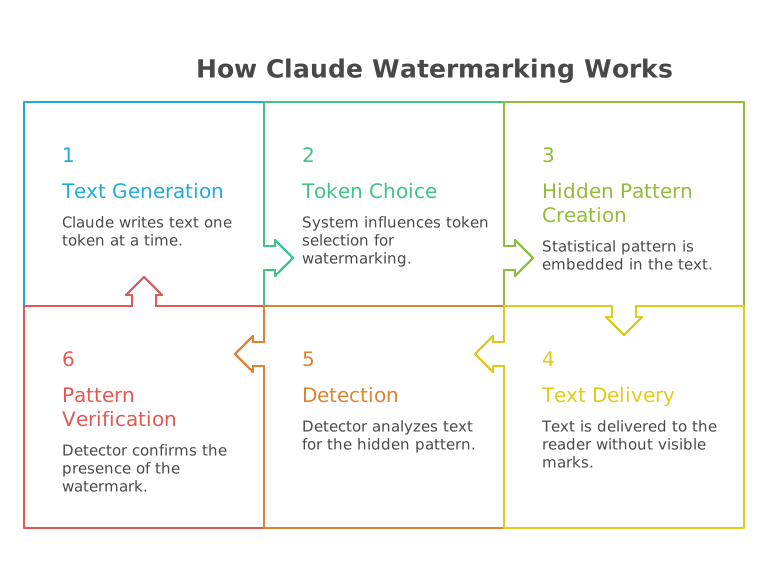
Claude watermarking is added while Claude generates text. Instead of placing a visible tag in the response, the system creates a hidden statistical pattern through the token choices the model makes. A detector with access to the matching method can later check for that pattern.
- Claude writes text one token at a time. At many points, several words can fit the sentence while keeping nearly the same meaning, such as “cold and grey” or “cold and cloudy.”
- The watermark works through these small token choices. The system slightly changes which tokens are more likely to be selected while Claude is writing.
- The reader does not see a label, symbol, hidden character, or extra word. The response looks like general text.
- The mark becomes visible only through statistical analysis. A detector checks many token choices together and looks for the pattern created during generation.
- Anthropic’s approach is connected to SynthID-Text, a method developed by Google DeepMind and published in Nature in 2024. SynthID-Text uses the earlier text and a secret value when influencing token selection.
- A single word does not reveal the watermark. Detection becomes more reliable when there is more text to examine.
- Editing can weaken the signal because some of the original token pattern may be lost. Anthropic says the watermark may remain after some editing, but the exact limits of Claude’s system have not been published.
Anthropic says watermarking does not change the meaning or readability of the response, and it does not add extra visible content.
What Claude watermarking does not tell you
This is the main piece of information relevant to governance. The Claude watermark only answers one specific question regarding the likelihood of the text having been created by Claude. It cannot determine if the text was written by a human, does not identify other machines, and does not give information on the user or organization.
- Short passages are harder to detect. With fewer token choices, the watermark leaves less evidence. Longer text gives the detector more material to assess.
- Constrained text carries a weaker watermark. When only one token makes sense, the model has little room to vary its choice. This is common in code, where exact syntax matters. Comments and other free-form text may carry more watermark evidence than executable code.
- Proofreading usually leaves little watermark evidence. If Claude only fixes grammar or wording, most of the original text remains unchanged, so only a small portion reflects Claude’s token choices.
- Editing can weaken the watermark. Minor changes may leave enough of the original pattern to detect, while a full rewrite can remove much of that evidence.
What Claude watermarking changes in enterprise delivery
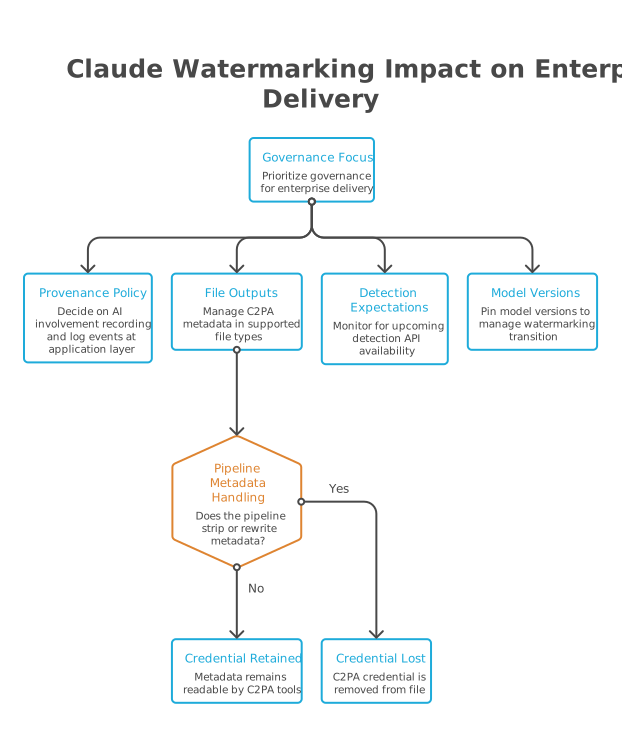
For many of the systems that we create, the runtime layer does not register any impact when it comes to retrieval pipelines and agent-based workflows. Latency targets and token registration remain unaffected. The area which needs to be focused on is governance, while the roadmap should target the four goals.
- Provenance policy. Decide per workflow whether AI involvement needs to be recorded. Watermark detection gives you evidence after the fact. It is not a record system. Log generation events at the application layer, where you control retention and audit.
- File outputs. Claude attaches C2PA content credentials to supported file types such as .png, .jpg and .svg. That is signed metadata rather than a watermark, readable by any C2PA-aware tool. If your pipeline strips or rewrites metadata, the credential goes with it.
- Detection expectations. Anthropic has said a detection API is coming and has not published implementation details at the time of writing. Treat both availability and semantics as unconfirmed until it ships.
- Model versions. Models launched before 2 August 2026 fall under a transition period, with watermarking rolling out over the following months. Which model version you pin determines what carries a mark.
The architectural read
The same principle applies to AI security. A watermark describes the text, but it does not enforce rules inside your system. If you need to prove what your software generated, keep that record within systems you control. This can include request logs, pinned model versions, output hashes, and defined retention periods. The watermark can then act as an extra verification signal for content that has already left your environment.
Prompts influence behaviour. Infrastructure enforces policy. Watermarks describe provenance, and your governance layer is what proves it.
For teams building more advanced Claude workflows, our guide to Claude agent development explains how Claude can be used in agent-based enterprise applications.
Enterprise teams do not need to re-architect their systems for Claude watermarking. They need to understand what the signal can confirm, where its limits are, and which system of record they rely on when someone asks who produced a document.
Want to build and manage enterprise AI workflows in one place? Explore the AI Matic platform from GoML.
FAQs
Does watermarking affect output quality?
According to Anthropic, there hasn’t been any impact on content, creativity or readability through internal testing. SynthID-Text work claimed there were no statistically significant alterations in user feedback when a part of Gemini’s traffic was watermarked, with testers stating there was no quality difference seen between responses.
Can a watermark be traced back to our organization?
No. The watermark does not contain information about the person using Claude, their company, or the conversation. It only indicates whether Claude may have produced the text.
Does it affect generated code?
Minimally. Where an exact token is required, the watermark is not applied. Comments and free-form text within a file can carry signal, and the effect on the code itself is negligible.
Does it change who owns an output?
No. It tests whether Claude was likely involved in producing or processing the content. It says nothing about ownership or authorship and does not alter rights under Anthropic’s terms.
Keep up with the latest in AI and ML engineering on the GoML blog.