Model Context Protocol (MCP) is an open standard that lets an AI application connect with an external system through a consistent interface. We at GoML have had 145+ production-grade deployments that leverage this tech, and here’s what we’ve learned from putting it into production. A Model Context Protocol (MCP) server sits between an AI client, such as Claude, an OpenAI tool, or an Amazon Bedrock agent, and the system it needs to access, such as a database, internal API, SaaS platform, or document repository.
In this guide, you will read about how an MCP server works, why it matters for enterprise AI, and how GoML builds it with controlled access, security, monitoring, and multi-model support. Instead of treating the Model Context Protocol (MCP) as a private tunnel built for a particular agent.
I prefer to view it as strongly controlled access to the company's systems. You develop the server once, and it can be accessed by any client interested in this service without breaking a single law.
Why Model Context Protocols (MCPs) make everything better
There is a clear difference between a good Model Context Protocol (MCP) server and a great one. A good server can handle a demo and produce the expected output when everything goes as planned.
A great Model Context Protocol (MCP) server is built for real-world use. Each response includes source and freshness details, while clear rules keep the server within its approved scope. Users confirm risky actions, call limits control usage, and sensitive data stays protected. The server is also monitored for accuracy, response speed, output format, and unexpected behavior.
Each server runs in the customer’s cloud account and stays limited to approved operations.
A good Model Context Protocol (MCP) server versus a great one
In my opinion, a reliable Model Context Protocol (MCP) server should work beyond a controlled demo. It needs to handle real-world conditions while keeping its behavior predictable and safe. It should return data with clear source and freshness details, reject requests outside its approved scope instead of guessing, and involve a human before high-impact actions. Request limits should prevent excessive use, while sensitive data needs proper protection.
The server should also be monitored for accuracy, response speed, output format and other unexpected nature. For customer deployments, it should run within the customer’s own cloud account with clear boundaries between it and other system components.
The difference becomes clear when a security team receives an unapproved request or the server must handle live data instead of test samples. A good server may need changes before approval. A strong server is designed to handle these situations without requiring major changes.
How GoML makes sure its Model Context Protocol (MCPs) hold up
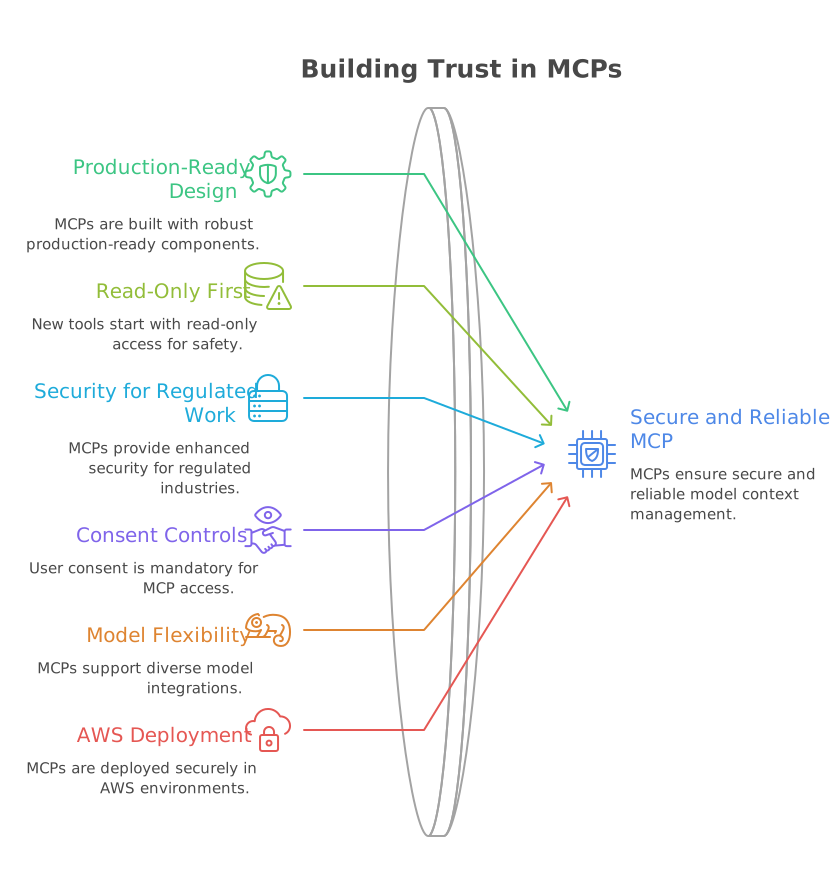
We built Model Context Protocol (MCP) servers as production systems from the start, with security, testing, monitoring, and access controls built into the design. The approach I’m breaking down here covers the full setup - all the way from system integration and model support to AWS deployment and final handover.
- Production-ready design: Each server uses a gateway, identity and consent layer, data and tool layer, policy service, evaluation, monitoring, and AWS infrastructure.
- Read-only first: New tools begin with read-only access. Tools that write data or carry higher risk require review before activation.
- Security for regulated work: Servers support healthcare, life sciences, and financial services use cases with protected data isolation, scoped access, short-lived tokens, and full activity records.
- Consent controls: Access requires user consent, which can also be withdrawn when needed.
- Model flexibility: One MCP server can work with Claude, OpenAI clients, Bedrock agents, and other MCP-compatible hosts.
- AWS deployment: GoML deploys servers as containers in the customer’s AWS account, using services such as ECS, Lambda, and Bedrock, with network isolation, rollback, tenant separation, and monitoring.
- Defined standards: Each project sets clear requirements upfront, including scope checks, defect limits, source and freshness details, and verification against customer data.
- Complete handover: Customers receive the design and threat model, Model Context Protocol (MCP) connector, security and schema package, runbook, and handover materials.
- Real-system testing: GoML tests against systems such as Snowflake, Salesforce, Jira, ServiceNow, internal APIs, document stores, and clinical or financial records instead of synthetic data.
- Tool documentation: Each completed server includes its available tools, their functions, permitted access, and sample responses.
How this approach shows up in GoML projects
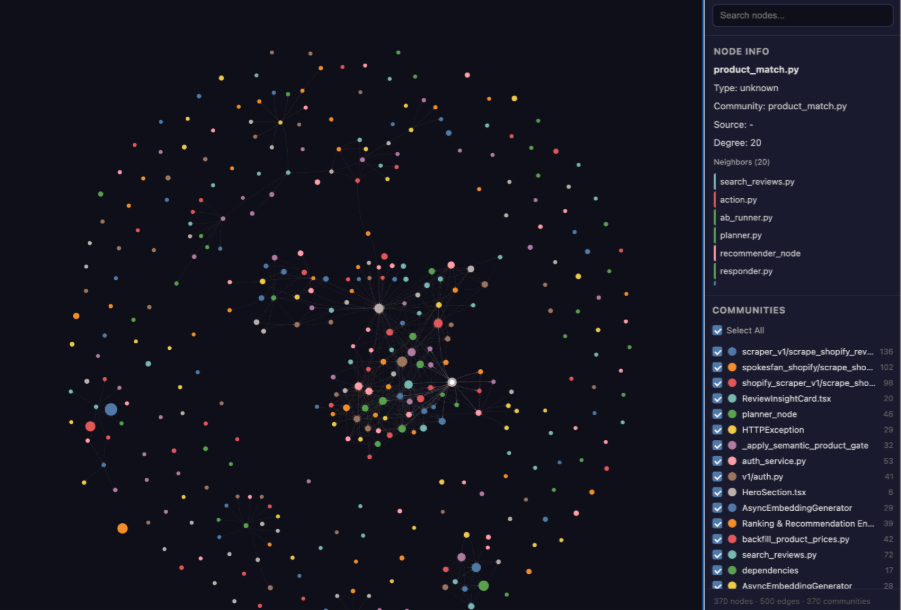
The value of Model Context Protocol (MCP) becomes clearer when the same idea is applied to real enterprise systems. A developer tool such as Graphify keeps project context available across Claude or Codex sessions. In enterprise environments, that context often sits across databases, APIs, documents, SaaS platforms, and internal applications. The challenge is giving AI systems access to it without removing the controls around the underlying data.
Paramean: Model Context Protocol (MCP) for secure access to financial and contract data
GoML used Model Context Protocol in Paramean’s AI financial assistant to provide authenticated and client-isolated access to Snowflake data and contract documents. The MCP layer gives the AI assistant controlled access to the information required for settlement investigation while maintaining clear boundaries around customer data.
Instead of connecting the model directly to underlying enterprise systems, MCP provides a defined interface through which the assistant retrieves approved financial and contractual context. This supports source attribution, auditability, and controlled access while allowing the AI assistant to work across the information required for value-based care settlement workflows.
The implementation shows the role MCP plays beyond maintaining context between AI sessions. In an enterprise environment, it becomes the controlled layer connecting AI applications with business data, documents, and tools.
The Connecter: Model Context Protocol (MCP) style tool execution for DeFi agents
GoML helped The Connecter build Glia, a multi-agent AI yield farming assistant on Amazon Bedrock AgentCore. The system includes specialized agents for strategy selection, execution, explanation, and monitoring. These agents work with external services and tools to scan DeFi opportunities and carry out actions such as token swaps, approvals, deposits, and compounding.
GoML features The Connecter among its MCP server development success stories because this type of agentic workflow depends on controlled access to external tools and actions. Instead of placing every DeFi integration directly inside the model, the tool layer gives agents defined ways to retrieve market information and execute approved operations. This structure supports the broader MCP principle of connecting agents to external systems through standardized and controlled tools.
The implementation contributed to 65% faster DeFi transaction execution and a 72% increase in user engagement.
SaluberMD: Secure tool access for agentic remote diagnostics
GoML built an agentic remote diagnostics pipeline for SaluberMD that processes clinical audio and medical images and integrates securely with its existing telemedicine backend. The system coordinates preprocessing, validation, classification, and inference while exposing the AI capabilities through secure APIs for use within existing clinical workflows.
GoML also includes SaluberMD among its Model Context Protocol (MCP) server development success stories. The project shows how the MCP approach applies to healthcare environments, where AI agents need access to clinical systems and diagnostic services without receiving unrestricted access to sensitive data. Controlled interfaces, identity and access policies, and clearly defined tool boundaries help keep the AI layer separated from the underlying healthcare systems.
The solution achieved 99% accuracy in auscultation audio classification and 95.71% accuracy in standardized medical image classification while operating on a HIPAA- and GDPR-aligned AWS architecture.
What this means for a customer choosing GoML
Working with GoML removes two common delays in AI projects. The first is rebuilding logins, permissions, audit logs, schema checks, rate limits, secret handling, and monitoring for every new agent or use case. One well-built server can support multiple agents across the company. The second is the gap between a working demo and a system people can rely on. GoML addresses this by handling security and testing early in the project rather than before launch.
Customers can use these servers for plain-language access to warehouse data with a record of who asked what, clinical or financial copilots that protect sensitive records, internal search across Jira, Confluence, and SharePoint, and operations agents that require human approval before destructive actions. These systems can also speed up contract and document review, reduce manual record searches, and keep a clear link to the source behind each response.
GoML follows a four-week path to deliver a working, secured MCP server in the customer’s AWS environment. Ongoing support is available for new tools, updates, and maintenance as customer systems change.
AI Matic and the GoML engineering vision
Consistency across projects comes from AI Matic, GoML’s internal delivery framework.
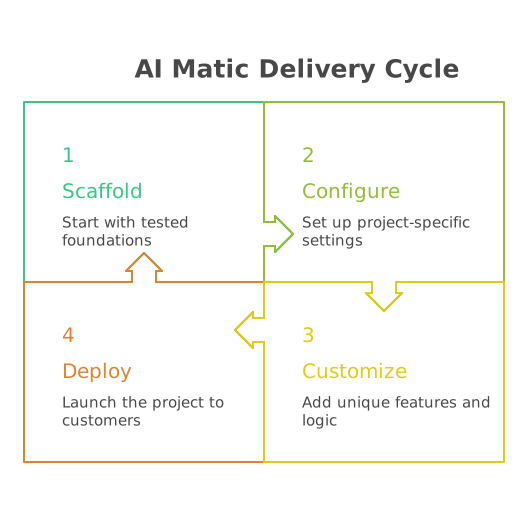
AI Matic is not a product customers buy. It is the system GoML’s engineers use across projects. It includes service templates, shared libraries, reusable architecture patterns, standard AWS infrastructure, governance controls, and monitoring practices. Projects start with tested foundations instead of empty repositories, with model access, authentication, response policies, evaluation hooks, and deployment setup already in place.
The delivery process follows four steps: Scaffold → Configure → Customize → Deploy. Customer-specific work is added through tool schemas, scopes, prompts, and guardrails without changing the standard structure or built-in controls. Using the same layout and conventions across projects helps maintain consistent quality as the team grows.
The goal is simple: solve the repeated engineering work once so each new project can focus on what is specific to the customer.
Results, and why this beats the alternatives
Most AI projects stall somewhere between a working demo and something people use every day. Reports on this put the failure rate above 85% for a lot of these efforts. GoML's numbers run the other way: most of its projects make it into daily use, because the security, testing, and operational pieces are present from the start rather than added at the end.
Compared to building this in-house, or hiring a general AI consultancy, the difference comes down to speed without giving up control. Nothing here asks a company to trade oversight for a faster launch, and nothing to be rebuilt from nothing on the next project. What ships is already being watched, already leaves a record of what happened, and already lives inside the company's own cloud account.
The bottom line
A good Model Context Protocol (MCP) server connects an agent to a system. A great MCP server becomes reliable infrastructure that an organization can trust across teams and agents for years. GoML builds this kind of MCP server with strong security, support for multiple model providers, and AWS deployment. GoML can have your MCP server ready within four weeks and follows the same careful process for every project.
Through its MCP server development services, GoML helps enterprises move from initial architecture to a production-ready MCP server in four weeks.
Contact GoML to discuss your MCP requirements.
FAQs
Does this work with AI providers other than Claude?
Yes. GoML builds MCP servers on the open Model Context Protocol standard, so the same server can work with Claude, OpenAI clients, Amazon Bedrock agents, and other MCP-compatible hosts. This keeps enterprises from tying their MCP infrastructure to a single AI provider.
How long does it take to build and launch an MCP server?
GoML follows a four-week delivery path to design, secure, test, and deploy a working MCP server inside the customer’s AWS environment. Ongoing support for new tools, integrations, updates, and maintenance is available after launch.
Is MCP safe for healthcare, financial, or other sensitive data?
Yes. GoML designs MCP servers for regulated environments with scoped access, data isolation, audit logging, and strict controls around sensitive information. New tools start with read-only access, while write actions or higher-risk operations go through additional review and approval before they are enabled.