With AI involved, most digital learning systems can now deliver content, but very few can adapt in real time. Very few can assess the requirement mid-conversation, and then assemble multimodal learning assets dynamically. This platform was deployed by the GoML team to close that gap - by combining conversational intelligence, retrieval-augmented generation, quiz interactivity and media orchestration into a single production workflow.
The result is an AI-native education engine that can:
- Respond conversationally with context-aware guidance,
- Generate long-form study materials tuned to learner context,
- Create and evaluate quizzes during live chat,
- Map or generate images/videos for topic reinforcement, and
- Persist learning interactions for continuity, scoring, and analytics.
Architectural blueprint
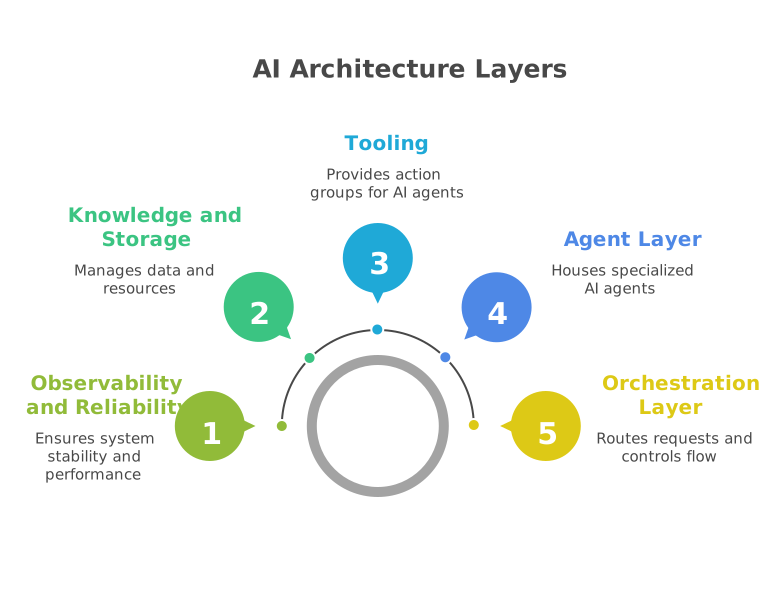
The system follows a layered architecture with clearly defined responsibilities:
- Interaction Layer: Real-time learner interface over persistent bidirectional communication channels, plus streaming endpoints for long-form generation.
- Orchestration Layer: Intent routing and flow control across specialized AI agents.
- Agent Layer: Dedicated agents for diagnostic tutoring, quiz generation/evaluation, and content creation.
- Tooling Layer: Modular action groups for image/video mapping, knowledge retrieval, and contextual utility actions.
- Knowledge and Storage Layer: Vector retrieval infrastructure, object storage for media, document/interaction persistence and session/cache infrastructure.
- Observability and Reliability Layer: Logging, health controls and resilient execution patterns.
This separation is what makes the system both extensible and operationally manageable under real-time load.
Core interaction model: dual-path learning experience
The platform intentionally implements two distinct runtime paths:
1) Conversational path (Real-Time)
Used for diagnostic chat, clarifications and quiz interactions.
This path optimizes for low latency, incremental response delivery, and context continuity.
2) Content Generation path (Streamed Long-Form)
Used when a learner requests comprehensive study content from a learning objective.
This path optimizes for structured generation depth and progressive rendering.
By splitting these paths, the platform avoids overloading conversational latency with long-form generation while preserving a unified user experience.
Real-time conversational pipeline
The live chat implementation operates as a stateful event stream:
Connection and liveness management
- Persistent channel establishment.
- Heartbeat cycle for dead-connection detection.
- Controlled termination for stale sessions.
Deferred authentication on first message
- Session validation performed when the first payload arrives.
- Prevents unnecessary compute on unauthenticated streams.
- Maintains compatibility with external session authority.
Conversation context restoration
- Recent message window retrieval with ordering controls.
- Conversation sanitization to ensure valid alternation patterns.
- Removal of unsafe/hidden fields before model invocation.
Intent routing by orchestrator
- Request analyzed for conversational vs quiz intent.
- Confidence-driven routing logic.
- Routing metadata attached for traceability.
Agent invocation and streaming return
- Selected agent invoked in streaming mode.
- Incremental chunks returned to learner in real time.
- Tool execution traces extracted and normalized.
Persistence and end-of-turn finalization
- User and assistant messages durably stored.
- Conversation recency updated.
- Message identifiers returned for downstream actions.
This flow provides a robust conversational substrate while preserving strict control over context hygiene and session continuity.

Orchestrated multi-agent intelligence
The platform uses role-specialized agents rather than a monolithic single-agent design.
Diagnostic Tutor Agent
Handles concept explanation, doubt resolution, and instructional dialogue.
It consumes rich session and learner context and performs retrieval-scoped grounding to reduce generic answers.
Quiz Agent
Handles both question generation and answer-evaluation interactions.
Its outputs are post-processed into strict interactive structures for frontend rendering and submission-grade assessment.
Content Creation Agent
Generates structured long-form learning material, supporting progressive stream rendering and optional media augmentation.
Why this matters
Specialized agents improve behavior determinism, reduce prompt overload, and allow independent tuning of educational goals (instructional quality vs assessment rigor vs content depth).
Quiz system: from generation to assessment loop
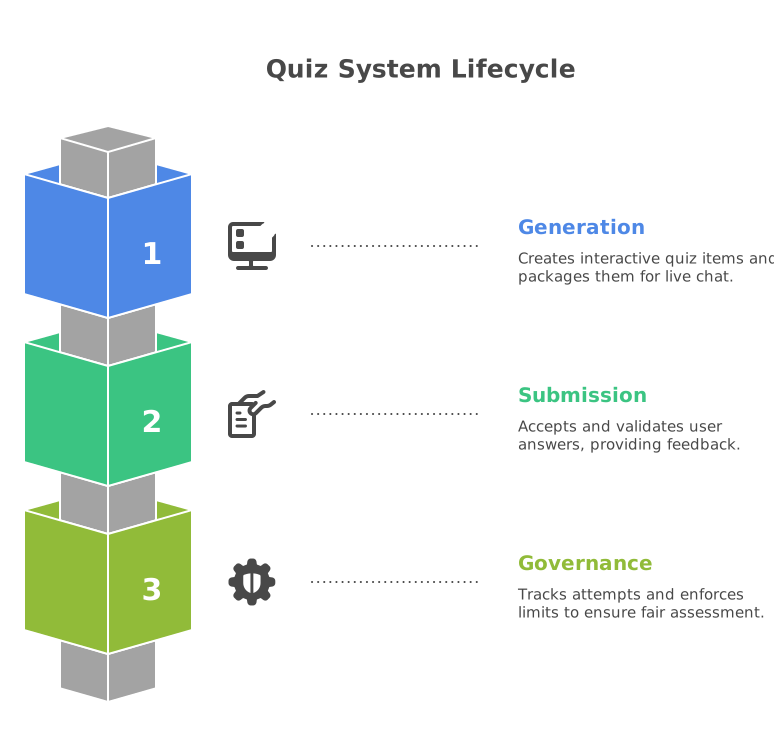
The quiz implementation is not just a generation endpoint; it is a full lifecycle engine.
Generation Stage
- Produces interactive assessment items (MCQ and fill-in-the-blank).
- Converts model output into strict typed structures.
- Assigns stable question and option identifiers.
- Packages questions for immediate live-chat rendering.
Submission Stage
- Accepts structured answer payloads.
- Validates quiz state and attempt eligibility.
- Grades each response with type-aware comparison logic.
- Generates per-question feedback and aggregate score.
Attempt Governance
- Tracks attempt sequence and history.
- Enforces maximum attempt limits.
- Deactivates quizzes once attempt policy is exhausted.
This closes the loop between teaching and formative assessment within the same conversation thread.
Retrieval-augmented intelligence and knowledge scope
The implementation integrates a retrieval layer backed by vector infrastructure to keep responses grounded in course-relevant material.
Key strategies include:
- Metadata-filtered retrieval scoping (for example by source/domain type),
- Controlled top-K retrieval limits for latency-quality balance,
- Tool-level trace extraction for explainability and debugging,
- Reusable reference metadata for transparent response provenance.
The retrieval design ensures that generated guidance remains anchored to approved instructional sources rather than drifting into generic model output.
Adaptive personalization signal
An external assessment signal is incorporated into the generation path to calibrate material difficulty and framing.
Scores are bucketed into adaptive tiers, enabling deterministic content-policy branching while still allowing model creativity inside each tier. This creates a practical personalization mechanism that is simpler than full recommendation systems yet significantly more adaptive than static content delivery.
Media Intelligence: Mapping, Fallback Generation, and Index Refresh. The media workflow combines deterministic retrieval with generative fallback:
Image/Video Discovery
- Existing assets are searched and mapped by topic context.
- Relevant references are returned with metadata-rich descriptors.
Fallback Visual Generation
- If matching visuals are unavailable, diagrammatic assets are generated.
- Generated outputs are stored as reusable learning artifacts.
Metadata and Reindexing
- Newly generated assets are tagged with retrieval-ready metadata.
- Synchronization updates knowledge indexes so future queries can reuse them.
This turns every new generation event into a long-term asset expansion mechanism.
Data model design for learning interactions
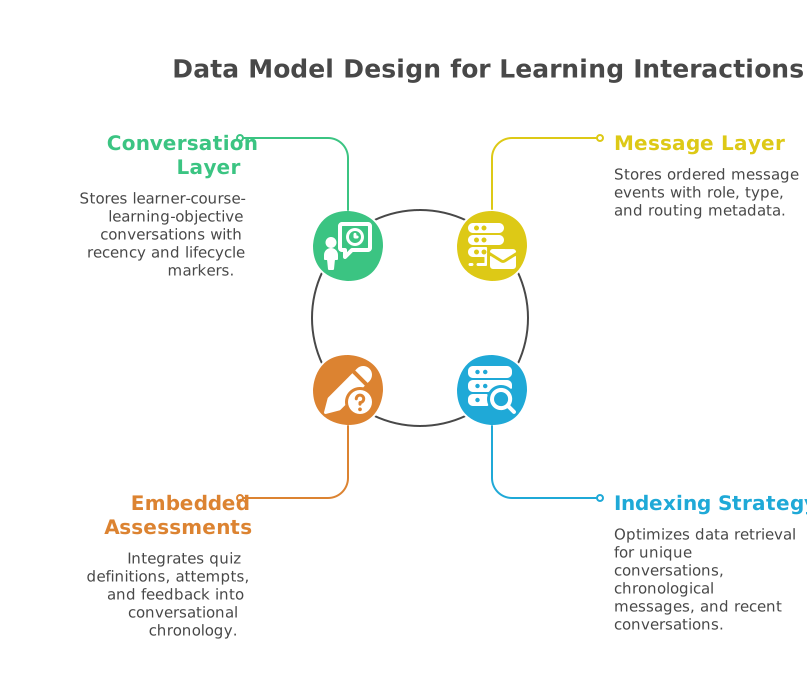
The persistence model is optimized for both real-time UX and analytics-ready history.
Conversation layer
Stores learner-course-learning-objective level conversation entities with recency markers and lifecycle flags.
Message layer
Stores ordered message events with role, type, routing metadata, and optional embedded quiz payloads.
Embedded assessment structures
Quiz definitions, choices, attempts, feedback objects, and scoring snapshots are embedded where they naturally belong in conversational chronology.
Indexing strategy
Indexes support:
- Unique conversation lookups by learner/course/objective context,
- Chronological message retrieval,
- Efficient quiz-message discovery,
- Recent conversation listing by learner.
This schema design balances query efficiency, write simplicity, and high-fidelity learning trace retention.
Session, authentication, and authorization model
The platform uses a federated session-validation strategy:
- Authentication authority remains with an upstream application,
- Sessions are validated on-demand from a shared session store,
- Protected operations enforce session presence and integrity checks,
- Cloud services are authorized through infrastructure-level identity and permission controls.
This approach allows the AI service to remain stateless at the edge while still enforcing user-bound access semantics.
API contract and transport strategy
The interface strategy intentionally uses both streaming and request-response modes:
- Real-time channels for interactive tutoring and quiz exchanges.
- Streaming content generation endpoint for long-form instructional output.
- Submission endpoint for quiz grading and feedback.
- History and scoring endpoints for lifecycle operations and learner interaction continuity.
The combined transport design aligns protocol behavior with workload shape: low-latency chat events versus heavier generation payloads.
Performance and availability engineering
The implementation targets real-time responsiveness and high service continuity through:
- Autoscaling-aware service decomposition,
- Cache-backed session and response acceleration,
- Replicated state infrastructure for critical stores,
- Global delivery optimization for media assets,
- Failover-conscious deployment architecture.
Availability goals are supported by redundancy in data and session tiers and by infrastructure rebuild readiness.
Reliability and failure handling patterns
The system employs explicit failure semantics across all critical boundaries:
- Structured validation errors for malformed payloads,
- Sanitized internal-failure responses for dependent service failures,
- Resilient behavior when historical data retrieval fails,
- Connection health enforcement via heartbeat logic,
- Traceable error logs with correlation context.
These patterns prevent silent degradation and make incident response substantially faster.
Configuration and environment strategy
Configuration is split between shared baseline settings and environment-specific overrides.
Sensitive values remain environment-bound, while stable defaults remain centrally versioned.
Operationally critical configurable domains include:
- Agent identifiers and aliases,
- Model choices for orchestration and structured post-processing,
- Attempt policies for quizzes,
- Data store connectivity,
- Endpoint base URL behavior by environment.
This separation enables predictable promotion across development, user testing, and production stages.
Deployment topology and runtime posture
The implementation supports staged environment progression:
- Local development for rapid iteration,
- User-acceptance deployment for validation and signoff,
- Production hardening for live learner traffic.
Runtime assumptions include modern Node execution, package-managed builds, and managed access to persistence and AI dependencies.
This keeps deployment reproducible while preserving flexibility across infrastructure providers.
Observability and operational diagnostics
Operational confidence depends on deep tracing of AI and tool workflows.
The platform captures execution context across:
- Routing decisions,
- Agent invocation lifecycle,
- Tool execution metadata,
- Session/auth outcomes,
- Storage and retrieval boundaries.
With correlation-aware logging, teams can rapidly isolate issues in intent routing, retrieval quality, or quiz evaluation logic.
Accessibility and learning experience considerations
Beyond technical correctness, the implementation is built for educational usability:
- Real-time feedback loops improve learner engagement,
- Mixed media output supports diverse cognitive preferences,
- Streaming responses reduce perceived latency,
- Structured quiz feedback supports mastery-oriented progression,
- Accessibility compliance validation is built into QA expectations.
This ensures that technical architecture serves pedagogical outcomes rather than existing as infrastructure alone.
Strategic outcomes
This platform demonstrates a production-ready pattern for AI-native education systems:
- Conversational tutoring + assessment in one continuous flow
- Grounded generation through retrieval-aware orchestration
- Dynamic media augmentation with fallback intelligence
- Durable learning-state persistence for continuity and analytics
- Configurable multi-environment operations with governed AI controls
In effect, it moves from “chatbot for education” to a real-time instructional operating system capable of teaching, assessing, adapting, and evolving with each learner interaction.
Keep up with the latest in AI system implementation on the GoML blog. Stay tuned for more engineering content.
.jpg)