Anthropic has announced a new enterprise AI services company backed by a $1.5 billion investment. Anthropic has said that this is an effort focused on closing the gap between AI prototypes and production systems - by embedding Anthropic’s applied AI engineers directly within client teams. This is good news for the industry and great validation for us at GoML, as this has been, almost verbatim, our mission for the last three years.
The GoML founding team, Rishabh, Jack and Siva, recognized very early that enterprises were hitting a wall with demo-grade AI that couldn't handle real-world data complexity or strict compliance standards. GoML, as an AI systems engineering and implementation company, has filled a void for 200+ organizations that had the vision for AI but lacked the specialized engineering discipline to deploy it safely.
The need for an enterprise AI services company
Anthropic launching an enterprise AI services company is a necessary response to the reality that foundation models are not ‘plug-and-play’ solutions for business needs. This space has moved with incredible velocity - 2023 was defined by the ‘Year of the POC’, where popular focus centered on simple wrappers and basic prompt engineering to prove initial feasibility. By 2024, the trend shifted toward RAG (Retrieval-Augmented Generation) as organizations sought to ground models in their own data, yet many still struggled to move these experiments out of the lab.
Today, the state of the market has matured into a demand for production-grade AI systems that can autonomously handle complex business logic within regulated environments. While a model provides the intelligence, a specialized services firm provides the nervous system - the integration, security and domain-specific logic that allows AI to function reliably at scale.
Enterprises have realized that scaling AI requires more than just an API key. It requires a partner who understands the friction of legacy infrastructure and the nuances of high-stakes workflows.
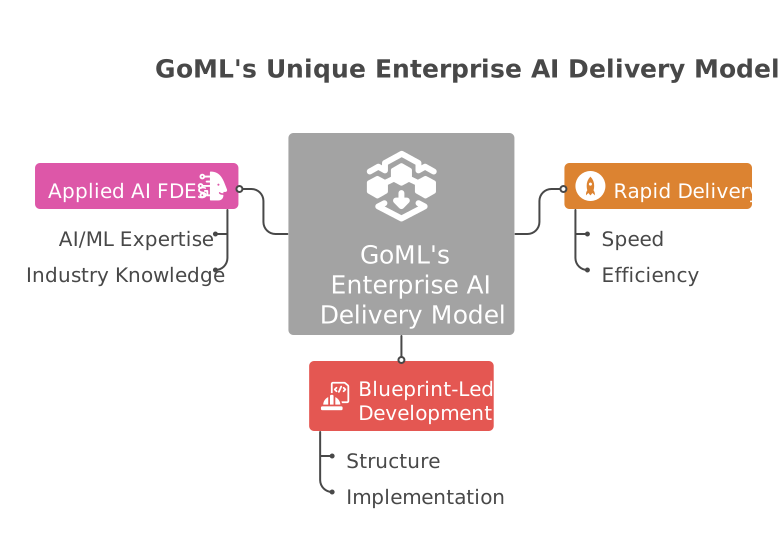
GoML’s business has been built around this need. While solving this need, we recognized that enterprise AI services are fundamentally different from traditional AI services. We honed our differentiation into a unique delivery model that has been built for AI delivery, from the ground up. In many ways, we are the anti Accenture of enterprise AI services. We focus on:
- Rapid delivery
- Blueprint-led AI systems development and implementation
- Applied AI FDEs with deep AI/ML and industry expertise
Blueprints for faster enterprise AI services delivery
Our expertise has been forged through the delivery of over 200+ production-grade projects across high-stakes industries like healthcare, finance, ISV, manufacturing, and others. In our engineering war rooms, we've spent thousands of hours perfecting the technical blueprints required to break through the ‘production wall’ that often halts deployment in high-stakes environments.
This journey led to the creation of AI Matic - our powerhouse delivery blueprints engineered to transform pilots into production-ready systems with unprecedented rapidity. The effectiveness of the AI Matic framework is demonstrated by its successful implementation across more than 200 production deployments, proving its ability to meet the most rigorous enterprise demands.
AI Matic utilizes six specialized blueprints that increase the efficiency of base builds by 10X, ensuring that observability, explainability and cost-governance are integral to the system being built - right from the start. These include:
- Agentic Workflows
- Content Generation
- Data Analytics
- Conversational Agents
- Document Intelligence
- Data Synthesis
These solution blueprints combine with our industry blueprints to ensure that enterprises can skip many months of foundational engineering in their AI transformation journey.
Our deployment in the aviation sector demonstrates how we leveraged our Agentic Workflow Accelerator to transform complex airline data into a production-ready fuel optimization system. This breadth of experience allows us to navigate the unique requirements of the AWS ecosystem, utilizing tools like Amazon Bedrock and SageMaker to build stateful, production-scale runtimes.
While developing an AI prototype serves as a vital first step in proving a concept, scaling that same vision to handle millions of transactions under strict regulatory scrutiny is where the real engineering challenges begin. In high-stakes industries, the production wall consists of very real hurdles. Things like hallucination management, latency at scale and cost-predictability to name a few. We have frequently dissected these exact challenges in our goBuild episodes, where our AI/ML architects dive deep into the technical friction points that require a disciplined approach to move from lab to live environment.
A battle-tested framework like AI Matic is necessary because it treats AI as a core component of the enterprise software stack rather than a standalone experiment. It demands the same, if not higher, rigor as any legacy database or cloud architecture. By using a framework-driven approach, we ensure that every deployment inherits the security protocols and architectural best practices we’ve refined over 200+ global projects.
Model flexibility as an enterprise AI systems design choice
The last 18 months have revealed a critical requirement for the modern enterprise - and that is the need for model flexibility. We have worked with numerous organizations looking to migrate workloads from OpenAI to more sovereign or specialized environments. This trend clearly highlights why enterprises must avoid vendor lock-in while setting up their Gen AI engine. Whether it’s moving a high-latency task to a smaller, more efficient model or shifting a complex reasoning task to a newer edition, the underlying infrastructure must remain agile. While Anthropic's enterprise AI service may offer deep delivery expertise, such services are often naturally confined to their own proprietary models, creating a new form of ecosystem lock-in.
GoML draws a direct parallel here to the AWS ecosystem. By leveraging Amazon Bedrock and SageMaker, we enable our clients to utilize open weight models and multi-model strategies. This ensures that as the frontier of AI moves, our clients can swap the "brain" of their application without rebuilding the entire "nervous system". As an enterprise AI services company, our role is to protect that agility, ensuring that our partners always have access to the best-performing models for their exact use case.
We have successfully deployed systems utilizing a diverse range of foundation models - including Anthropic’s Claude, Meta’s Llama, Mistral and Amazon Titan - to ensure our clients maintain model sovereignty. This approach was instrumental for Atria Health, where we implemented an intelligence layer that allows their teams to analyze clinical data using the most effective model for specific medical sub-tasks.
By treating models as interchangeable components rather than the foundation itself, we ensure that an enterprise's AI investment remains future-proof, cost-optimized and resilient to the rapid shifts in the frontier model landscape.
Applied AI FDEs for rapid enterprise AI services delivery
Our Forward Deployed Engineers (FDEs) operate as specialized technical pods that establish Day 1 working baselines for production-ready systems. Unlike provider-specific teams whose implementation experience is restricted to a single model's capabilities, our FDEs bring a broader perspective forged through delivering over AI systems across diverse architectures.Every architect and engineer in this unit has delivered at least five production AI systems, providing the senior expertise needed for complex model evaluation and fine-tuning.
They bring AI Matic’s pre-orchestrated solution blueprints, which allow teams to bypass architectural bottlenecks and bake in enterprise-grade governance from the start. This engineering-first approach has achieved an 82% success rate in moving POCs to production in the latter half of 2025, compressing the typical multi-year delivery cycle into a 63-day average enterprise AI services project.
A healthy evolution for enterprise AI services delivery
Enterprise AI services delivery is rapidly maturing, moving away from simple wrappers and toward complex, agentic orchestrations. The entry of massive capital from firms like Blackstone and Goldman Sachs into this category is a very positive signal for the entire ecosystem. It validates that the industry is finally prioritizing engineering execution over conjecture.
And here at GoML, we welcome this competition. It makes the space healthier and sets a higher bar for what production AI really means. We are proud to have been at the forefront of this shift for the last three years, and we look forward to continuing to build the invisible, robust infrastructure that powers the next generation of enterprise intelligence.
To see how we move Gen AI from POC to production, explore our latest AI case studies and technical insights.