For those building with AI, it's well understood that modern AI agent systems are inherently complex by design. Most setups rely on separate models for vision, speech and language. Each model processes its own input and passes results to the next step in the workflow.
However, this approach tends to slow the system down while increasing coordination effort - and often breaks context between modalities.
NVIDIA’s Nemotron 3 Nano Omni takes a different approach to this problem. It brings all three capabilities into a single model - reducing delays, lowering system overhead and keeping context intact across tasks.
What Is Nemotron 3 Nano Omni?
Nemotron 3 Nano Omni is an open multimodal AI model designed to handle perception and context within larger agent systems. It processes text, images, audio and video together in a single inference loop. Instead of sending each input type through separate models, it combines vision and audio directly into one shared entity. This removes the need for multiple model handoffs and keeps context consistent across inputs. Really a game changer!
The model uses a 30B-A3B hybrid Mixture-of-Experts Transformer-Mamba architecture. It has 30 billion total parameters but activates only 3 billion during each pass. This setup improves efficiency while maintaining strong performance. It also supports context lengths between 131K and 300K tokens, which allows it to handle long video sequences, detailed documents, and extended multi-step agent workflows without losing continuity.

Why this matters for agentic AI
As of today, enterprise agent workflows depend on multiple input types. An agent working inside a graphical interface must read on-screen text, understand layout, and respond to spoken or written instructions at the same time. Until recently, this required chaining separate models for vision, speech, and language, each running in sequence.
Nemotron 3 Nano Omni removes this complexity to a large extent. It handles all modalities within a single model call. As a multimodal AI system, it acts as the perception layer of an agent, processing visual, audio, and text inputs together while keeping context consistent. This reduces inference steps, simplifies system design and lowers cost per task.
Performance that sets a new benchmark
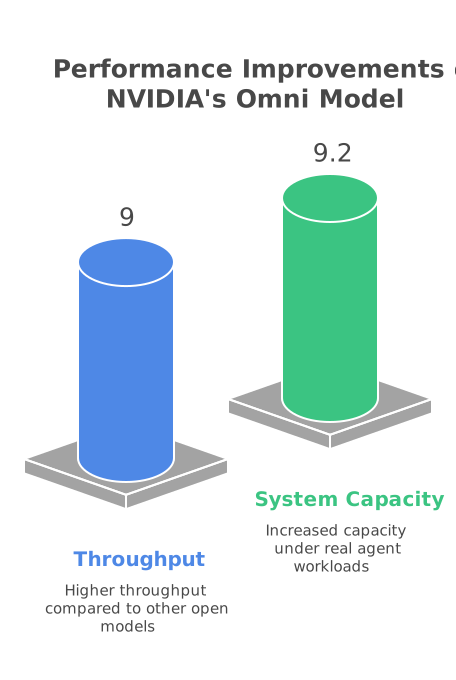
The performance improvements are dramatically better while being significant for builders. NVIDIA reports up to 9x higher throughput compared to other open omni models at similar interactivity levels. In video reasoning tasks, the model delivers about 9.2x higher system capacity under real agent workloads, not controlled benchmarks.
The model also ranks at the top across six multimodal benchmarks. These include document-focused evaluations like MMlongBench-Doc and OCRBenchV2, along with video and audio benchmarks such as WorldSense and DailyOmni. When deployed on Blackwell GPUs using NVFP4 quantization, it achieves leading throughput among open multimodal models built for enterprise use.
A modular fit within the Nemotron 3 family
Nemotron 3 Nano Omni works as part of the broader Nemotron 3 model family. It connects with Nemotron 3 Super, which focuses on high-frequency reasoning and tool execution, and Nemotron 3 Ultra, which handles complex planning. Each model plays a specific role, which creates a modular and scalable agent system where tasks stay clearly separated.
If you want to see how Nemotron 3 Super supports multi-agent execution and complements this setup, check out the detailed breakdown on the GoML blog. It explains how both models work together in real-world deployments.
Real-world applications
This multimodal AI model supports a wide range of real-world applications across industries. In finance and legal services, it can analyze contracts, financial data, and visual charts within a single context. In healthcare, it can combine patient records, voice notes, and diagnostic images to support decision-making. In media and entertainment, it enables fast processing of video and audio content at scale. For enterprises handling large volumes of documents or customer interactions, this leads to quicker responses and reduced operational costs.
Open weights, full control
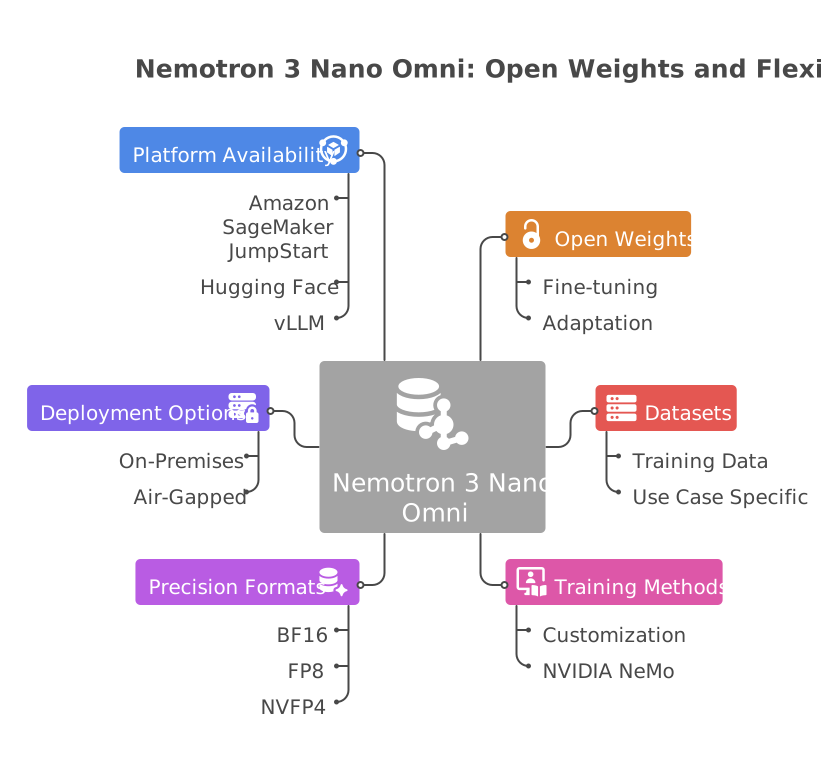
NVIDIA has released Nemotron 3 Nano Omni with open weights, along with access to datasets and training methods. This allows teams to fine-tune and adapt the model to their specific use cases. Organizations can use NVIDIA NeMo for customization and deploy the model in secure environments, including on-premises or air-gapped setups.
The model supports multiple precision formats such as BF16, FP8, and NVFP4, giving flexibility based on hardware and cost targets. It is available across platforms like Amazon SageMaker JumpStart, Hugging Face, and vLLM, which makes integration into existing AI workflows straightforward.
Final thoughts
Nemotron 3 Nano Omni marks a clear shift in how multimodal AI models are designed for agent-driven systems. It brings vision, audio, and language reasoning into a single open model, which makes deployment simpler and more cost-efficient.
For teams building production-ready agent workflows, this creates a clear opportunity to reduce system complexity while improving performance across multimodal tasks. Platforms like GoML’s AI Matic help operationalize this advantage by enabling teams to design, deploy, and scale agentic workflows on top of such models with less engineering overhead. It is a strong option to evaluate for real-world implementations.