Claude Opus 5 is the first model release in this class that enterprises can realistically approve and deploy.
Most model releases focus on capability. Enterprises review the benchmark gains, compare performance shifts, and then leave their plans unchanged. The real barrier has rarely been whether the model is good enough. It has been whether legal, security, and procurement teams are comfortable with where company data goes and how it is handled.
Anthropic released Claude Opus 5 on 24 July 2026, and AWS made it available through Amazon Bedrock and Claude Platform on AWS the same day. On Bedrock, zero data retention is enabled by default. The model is priced at $5 per million input tokens and $25 per million output tokens. For clients seeking frontier-level performance inside their own AWS environment, this is the kind of release we have been waiting for.
This is an early view. It draws from Anthropic’s published benchmarks, AWS terms, and our first rounds of testing. We have not used Claude Opus 5 in a client engagement yet. Given how recent the launch is, no one has tested it at meaningful production scale. Even so, the release gives us enough evidence to form an initial position.
Claude Opus 5 release details, in short
One: Claude Opus 5 reaches Fable territory without pricing
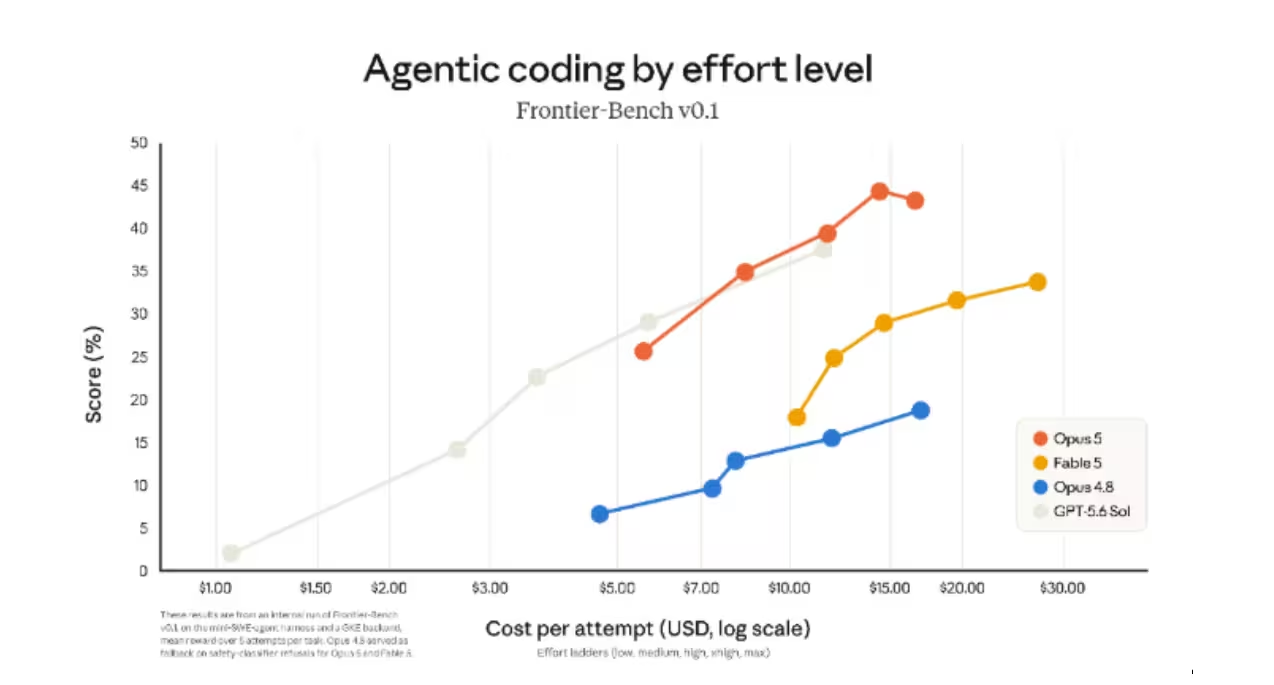
Anthropic says Claude Opus 5 comes close to Fable 5’s intelligence at half the price, and the published results support that claim. On Frontier-Bench v0.1, it scores more than twice as high as Opus 4.8 while lowering the cost per task. At max effort on CursorBench 3.2, it finishes within half a percentage point of Fable 5’s best score at half the cost per task. On ARC-AGI 3, it scores about three times higher than the next model. On OSWorld 2.0, it exceeds Fable 5’s top result at a little over one-third of the cost.
Our view is that the gap between the frontier tier and the working tier has narrowed enough to matter less for most enterprise workloads. Fable 5 still leads on some coding tests, and Mythos remains ahead of both. Yet for the work our clients pay for, document reasoning, multi-step process automation, and agentic engineering, the remaining difference is unlikely to change the business outcome. It mainly changes the ranking on a benchmark table.
The frontier tier stopped being the only place frontier work gets done.
We hold that view with a caveat we will state plainly. These figures come from Anthropic's launch harnesses and system card. Several shift materially with the effort setting. We report them as vendor claims because that is what they are.
Two: Claude Opus 5 zero data retention is the line that unblocks deals
The most consequential part of the Claude Opus 5 launch is its data handling model, yet it has received far less attention than the benchmark results.
Amazon Bedrock offers Claude Opus 5 with zero data retention enabled by default. Data remains within the selected AWS region, operator access is blocked, and the model runs inside the customer’s own AWS environment. Claude Platform on AWS also supports zero data retention on request while retaining Anthropic’s native tools, AWS billing, and AWS authentication.
Every enterprise AI project faces the same three questions from legal, risk, and compliance teams: where does the data go, who can access it, and how long is it stored? These questions have often stopped frontier-model proposals before production. Some teams moved to weaker self-hosted models. Others launched pilots that stayed in isolated test environments because legal teams would not approve the retention terms attached to the preferred model.
Amazon Bedrock addresses these concerns before the procurement review begins. The client chooses the region, owns the AWS account, and can use Bedrock Guardrails and Knowledge Bases within the same service. The discussion shifts from whether Claude Opus 5 is permitted to which workload should use it first.
One distinction needs to remain clear. Zero data retention belongs to the hosting environment, not to the model itself. Amazon Bedrock applies the same protection to the models it hosts, including Fable 5. Retention comparisons should focus on the hosting environment rather than the model name.
Three: Claude Opus 5 pricing rewrites what is worth automating
Claude Opus 5 keeps the same pricing as Opus 4.8 while delivering close to twice the performance on Anthropic’s leading coding benchmark. Compared with Fable 5, it costs half as much for both input and output tokens. Cached input costs about 90% less, while the Batch API reduces both rates by half for tasks that do not require an immediate response.
For enterprise delivery, cost per completed task matters more than token price alone. A model that resolves a ticket in four attempts can cost less than a cheaper model that needs twenty attempts. This pattern has appeared across earlier Opus releases. A low token rate does not always produce a lower final bill.
Claude Opus 5 could also make more business processes financially practical to automate. Some workflows were previously ruled out because the model capable of handling them cost more than the manual process. At this price, those workflows deserve another review. If our testing confirms the published results, the business case could be stronger than the technical case.
Effort control turns model selection from a procurement decision into a runtime parameter.
The five-level effort dial reinforces this. The same model can serve a low-latency extraction step and a long-horizon refactor, without maintaining two integrations, two prompt sets and two tokenizers. Operationally that is a meaningful reduction in surface area.
What we think enterprises should take from Claude Opus 5
Claude Opus 5 shows a working pattern that matters more than benchmark scores alone. Anthropic reports that the model built its own computer vision pipeline when it could not access a drawing directly. It also created a test harness when no live data feed was available. In both cases, the model found another way to check its work instead of stopping after producing an answer.
This matters for long-running agents. One of the most damaging failure modes in enterprise systems is a model claiming that a task is complete when the work has not been verified. A model that creates its own checks has a better chance of catching errors before they reach the user.
Early practitioner feedback points in the same direction. Theo Browne has named Claude Opus 5 his default coding model, citing less supervision, fewer corrective prompts, and more predictable behavior across real codebases. These observations come from one engineer working with his own repositories, so we view them as an early signal rather than firm proof.
Where we are cautious about Claude Opus 5
A credible point of view must acknowledge where Claude Opus 5 still falls short. Four concerns shape our current position:
• Factual accuracy: Anthropic reports a higher hallucination rate than Opus 4.8 on at least one test. Workflows where incorrect answers carry financial, legal, or operational costs need a separate verification step rather than relying on an overall model score.
• Token consumption: Lower per-token pricing does not guarantee lower total spend. Claude Opus 5 can use more tokens than Fable 5 in some agentic workflows. The final cost depends on the number of steps, retries, and tool calls required to complete the task.
• Classifier friction: Safety routing can block or redirect some legitimate requests. Agent workflows need fallback logic for these cases rather than assuming every request will return a usable response.
• Benchmark comparability: Published scores depend on effort settings, tool access, context handling, and compaction. Comparisons that leave out these conditions provide an incomplete view of how the model will perform in real workloads.
These concerns do not change our overall position on Claude Opus 5. They define what our evaluation must test before the model reaches a client environment.
.svg)
Our position
Claude Opus 5 is the release where frontier-class capability, enterprise data governance, and workable unit economics arrived together. Each would have mattered on its own. Combined, they shift the enterprise AI question from whether the model is capable enough to whether the organization is ready to assign it real work.
This is why Claude agent development now sits at the center of our AWS delivery work. We plan to use Claude Opus 5 as the lead-agent candidate, with lower-cost tiers handling retrieval, extraction, and formatting. This position remains provisional until the model passes our evaluation against real client task history. Fable 5 still holds an edge in some areas, but at twice the price, we do not expect the difference to justify the added cost for the workloads our clients run.
Frequently asked questions
Is Claude Opus 5 available on AWS Bedrock?
Yes. AWS made Claude Opus 5 available through Amazon Bedrock and Claude Platform on AWS on 24 July 2026, the same day Anthropic released it.
Does Claude Opus 5 support zero data retention?
Yes. Amazon Bedrock enables zero data retention by default for Claude Opus 5, and Claude Platform on AWS supports it on request.
How is Claude Opus 5 priced compared to Fable 5?
Claude Opus 5 is priced at $5 per million input tokens and $25 per million output tokens half of Fable 5's $10/$50 rate card, and the same rate as Opus 4.8.