The world is a lot better off with AI generated stories. It's radically changing how personalized children's books are created. For Ojje, the GoML team built a complete production pipeline that creates interactive storybooks based on an individual child's needs and preferences. Every story is paired with carefully designed illustrations, making it possible to produce large numbers of unique books that can be delivered directly to classrooms and students.
AI reduced Ojje's story creation time from 70 days to 2 days, while editing, formatting, and final review took about a day before publishing. To support more personalized storybooks, our deployment streamlined this final stage to just a few hours while maintaining quality checks, enabling faster publishing and delivery to classrooms.
Why Ojje needed more than static AI generated stories
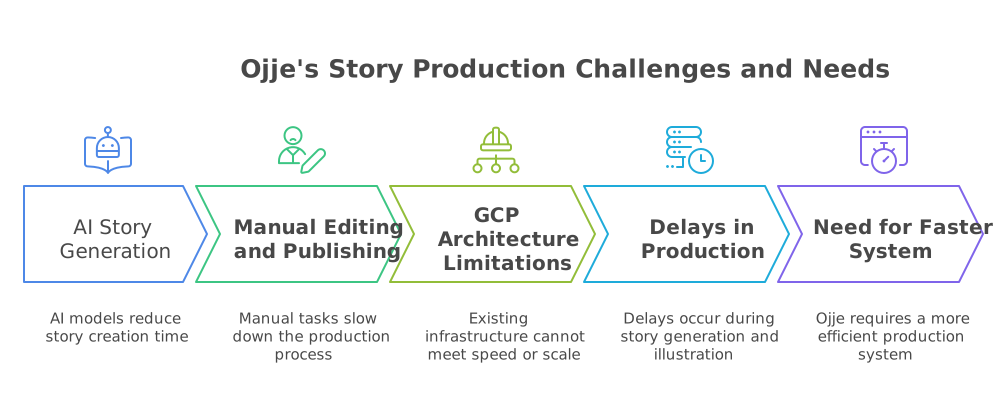
The gap between creating AI generated stories and publishing them continued to grow as Ojje expanded its platform. While generative models reduced story creation time dramatically, moving from concept to a completed book still took 1 to 2 days because of manual editing, publishing tasks, and system constraints that slowed the final stages of production.
Ojje's existing Google Cloud Platform (GCP) architecture could not meet the speed or scale needed to produce large volumes of personalized storybooks. Delays during story generation, illustration rendering, and task coordination made it difficult for the team to deliver books to classrooms and students as quickly as planned. Ojje needed a faster and more dependable production system that could reduce delays across the entire story pipeline, support a growing number of users, and maintain the quality of both the stories and the illustrations as production volume increased.
Why GoML was the right partner for Ojje
Ojje was looking for a partner that could assist in upgrading from its outdated and slow infrastructure to one that would provide a high-performance, scalable, reliable, and low-cost solution. A complete production-ready solution provided by GoML has allowed Ojje to automate and provide an end-to-end solution for creating and delivering AI generated stories from prompt to published.
In a recent episode of goLive on GoML, Adrian Chernoff, Founder of Ojje, spoke with Rishabh Sood, Founder and CEO of GoML, about how the partnership helped Ojje to create unique content at speed. Adrian noted that by partnering with GoML and using AWS, Ojje was able to create and publish 36 unique versions of each story in less than 6 minutes. This provided teachers with the resources needed to better serve their students and allow them to grow and develop their skills.
What was built into Ojje's pipeline for AI generated stories
GoML used its AI Content Generation blueprint, accelerated through the AI Matic framework, to build an end-to-end, AWS-native pipeline that automated AI for story generation, illustration creation, and publishing.
- Story generation with Amazon Bedrock: A large language model on Amazon Bedrock generated compelling, AI generated stories for children, automatically structured and adapted for different age groups, drastically reducing the need for manual input.
- Illustration generation with Midjourney: Midjourney was used to create unique, stylized illustrations aligned with each story's theme, making every storybook visually engaging while cutting down illustration wait times.
- Event-driven architecture with Lambda and SQS: An Amazon SQS queue managed task workflows for story and image creation, while AWS Lambda functions handled processing events serverlessly, keeping response times low and enabling seamless scaling.
- Scalable compute with EC2: The core application was containerized and deployed on EC2, letting Ojje manage variable workloads and launch updates quickly across environments.
- Metadata management with MongoDB: Each story's prompts, metadata, and decision paths were stored in MongoDB for flexible access, editing, and auditing.
- Durable image storage with S3: Illustrations were stored in Amazon S3 for high durability and fast retrieval during publishing.
- Monitoring with CloudWatch: Real-time visibility into function performance, errors, and usage was enabled through CloudWatch, keeping the pipeline operationally reliable.

Results
- 98% reduction in creation time for interactive, AI generated stories, from 2 days to under 1 hour
- 40% gain in efficiency through automated prompt engineering
- 50% scalability boost with AWS-native infrastructure supporting growing demand
"With GoML and AWS, we deliver 36 differentiated versions of every story in minutes, enabling teachers to reach every learner and help students build skills." ~Adrian Chernoof, Founder, Ojje
Watch the full goLive episode featuring Adrian Chernoff and Rishabh Sood to hear how Ojje worked with GoML and AWS to build a faster, more scalable pipeline for AI generated stories.
The picture of success with AI generated stories at Ojje
With publishing time cut from days to under an hour, Ojje can now produce far more personalized, differentiated, AI generated stories without being held back by infrastructure or manual review. The lesson for other publishers is to avoid leaning on manual review even after integrating LLMs, to not delay infrastructure transitions despite scaling needs, and to treat illustration as part of the automated pipeline rather than a separate, static design task.
Keep an eye out for the latest on the GoML blog to stay up-to-date with AI and ML engineering.