Every hospital has a large stack of denied claims that staff hasn't gotten around to yet. Pretty often that’s a substantial amount of money, waiting to be recovered. Statistics show that many of these denials can be challenged and won, but that involves a lot of manual effort - someone has to pull the chart, find the payer’s policy, check the contract and then write a compelling argument.
Or you can employ a cutting-edge AI denial management system like Healthintellix to do it for you... automatically.
How much revenue is stuck in denials
A recent report by Kodiak solutions tracks revenue data from 2300 hospitals. The record shows that hospitals lost $48.4B to final denials and bad debt in 2025 alone. Hospitals also spent $43B that year to collect what insurers owed them.
Another report by Premier surveyed 280 hospitals and found that close to 70% of denials were eventually overturned and paid. 70% is a promising number, especially if your team doesn’t spend more than a few hours a week to recover them.
What is AI denial management?
An AI denial management system, like HealthIntellix developed by GoML, uses machine learning and language models to find, rank and appeal denied insurance claims. It reads the remittance data and tells you all you need to know about a denied claim. Further, it scores each denial, pulls the chart and policy evidence and drafts the appeal for the reviwer to approve.
An intelligent AI recovery system like HealthIntellix works the denials you already have, which is where the recoverable revenue is sitting right now.
Why so many denied claims go unworked
Primarily, denials pile up for two main reasons - appeals take more time than most teams have, and payers keep sending new denials.
A study cited by the American Academy of Family Physicians found that majority of denied claims are never reworked. Additionally, a single denial could also end up taking several rounds to resolve.
The average hospital had 64 billing and administrative staff chasing insurer payments in 2024. The numbers have only grown each year. And the queue keeps increasing, because payers deny claims even when they go out clean.
Why do claims get denied?
A claim can pass every check before submission and still come back denied. Many denials come from the payer’s clinical review, after the claim has gone out. In 2025, clinical denials, like medical necessity and prior authorization disputes, drove nearly all of the increase in denial rates, Kodiak found.
Pre-approved care gets denied too. Premier’s survey found that 10.4% of denied claims in 2023 had already been approved through prior authorization, up from 3.2% in 2022. And many of these denials fall apart on appeal. In June 2026, the HHS Office of Inspector General reported that Medicare Advantage plans overturned 95% of appealed prior authorization denials for skilled nursing facility admissions.
Payers are also taking back money they already paid. In the first half of 2026, insurer clawbacks equaled 1.57% of accounts receivable, up from 1.38% a year earlier, Kodiak reported.
So your denial queue keeps filling, even when your claims go out clean. HealthIntellix is built to work that queue.
How AI denial management works
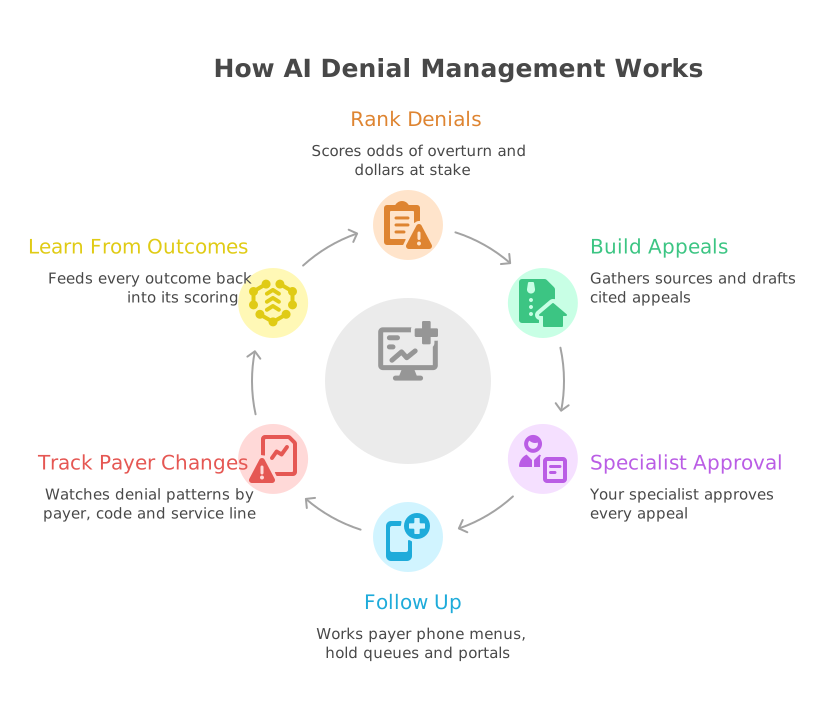
HealthIntellix runs the full recovery loop, from the moment a denial arrives to the final outcome. A specialist on your team approves every appeal before it goes to the payer.
Ranking denials by expected recovery
Most teams work denials by age, or by whatever reaches the front of the queue. HealthIntellix scores every denial on two things: the odds it gets overturned and the dollars at stake. Multiply the two and you get its expected recovery.
Take two denials, each with a 40% chance of winning. A $12,800 claim is worth $5,120 in expected recovery. A $2,100 claim is worth $840. If the smaller claim is older, an age-based queue works it first. A ranked worklist puts the $12,800 claim at the top.
Building appeals with cited evidence
Building an appeal by hand means pulling the claim, the chart, the payer’s policy, the coding guidelines and the contract. Then someone writes the argument from scratch.
HealthIntellix gathers those sources for you. It matches the chart to the payer’s own policy language and drafts an appeal where every statement cites a document. Your reviewer can check each point against its source before signing off.
Keeping a specialist on final approval
AI writes the draft, and your specialist approves it. That keeps clinical and coding judgment with the people trained for it. It also gives you a record of who approved each appeal.
Following up with payers
A lot of denial work happens on the phone and in payer portals. Someone has to check claim status, confirm what the payer needs and chase appeals that have gone quiet. HealthIntellix works the payer phone menus, hold queues and portals for your team, so your specialists can spend their time on the appeals themselves.
Tracking changes in payer behavior
HealthIntellix watches denial patterns by payer, code and service line. When a payer starts denying something it used to pay, the change shows up in your remittance data, and HealthIntellix flags it early. Your team can respond before those denials pile up.
Learning from every outcome
Each appeal ends one of three ways: paid, denied again or partially paid. HealthIntellix feeds every outcome back into its scoring. Over time, its estimates for each payer get sharper, and the most winnable denials move to the top of the list.
Benefits of AI denial management for hospitals
- More denials worked: Your team can work the whole queue, including the smaller claims that used to age out.
- Faster appeal prep: Evidence gathering and first drafts are done before a specialist opens the case.
- Stronger appeals: Every argument cites the chart and the payer’s own policy.
- Earlier warning: Changes in payer behavior show up while you still have time to respond.
- Better use of staff: Your specialists spend their time on clinical judgment and complex cases.
How to choose an AI denial management tool
These questions show you which tools will hold up in your workflow:
- Cited evidence: Ask the vendor to show you the source behind each line of a sample appeal.
- Human approval: Check that every appeal needs a named person’s sign-off before it goes to a payer.
- Prioritization: Ask how the tool ranks denials, and whether it learns from your own outcomes.
- Payer follow-up: Find out whether it handles payer phone lines and portals, or only drafts letters.
- EHR fit: Confirm it works with your EHR and reads your 835 remittance files.
- Security: Ask for HIPAA compliance, a signed business associate agreement and a recognized certification like ISO 27001.
- Outcome tracking: Make sure it records paid, denied-again and partial results by payer.
HealthIntellix cites its evidence, requires human sign-off, ranks denials by expected recovery, works payer phone lines and portals, and tracks every outcome. It works with Epic, Oracle Health (Cerner), MEDITECH and athenahealth. GoML, the AI software development company behind HealthIntellix, is HIPAA compliant and ISO 27001 certified.

How to measure results
Write down your starting numbers before you switch anything on. Then track these each month:
- The share of open denials your team worked
- Overturn rate by payer
- Days from denial to appeal filed
- Dollars recovered compared with the same period last year
Start with one high-volume payer. Run the ranked worklist on that payer’s open denials for a month, then compare recovered dollars against the queue you used before.
HealthIntellix, developed by GoML, offers AI denial recovery for health systems. Request a proposal and you’ll get it within 48 hours.
AI denial management FAQs
Is AI denial management HIPAA compliant?
It can be. The vendor has to handle protected health information under HIPAA and sign a business associate agreement with you. Ask for both before any patient data moves.
Will AI replace denial management staff?
It changes where their time goes. AI handles the sorting, the document gathering and the first drafts. Your specialists review and approve appeals and handle the clinical disputes.
Can AI write appeal letters for denied claims?
Yes. It drafts the letter from the claim, chart, payer policy and contract, and cites its sources. A person should review and approve every letter before it’s sent.
What is agentic AI denial management?
Agentic AI uses AI agents that carry out multi-step work, like ranking denials, gathering evidence, drafting appeals and following up with payers. In HealthIntellix, a specialist still approves every appeal before it’s sent.
What does AI denial management leave to your team?
Your team keeps the clinical judgment calls, the peer-to-peer reviews with physicians and the final sign-off on every appeal. Payers still set their own response times. AI speeds up your side of the process.
Do you need AI denial recovery if you already use a claim scrubber?
Yes. A claim scrubber checks claims before they go out, but payers still deny clean claims, especially on medical necessity and requests for more records. AI denial recovery works those denials after the payer says no.