
En-Pro is a leading energy cost control solution provider in North America. As part of its natural gas services, the company uses forecasting models to predict Henry Hub natural gas prices for strategic planning, risk management, and market positioning. En-Pro’s existing monthly forecasting process used seven to eight manually selected variables and achieved 78 to 79 percent accuracy. However, the process required extensive manual feature engineering, included limited macroeconomic factors, and provided little visibility into how the model reached each prediction.
Problem: Manual feature engineering limited natural gas forecasting
En-Pro’s forecasting team relied on a manually selected set of variables to predict monthly Henry Hub natural gas prices. Although its existing Random Forest model delivered 78 to 79 percent accuracy, analysts had to identify, prepare, and review each input variable manually. This process made it difficult to include emerging market factors such as geopolitical events, legislative changes, interest rates, inflation, weather conditions, supply disruptions, demand shifts, and LNG flow changes.
The model also operated as a black box. It generated forecasts without clearly explaining which variables influenced the prediction or why the forecast changed from the previous month. This made it harder for En-Pro’s advisory teams to communicate forecast reasoning to stakeholders. The company needed a natural gas forecasting solution that could recommend relevant variables, validate them quantitatively, preserve analyst oversight, and produce clear technical and market-based explanations for every forecast.
Solution: Natural gas forecasting with dynamic features and explainable AI
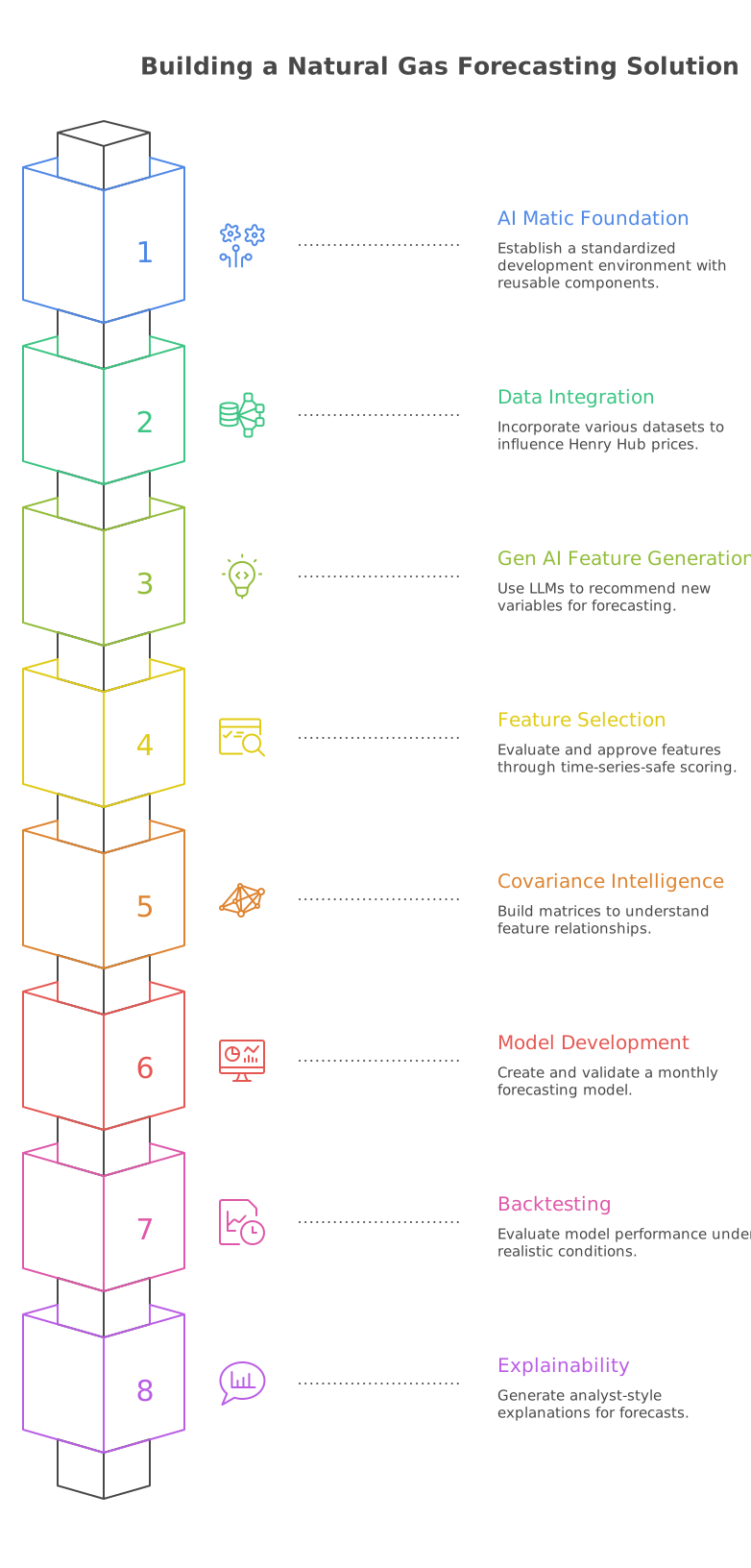
GoML used AI Matic’s AI Data Analytics blueprint as the standardized development foundation for En-Pro’s natural gas forecasting solution. The blueprint provided reusable engineering components, data processing patterns, model integrations, testing frameworks, and deployment templates for building analytics-driven AI applications.
This allowed the team to focus on En-Pro-specific requirements such as Henry Hub feature generation, quantitative feature validation, covariance intelligence, walk-forward backtesting, and post-prediction explanations.
AI Matic development foundation
GoML used AI Matic as the standardized development foundation for En-Pro’s natural gas forecasting solution.
AI Matic provided reusable engineering components, infrastructure templates, model integrations, testing frameworks, and a consistent project structure. This allowed the team to focus on Henry Hub forecasting logic, feature validation, backtesting, and explanation quality.
The AI Matic foundation supported:
• Data ingestion and feature preparation
• Amazon Bedrock and Claude integration
• Python-based forecasting services
• API and database integration
• Testing and validation workflows
• Logging and deployment configuration
GoML customized this foundation around En-Pro’s monthly forecasting cadence, benchmark definition, advisory logic, and existing KNIME process.
Henry Hub data source integration
The natural gas forecasting solution integrates additional datasets that could influence monthly Henry Hub prices.
The integration layer supports:
• Existing Henry Hub market data
• Weather information
• Supply and demand indicators
• LNG flow data
• Macroeconomic signals
• Policy and legislative indicators
• Public market reports
• Historical market events
The system aligns all approved datasets to a monthly cadence, performs quality checks, and prepares structured feature tables for model training.
Gen AI-assisted feature generation
The solution uses an LLM to recommend new variables and transformations that could improve natural gas forecasting.
Proposed feature types include:
• Historical lags
• Rolling averages and statistics
• Seasonal indicators
• Market spreads
• Variable interactions
• Weather-based signals
• Supply and demand factors
• Macroeconomic indicators
The LLM only recommends feature candidates. It does not add them directly to the forecasting model.
Dynamic feature selection and human approval
Each proposed feature is evaluated through time-series-safe scoring, walk-forward backtesting, and stability checks.
The validation process includes:
• Quantitative feature scoring
• Forecast contribution analysis
• Stability testing across periods
• Include or exclude justification
• Human review and approval
• Rejection of unsupported features
This approach combines Gen AI-assisted feature discovery with analyst oversight. En-Pro retains control over the variables used in the final forecasting model.
Covariance and correlation intelligence
The solution builds covariance and correlation matrices across candidate features.
This intelligence layer helps En-Pro identify variables that provide similar information or introduce multicollinearity.
The system supports:
• Correlation analysis
• Feature clustering
• Redundancy detection
• Diversification constraints
• Relationship shift monitoring
• Market regime change detection
This helps maintain a more stable and diversified feature set.
Monthly forecasting model development
GoML builds and validates a monthly Henry Hub forecasting model using the approved feature set.
The modelling workflow includes:
• Dynamic feature inputs
• XGBoost-based forecasting
• Python processing
• Monthly forecast generation
• En-Pro-compatible output formatting
The Proof of Concept remains limited to monthly Henry Hub natural gas forecasting. Other hubs, commodities, and forecasting frequencies remain outside the initial scope.
Walk-forward backtesting and benchmark comparison
The natural gas forecasting solution uses walk-forward or rolling-window backtesting to evaluate model performance under realistic time-series conditions.
The benchmark process includes:
• Training on earlier historical periods
• Testing against later forecast periods
• Comparison with En-Pro’s current model
• Evaluation using En-Pro’s benchmark definition
• Feature-level diagnostics
• Forecast stability checks
• Performance reporting
The Proof of Concept targets monthly accuracy above 78 percent while maintaining or improving En-Pro’s existing benchmark.
Post-prediction explainability
The solution generates analyst-style explanations after every forecasting run.
These explanations combine technical model outputs with relevant market context.
Technical explanations include:
• Feature importance contribution
• Changes from the previous forecast
• Directional influence of major variables
• Factors increasing the forecast
• Factors reducing the forecast
Market explanations include:
• Weather events
• Supply disruptions
• Demand changes
• LNG flow movements
• Policy developments
• Macroeconomic signals
The output follows En-Pro’s existing advisory narrative style, helping analysts explain forecast changes to stakeholders.
Market signal contextualization
The Proof of Concept includes a limited market context layer to support forecast explanations.
The system uses:
• Historical event references
• Public market reports
• Weather indicators
• Supply disruption information
• Available policy and macroeconomic signals
This layer supports explanation generation. It does not operate as a complete market intelligence platform.
Quality assurance and governed AI
Testing focuses on forecast accuracy, feature relevance, explanation quality, model stability, and workflow integration.
Key validation areas include:
• End-to-end workflow testing
• Feature recommendation validation
• Walk-forward backtesting
• Benchmark comparison
• Explanation quality review
• KNIME and RDS integration testing
• Human approval workflow validation
• Model stability testing
LLM-generated features are accepted only after quantitative scoring and backtesting. This prevents unsupported variables from entering the natural gas forecasting model.
Impact
• More than 78% target accuracy for monthly Henry Hub forecasts
• 50% less manual effort in feature research and evaluation
• 3x faster assessment of emerging market signals
• 30% faster preparation of forecast explanations
• Clear include or exclude rationale for proposed variables
• Stronger model stability through covariance checks
About
Before Gen AI and after Gen AI
“With Gen AI-powered natural gas forecasting, En-Pro can evaluate more market signals, maintain analyst oversight, and explain the factors influencing each monthly Henry Hub prediction.”
Prashanna Rao, Head of Engineering, GoML.
Key takeaways for natural gas forecasting teams
Common challenges
- Manual feature engineering limits the number of variables analysts can evaluate
- Black-box models make forecasts difficult to explain
- Emerging market signals are difficult to incorporate consistently
- Highly correlated variables can reduce model stability
- Random validation methods are unsuitable for time-series forecasting
- AI-generated features require quantitative checks and human approval
Practical guidance
- Use Gen AI to recommend features rather than approve them automatically
- Validate each variable through time-series-safe backtesting
- Maintain human approval for model input changes
- Track covariance and correlation across candidate variables
- Combine technical explanations with current market context
- Integrate AI capabilities with existing forecasting workflows
- Start with one market and forecasting frequency before expanding scope
Ready to improve natural gas forecasting
Partner with GoML to build a transparent and scalable natural gas forecasting solution with dynamic feature selection, quantitative validation, human oversight, and explainable market intelligence using AI Matic platform.


.avif)


