Enrichly is a digital health platform focused on improving self-esteem and mental well-being for young people aged 10 to 22. The platform works with pediatric clinics, school systems, and nonprofit healthcare organizations, combining validated assessments such as GAD-7 and PHQ-9 with digital wellness interventions.
Problem: Static workflows limited the AI mental health chatbot experience
Enrichly’s existing platform relied on manually tagged recommendation logic, content workflows, and enrollment processes. This limited the platform’s ability to personalize interventions dynamically as user context, assessment scores, and wellness needs changed.
The platform also needed an age-aware conversational experience for users between 10 and 22. Responses had to remain contextual and supportive while applying strict controls around harmful content, unsafe guidance, and inappropriate recommendations. A fragmented database structure added another challenge. Fourteen PostgreSQL tables owned by the Mesh service needed migration into the existing Aurora MySQL environment to remove cross-database references and establish a single operational data foundation.
Solution: AI mental health chatbot and recommendation engine on AWS
GoML transformed Enrichly’s existing wellness platform into an integrated AI mental health chatbot and recommendation system connecting conversational AI, user context, emotional indicators, personalized recommendations, session history, and safety controls. The implementation aligns most closely with GoML’s AI Matic platform for additional recommendation intelligence and youth-focused response governance.
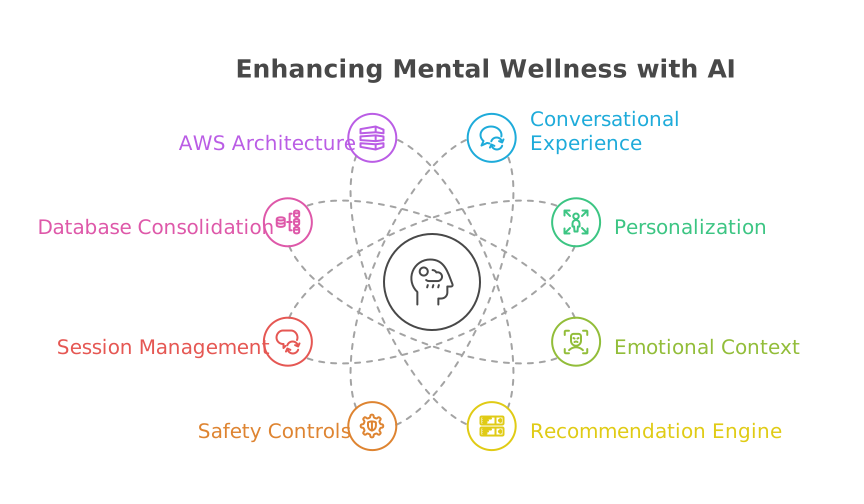
AI mental health chatbot conversational experience
GoML built a conversational layer that maintains context across interactions and adjusts responses using user information and recent conversation history. The AI mental health chatbot supports real-time communication while keeping the experience connected across sessions.
• Processes natural-language wellness conversations through Amazon Bedrock.
• Maintains multi-turn context and conversation continuity.
• Streams responses to the frontend for faster interaction.
• Uses user profile information to improve response relevance.
• Stores conversation and session history for future interactions.
AI mental health chatbot personalization
GoML developed a context builder that combines user profile information, age, conversation history, and self-esteem indicators before sending requests to the AI layer. This allows the chatbot to adjust communication and recommendations to each user.
• Classifies users into child, teen, young adult, and adult age groups.
• Uses birthday and profile attributes to build contextual prompts.
• Includes self-esteem indicators in the user context.
• Reconstructs recent conversation history for personalized responses.
• Generates a structured profile summary for AI processing.
AI mental health chatbot emotional context
The assistant analyzes conversational signals to understand the themes influencing each interaction. These indicators support personalization and recommendation selection rather than serving as clinical diagnoses.
• Detects themes such as stress, anxiety, burnout, sleep difficulties, and academic pressure.
• Infers conversational indicators related to anxiety, mood, and self-esteem.
• Combines the current message with recent history and profile information.
• Uses emotional context to improve recommendation relevance.
• Keeps AI-generated indicators separate from clinical assessments.
AI mental health chatbot recommendation engine
GoML built an AI-powered recommendation engine that connects conversational context with Enrichly’s wellness content. Recommendations depend on emotional themes, age, user profile information, previous suggestions, and available course metadata.
• Recommends courses, games, and webinars from the Enrichly content catalog.
• Filters available content according to user age before AI selection.
• Uses emotional themes and conversation context to determine relevance.
• Removes previously recommended content where appropriate.
• Returns up to three recommendations with a reason for each selection.
AI mental health chatbot safety controls
GoML integrated AWS Bedrock Guardrails into the conversational flow to govern responses before they reach users. The safety layer is especially important because Enrichly serves younger users and handles wellness-related conversations.
• Filters harmful or inappropriate content.
• Blocks unsafe mental health guidance and dangerous recommendations.
• Suppresses recommendations when guardrail intervention occurs.
• Returns a safe fallback response when generated content fails validation.
• Applies response validation before AI-generated content reaches the user.
AI mental health chatbot session management
GoML designed persistent session management so conversations do not restart without context after each interaction. User messages, assistant responses, recommendation metadata, and session information remain available for future exchanges.
• Creates or resumes an active chat session.
• Retrieves recent conversation history for context reconstruction.
• Stores assistant and user messages after each interaction.
• Maintains recommendation history across the session.
• Uses the previous 10 messages as the configured AI context window.
AI mental health chatbot database consolidation
GoML also reworked Enrichly’s backend data architecture to reduce dependency on separate database implementations. The migration moved PostgreSQL-specific backend behavior toward a MySQL-compatible architecture.
• Migrated 14 Mesh-owned PostgreSQL tables toward Aurora MySQL.
• Replaced PostgreSQL-specific SQL and ORM patterns with MySQL-compatible equivalents.
• Removed cross-database dependencies and dual-write paths.
• Consolidated application data around the primary operational database.
• Updated backend APIs to support the chatbot and recommendation services.
AI mental health chatbot architecture on AWS
The AI mental health chatbot uses a cloud-native architecture that separates frontend interaction, APIs, application logic, AI processing, and persistence. This structure supports independent scaling and clearer control over each part of the conversational workflow.
• Next.js, React, and AWS Amplify support the frontend experience.
• Amazon API Gateway manages REST and streaming endpoints.
• FastAPI and AWS Lambda handle application logic and orchestration.
• Amazon Bedrock and Claude Sonnet 4.6 handle language processing and recommendation selection.
• AWS Bedrock Guardrails provide AI response governance.
• Aurora MySQL stores user profiles, content, sessions, and conversation history.
AI Matic delivery
GoML used the Conversational AI Agent blueprint approach as the delivery foundation for Enrichly’s AI mental health chatbot, adding user-context generation, emotional-theme detection, age-aware responses, personalized content recommendations, persistent conversations, and AI safety controls.
The AWS stack includes Amazon Bedrock and Claude Sonnet for conversational intelligence, AWS Bedrock Guardrails for safety, AWS Lambda and FastAPI for backend processing, API Gateway for service access, AWS Amplify for frontend delivery, and Aurora MySQL for persistent application data.
AI Matic delivery metrics
- Average TTFV: 20 days
- Average person-days saved: 7 days
Impact
• 35–45% higher recommendation relevance.
• 50–60% less manual recommendation effort.
• Up to 60% faster perceived response.
• 30–40% fewer repeated recommendations.
• Up to 80% faster session retrieval.
About
Before Gen AI and after Gen AI
“With Enrichly’s AI mental health chatbot, GoML connected conversational AI, personalization, recommendations, persistent context, and safety controls into one AWS-based experience designed around the needs of younger users.”
Prashanna Rao, Head of Engineering, GoML
Key takeaways for AI mental health chatbot development
Common challenges
• Responses need user context to remain relevant across longer conversations.
• Younger users require age-aware communication and stronger safety controls.
• Recommendation systems need structured profile and content data.
• Conversational indicators should remain separate from clinical assessments.
• Fragmented backend data makes personalization and session continuity harder.
Practical guidance
• Build user context before sending requests to the language model.
• Apply age filters before selecting wellness content.
• Keep safety validation outside the conversational response itself.
• Store session and recommendation history for continuity.
• Use deterministic filtering before AI-based recommendation ranking.
• Keep wellness indicators clearly separated from clinical diagnoses.
Ready to build an AI mental health chatbot
Partner with GoML to build a personalized, context-aware, and safety-focused AI mental health chatbot on AWS with AI Matic.