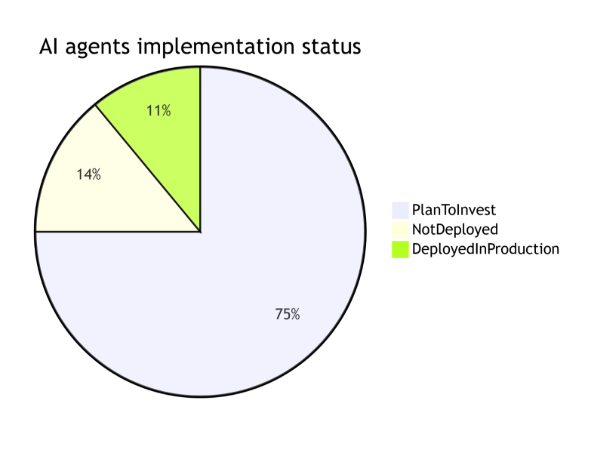
Many organizations are discussing AI agents, but agentic AI implementation remains challenging. While 75% of businesses plan to invest in AI agents this year, only 11% have successfully deployed them in production environments. This significant gap indicates a disconnect between strategic planning and practical execution of agentic AI implementation.
Understanding AI agents
AI agents represent an evolution beyond traditional AI systems. Rather than simply responding to queries, AI agents can autonomously make decisions, complete tasks, and operate with minimal human supervision.
The global AI agent market is projected to reach $45 billion by 2030. However, industry analysts predict that 40% of organizations attempting agentic AI implementation will fail by 2027. The primary reason for this high failure rate is a fundamental implementation error.
The primary failure point in agentic AI implementation
Many organizations make the mistake of applying AI agents to existing inefficient workflows. This approach is comparable to installing advanced components in a fundamentally flawed system.
Successful organizations take a different approach by redesigning their processes from the ground up.
Consider Toyota's supply chain operations. Previously, their team monitored 50 to 100 different systems to track vehicle deliveries to dealerships. Through successful agentic AI implementation, they automated this entire process. However, their success came not from simply automating the existing workflow, but from completely reimagining how the process should function.
The financial impact of failed agentic AI implementation
Despite the significant reduction in AI processing costs approximately 280 times lower than two years ago some organizations with failed AI agent projects continue to spend millions monthly.
This occurs because usage growth often outpaces cost reductions. Organizations frequently discover that infrastructure suitable for testing and pilot programs becomes prohibitively expensive when scaled to full production deployment across the enterprise.
Infrastructure requirements for agentic AI implementation
Most existing IT infrastructure was designed for traditional computing needs and is inadequate for AI agents that require continuous data access and real-time decision-making capabilities.
Leading organizations are implementing three-tier infrastructure systems:
- Cloud computing platforms for flexible AI training workloads
- On-premises servers for predictable operational tasks
- Edge computing solutions for time-sensitive local processing
This infrastructure upgrade is essential for successful agentic AI implementation. By 2026, AI model execution is expected to consume two-thirds of all AI computing resources. Organizations that fail to modernize their infrastructure will face significant competitive disadvantages.
The human element in agentic AI implementation
Contrary to common concerns about workforce reduction, 70% of technology leaders plan to expand their teams following agentic AI implementation.
However, job roles are evolving. Employees are transitioning from executing repetitive tasks to managing AI agent systems. Organizations need personnel who can oversee AI agents, make strategic decisions, and handle complex work that requires human judgment and creativity.
Forward-thinking organizations are investing in comprehensive training programs to prepare their workforce for this transition. They recognize that success requires consideration of both AI capabilities and effective human-AI collaboration.
Security considerations
AI agents present a complex security challenge. The same technology that provides competitive advantages also creates new vulnerabilities.
Cyber threats now operate at machine speed, making traditional human-monitored security measures inadequate.
The solution involves deploying AI-powered security systems, including automated threat detection and continuous monitoring, to protect agentic AI implementation effectively.
Characteristics of successful agentic AI implementation
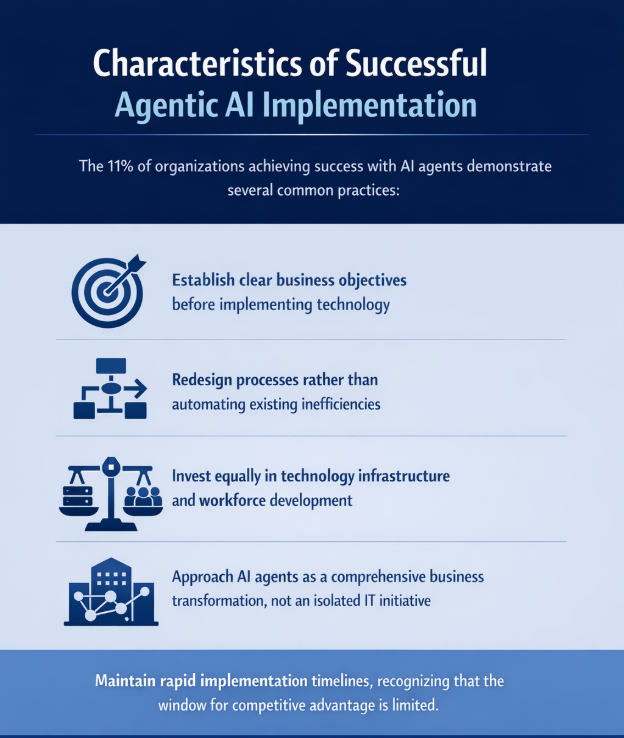
The 11% of organizations achieving success with AI agents demonstrate several common practices:
- They establish clear business objectives before implementing technology
- They redesign processes rather than automating existing inefficiencies
- They invest equally in technology infrastructure and workforce development
- They approach AI agents as a comprehensive business transformation rather than an isolated IT initiative
Additionally, these organizations maintain rapid implementation timelines, recognizing that the window for competitive advantage is limited.
Conclusion
AI agents represent current business reality rather than a future possibility. Search engines already utilize AI three times more frequently than standalone AI applications. Business software is becoming increasingly autonomous through agentic AI implementation.
Organizations that succeed will be those willing to fundamentally restructure their operations rather than simply enhance existing processes. Success requires investment in modern infrastructure, workflow redesign, workforce training, and decisive action.
The critical question is not whether AI agents will transform your organization, but whether you will lead that transformation or observe competitors gain market advantage.
The performance gap between successful and unsuccessful agentic AI implementation continues to widen. Your organization must decide which category it will occupy.
GoML’s AI Matic helps you redesign processes, deploy production-ready AI agents, and scale securely without runaway costs.