The Mythos era is officially upon us. Anthropic has launched Claude Fable 5, and it's the first generally available Mythos-class model, alongside Claude Mythos 5 - a higher-risk variant with relaxed safeguards for vetted users in cybersecurity and life sciences. Fable 5 is being positioned as Anthropic’s most capable model to date, designed for demanding reasoning, long-horizon agentic workflows and multimodal knowledge work, while Mythos 5 exposes the same underlying capabilities with fewer safety classifiers through Project Glasswing and a trusted access program.
Both models offer a 1M-token context window with up to 128k token outputs and are priced at 10 USD per million input tokens and 50 USD per million output tokens, significantly undercutting the earlier Claude Mythos Preview while targeting premium, high-value workloads
In this comprehensive breakdown of Claude Fable 5, we walk through the architecture-level behavior (adaptive thinking), capabilities across coding, knowledge work, vision and science, benchmark results, safety design (classifiers, refusals, fallback), pricing and availability and practical implications for builders.
Model positioning and taxonomy
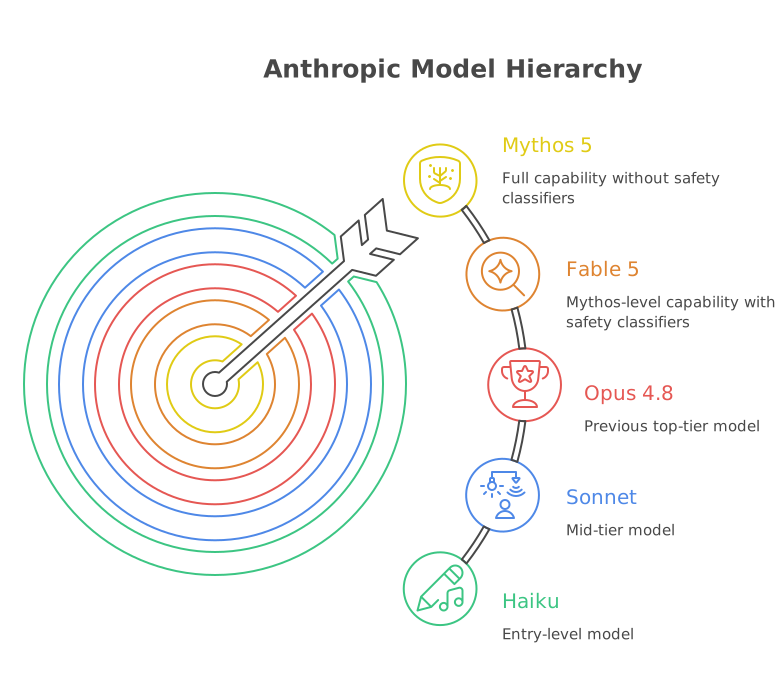
Anthropic classifies Claude Fable 5 as a Mythos-class model that extends the Claude family beyond Haiku, Sonnet and Opus, representing it as a tier above Opus in raw capability. Fable 5 is described as the most capable model Anthropic has ever made broadly available, intended for long-horizon agentic work such as autonomous coding, research and complex analytical workflows. Claude Mythos 5 is defined as sharing the same underlying model and capabilities as Fable 5 but without the safety classifiers that gate certain high-risk request categories, making it suitable only for tightly controlled partners via Project Glasswing and future trusted access programs
The key distinction between Fable 5 and Mythos 5 is, therefore, not capability but policy and routing - Fable 5 uses classifiers to refuse or route a subset of queries to Opus 4.8, while Mythos 5 exposes the full behavior in domains like cybersecurity and advanced biology to approved users. Anthropic notes that in over 95% of user sessions, Fable 5’s behavior is effectively identical to Mythos 5 because no fallback is triggered, underscoring that for most workloads Fable 5 is a practical stand-in for Mythos-level capability.
Architecture-level behavior- Adaptive thinking
On the API itself, Claude Fable 5 and Claude Mythos 5 use a single “adaptive thinking” mode rather than the multi-mode thinking configuration - previously seen in earlier models. Adaptive thinking is always on: if the thinking parameter is omitted, the model automatically decides how much internal reasoning to perform. Additionally, disabling thinking (type: "disabled") is not supported for these models. Developers control the depth and cost of reasoning through an effort parameter, which tunes how extensively the model plans, decomposes and verifies tasks internally.
Neither Fable 5 nor Mythos 5 ever returns raw chain-of-thought. Instead, the API returns either omitted thinking blocks (display: "omitted") or summarized reasoning (display: "summarized"), with the expectation that clients pass thinking blocks back unchanged in multi-turn conversations. This design aims to preserve strong reasoning performance while limiting the exposure of internal traces that could be misused for model extraction or jailbreak engineering.
Core capabilities
Long-horizon agentic work
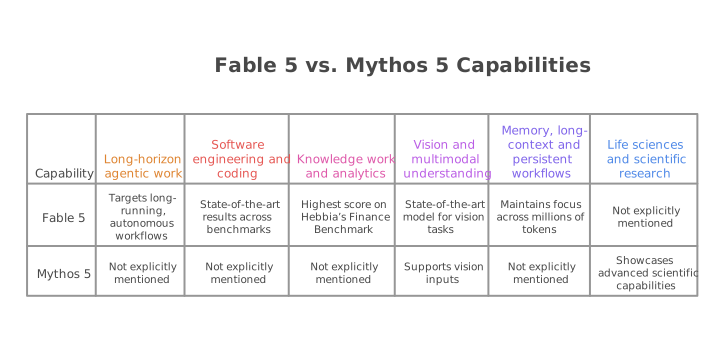
In this much anticipated release, Anthropic explicitly targets long-running, autonomous workflows as a primary use case for Fable 5, highlighting that it can work for days at a time in agent harnesses such as Claude Code. In early access deployments, Stripe reported that Fable 5 performed a codebase-wide migration in a 50-million-line Ruby codebase in about a daywork that would otherwise have required a team over two months illustrating the model’s ability to plan and execute large refactors. Benchmarks such as Cognition’s Frontier Code and independent evaluations from CursorBench and FrontierBench also report that Fable 5 leads frontier models on long-horizon agentic coding tasks, particularly when operating at medium to high effort levels.
Software engineering and coding
Anthropic states that Fable 5 achieves state-of-the-art results across software engineering benchmarks, including Cognition’s FrontierCode, where it ranks as the highest-scoring frontier model while remaining token-efficient at medium effort. This is really good news. Even external evaluations from platforms like BenchLM and third-party model hubs report that Fable 5 ranks near the top of global coding benchmarks, with particularly strong scores on SWE-bench-derived tasks and other software engineering suites. IMC and other financial-sector partners also highlight its ability to perform complex trading-analysis workflows involving factual lookup, conceptual reasoning, root-cause analysis, and expected-value analysis.
Knowledge work and analytics
In knowledge work, Anthropic cites Hebbia’s Finance Benchmark for senior-level reasoning, where Fable 5 achieves the highest score among evaluated models, especially on document-based reasoning, chart and table interpretation, and complex problem solving. Early enterprise adopters report that Fable 5 meaningfully improves performance on long-running analytical workloads, with one analytics provider noting that Fable 5 was the first model to surpass 90% on a core analytics benchmark of complex, multi-step tasks a ten-point improvement over Claude Opus 4.8, while completing runs in fewer turns and 25–30% less time.
Vision and multimodal understanding
Fable 5 is being described as Anthropic’s new state-of-the-art model for vision tasks too, with the ability to extract precise numeric values from dense scientific figures and to reconstruct web application source code from screenshots alone. Anthropic notes that Fable 5 can solve complex vision-only tasks that previously required substantial tool scaffolding, such as beating the game Pokémon FireRed with a minimal harness after earlier Claude models struggled even when given additional tools. Platform documentation confirms that both Fable 5 and Mythos 5 support vision inputs alongside text and are available via the Claude Platform and cloud providers for document- and image-heavy workflows.
Memory, long-context and persistent workflows
Both models support a 1M-token context window and up to 128k output tokens per request, enabling extremely long interactions such as multi-day agent runs, extensive codebases, and large document collections. Anthropic reports that Fable 5 maintains focus across millions of tokens and can improve its outputs by reading and reusing its own notes across long-running tasks. In an internal evaluation using the deck-building game Slay the Spire, giving Fable 5 access to persistent file-based memory improved its performance three times more than Opus 4.8 and allowed it to reach the game’s final act three times as often, suggesting stronger exploitation of long-term memory mechanisms.
Life sciences and scientific research (Mythos 5 focus)
Many of the most advanced scientific capabilities are showcased via Claude Mythos 5, where safety constraints are relaxed for vetted researchers in domains like protein design, molecular biology, and genomics. Anthropic reports that Mythos 5 can autonomously execute an end-to-end protein design workflow selecting binding sites, choosing and operating protein design and bioinformatics tools, and recovering from failures matching or exceeding skilled human operators on 9 of 14 evaluated protein targets. Mythos 5 also consistently generates novel, compelling molecular biology hypotheses preferred by Anthropic scientists over Opus-class outputs in roughly 80% of blinded comparisons, with at least one hypothesis independently corroborated by an external lab working on the same protein.
In genomics, Mythos 5 reportedly assembled single-cell RNA datasets for millions of cells across 138 animal species, designed and trained a custom model to align cell types across species, and achieved performance exceeding a recent Science paper while using a model 100 times smaller, operating largely autonomously over more than a week. Anthropic indicates that these results will be submitted for peer-reviewed publication, positioning Mythos 5 as an active contributor to frontier biological research.
Benchmarks and performance
Claude Fable 5 launches with standout results across coding, knowledge work, vision, agentic tasks, and safety-sensitive domains. In Anthropic’s benchmark table, it outperforms Claude Mythos Preview, GPT 5.5, and Gemini 3.1 Pro on several core evaluations, especially in long-horizon agentic work and real-world knowledge tasks.
One of the strongest signals is in agentic coding, where Fable 5 scores 80.3% on SWE-Bench Pro, ahead of Claude Mythos Preview at 77.8%, GPT 5.5 at 58.6%, and Gemini 3.1 Pro at 54.2%. It also posts 29.3% on FrontierCode, compared with 13.4% for GPT 5.5 and 5.7% for Gemini 3.1 Pro, showing a clear edge on difficult coding workflows that require sustained reasoning and tool use.
In knowledge work, Fable 5 scores 1932 on GDPval-AA, ahead of GPT 5.5 at 1890, Gemini 3.1 Pro at 1314, and roughly matching or exceeding the strongest prior Claude models shown in the table. It also performs strongly in multidisciplinary reasoning and humanity’s last exam style evaluations, where it posts 59.0% and 64.5%, respectively, reflecting broad reasoning strength across mixed-domain tasks.
The model also shows strong results in multimodal and computer-use benchmarks. It reaches 29.8% on ODIN for knowledge work vision, 38.6% on Blueprint Bench 2 for spatial reasoning, 17.4% on automation bench for tool use, and 85.0% on OSWorld for computer use. These results matter because they show Fable 5 is not just strong at text-only reasoning, it is also effective in real interface-driven workflows where models need to see, plan, and act.
Anthropic also highlights domain-specific strength in biology and cybersecurity, where Fable 5 scores 46.1% and 83.9% on biology-related benchmarks, 78.0% on cybersecurity, and 66.0% on health-related tasks. These numbers help explain why Anthropic treats Mythos-class capability carefully: the same model family that excels at coding and research also reaches a level where safety and access controls become necessary.
Overall, the benchmark picture is clear: Claude Fable 5 is built for serious, long-horizon, high-complexity work, and the scores suggest real gains in agentic coding, multimodal reasoning, and domain expertise rather than just incremental improvements.