For years, incident response was a manual and laborious task. Not anymore. AWS DevOps Agent is an automated incident response product announced at re:Invent 2025, that went generally available on March 31, 2026. It's supposed to be an “always-on” incident responder, providing automation for the first stage of incident handling. The service works by identifying correlations between metrics, logs and $CI/CD$ pipelines and presenting a hypothesis of the root cause, thereby automating the process of gathering context prior to any human involvement.
During the public preview period for multiple AI-based products, many engineers questioned whether the industry was simply building faster chatbots or solving the cognitive overhead involved in incident response.
AWS offered its solution at re:Invent 2025 with the AWS DevOps Agent, one of the leading contenders in the category of “Frontier Agents”.
Building a system that "sees"
As it has already become clear, the first distinctive feature observed while exploring the AWS DevOps Agent architecture is its carefully designed dual-consoles strategy. The administration takes care of the "boring yet important" task of Agent Spaces creation, which means setting up IAM roles and integrating services in AWS Management Console, while the actual operations team works from a dedicated web app acting as an investigation surface. And this separation is extremely important since each Agent Space is a logical entity where the investigation data of one team cannot contaminate the data of another one.
The agent can only reason based on the information about system topology represented as its topology graph. And this graph is constructed automatically using either CloudFormation stacks or resource tags. There is only one potential problem here for those who use Terraform or manually alter their configuration in the console the agent will not see the elements of system structure that are not tagged or are part of any CloudFormation stack. And even though the agent can interact with the services API in real-time conditions, having a gap in its topology graph may undermine its reasoning capabilities.
The multi-signal narrative
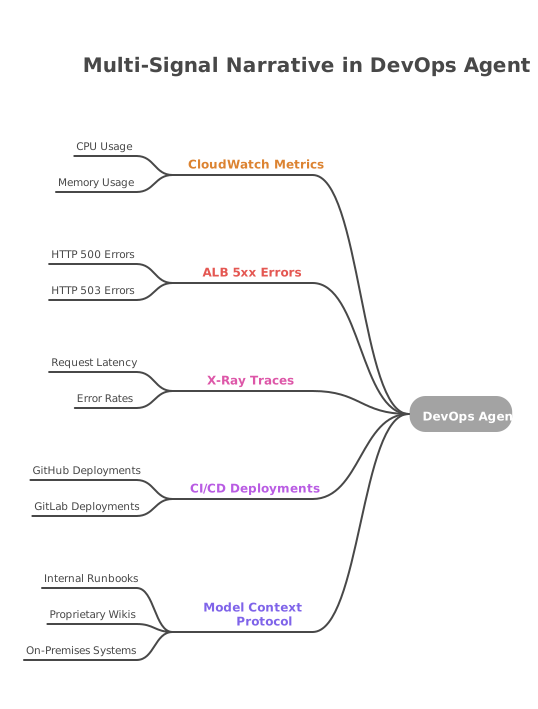
Multi-signal correlation is something that is impressive when evaluating this technology. While traditional monitoring would tell you something like "CPU is high", the DevOps Agent tries to tell the whole story. That is, it correlates CloudWatch metrics, ALB 5xx errors, X-Ray traces and recent CI/CD deployments on GitHub and/or GitLab to come up with the root cause of the issue in question. In one use case scenario it’s been witnessed its ability to recognize that an increased load on a payment system was merely the result of a database read replica being slow, something that would normally take a human 15 minutes of analyzing various dashboards.
It is not only the AWS platform that the agent can extend in such way. It can be done via the Model Context Protocol, through which one can give access to their internal runbooks, proprietary wikis, or on-premises systems. The DevOps Agent treats all those things on equal footing as CloudWatch logs.
Proactive resilience advantage
Whereas all of those reviewing it emphasize the "firefighting" element, we think the AWS DevOps Agent Proactive Evaluation mode is the true hidden treasure. Instead of being reactive when there's no problem at hand, the agent monitors your observability blind spots, infrastructure choke points, and even your deployments to see whether they contain potential risks that could cause an issue and require you to be pared down the road.
This transition to proactive management is where we think the real compounded benefit lies for a development team.
Production challenges begin to surface
Let's be real here when it comes to the limitation of AWS DevOps Agent. First, by default, it is in a read-only mode. That will not change until the technology matures in the coming future. What happens next is that the DevOps Agent will give you the necessary commands or steps required to fix the problem. However, the autonomous agent will not do the work for you. In cases such as the restarting of pods, having an intermediary person will add to the list of things that have to be taken care of manually.
This can lead to a scenario where we have the "garbage in, garbage out" theory at play. If you do not offer it quality data, the outcome will be subpar even though the hypotheses generated make sense. It doesn't always tell you when it’s operating with incomplete data, which is a reliability risk that early adopters should not underestimate.
The operational tax and the bottom line
There are two major taxes to consider before a full-scale rollout. First, there is a time-gap sensitivity in its correlation logic. If a deployment happened 45 minutes before a resulting latency spike, the agent’s ability to link the two events weakens significantly. It struggles with these "slow-burn" incidents where the cause and effect are separated by a large time window.
Second, the cost structure is significant. While the preview was free, community estimates for GA pricing for a mid-sized production environment range from $10,000 to $30,000 per month depending on usage. For small teams or organizations with messy infrastructure, the ROI might not pencil out compared to the engineering time saved. Furthermore, the migration from preview to GA was a breaking change, requiring manual IAM updates and resulting in the deletion of preview chat histories a clear reminder that even at GA, we are still in the early days of this technology.

Final verdict
If you are an AWS-native team running ECS or EKS microservices with solid CloudFormation discipline and high observability maturity, AWS DevOps Agent is a massive force multiplier. It removes the "context assembly" phase of on-call, letting your engineers focus on decision-making rather than data-gathering. However, if your infrastructure is a mix of inconsistently tagged Terraform and minimal tracing, we would suggest fixing your observability foundation first. The agent will only amplify the signals you already have, whether they are good or bad.
Our recommendation is to run it in parallel with your existing on-call rotation for 30 to 60 days on non-critical paths. Measure the quality of its investigations against what your team produces manually, and model that against the GA pricing before committing your production workloads. We are entering a world where humans are no longer the ones finding the needle in the haystack, but we are still the ones who must decide what to do once it's found.
Stay tuned to the GoML blog for daily updates in the world of AI and ML engineering.