Exactly a year ago, at re:Invent 2024, Amazon announced their foundation models – Amazon Nova. At Day 2 of re:Invent 2025, Amazon announced an expansion of its Nova family with four new models – with substantial increase in performance while maintaining similar pricing. In short, Nova 2 takes it all up a notch.
Nova 2 is a major upgrade across reasoning depth, multimodal intelligence, speed and cost efficiency. GoML received early access as part of AWS’s preview program and has already begun piloting Nova 2 in production-grade systems for enterprise teams.
Over the last year, we’ve seen a clear pattern across customer deployments. Teams want models that are cost-efficient, stable under heavy workloads and flexible enough to support text, image, video and speech without juggling multiple architectures.
Nova 2 steps into that gap with a level of consistency that the original Nova lineup couldn’t reliably deliver.
Why is Nova 2 needed
The first Nova generation handled everyday conversational and creative tasks well, but teams pushing the models into larger workflows began noticing consistent pressure points. Multilingual performance varied across languages. Longer documents required frequent workarounds because the context window wasn’t large enough. Automation workloads sometimes hit rate limits. And because text, image and video models sat on separate backbones, multimodal reasoning wasn’t always reliable.
The early Nova models also offered only basic reasoning depth, which made them usable for simple steps but less dependable for multi-step or domain-specific tasks. Voice and speech workflows weren’t supported, so teams often had to bring in external models to fill those gaps.
Nova 2 was introduced to address these real-world limitations. With longer context windows, stronger cross-language handling, more stable reasoning, and unified multimodal processing, the new generation is built to support the kinds of production systems enterprises now expect to run on AWS.
In practice, this means fewer workflow failures, fewer guardrails to engineer, and far less effort spent stitching together multiple models to handle a single task. Nova 2 aims to reduce both cognitive and operational load for teams working inside AWS, which is where it creates real, measurable value.
Exploring the Nova 2 model family
Nova 2 consists of three core models:
1) Nova 2 Lite
Nova 2 Lite is the most efficient member of the family, designed for high-volume workloads that require low latency and practical reasoning.
Key upgrades
- Supports 200+ languages
- Extended-thinking capability for multi-step reasoning
- Developer-controlled reasoning depth (faster vs more accurate)
- Lower inference cost than many compact frontier models
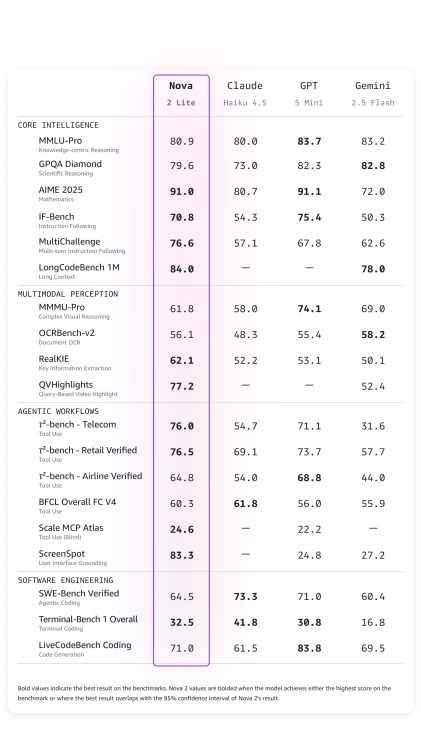
This makes Nova 2 Lite suitable for large-scale chat systems, customer support automation, classification workflows, and document-heavy processes where cost and latency matter more than premium reasoning depth. One of the biggest changes in Nova 2 Lite is how much closer it now sits to compact frontier models on standardized benchmark tests. The earlier Nova Lite trailed this category by a comfortable margin; Nova 2 Lite closes that gap.
Nova 2 Lite Benchmarking
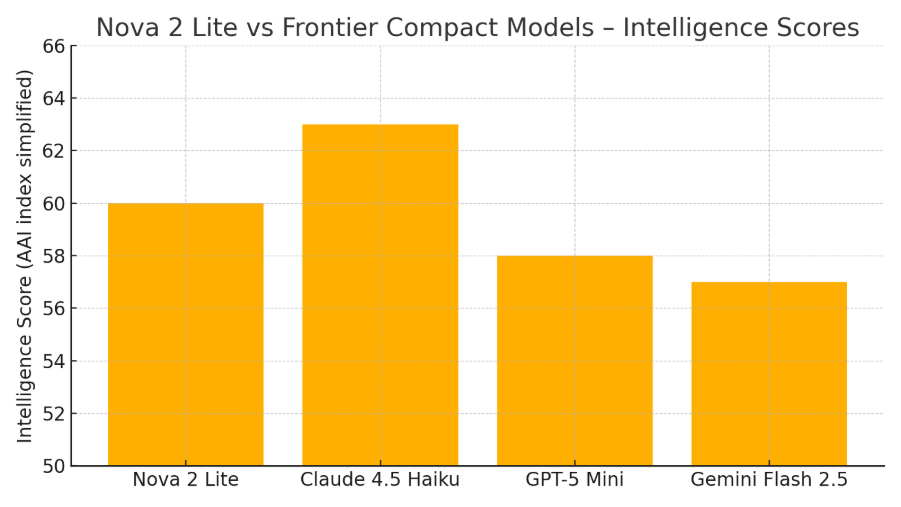
Nova 2 Lite now sits directly in the competitive compact-frontier tier.
According to Amazon, Nova 2 Lite equal or better on 13 out of 15 benchmarks compared to Claude Haiku 4.5, equal or better on 11 out of 17 benchmarks compared to GPT-5 Mini, and equal or better on 14 out of 18 benchmarks compared to Gemini Flash 2.5.
2) Nova 2 Pro
Nova 2 Pro is Amazon’s highest-intelligence reasoning model in the Nova 2 lineup. It processes text, images, video, and speech within a single reasoning flow, and includes a 1M-token context window.
What’s new compared to Nova Pro
- Higher reasoning accuracy across multi-step workflows
- Suitable as a teacher model for knowledge distillation
- More consistent multimodal reasoning
- Better performance across perception tasks (OCR, object detection, frame understanding)
In most workflows, Nova 2 Lite will handle the bulk of everyday tasks. Nova 2 Pro becomes the right choice when the system needs deeper analysis, stronger multimodal reasoning, or longer reasoning chains that require more careful planning.
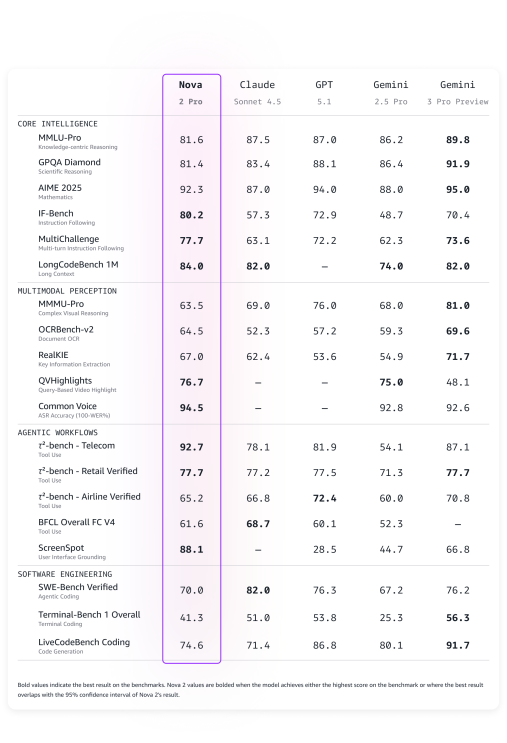
The improvement becomes clearer when comparing Nova 2 Pro against models in the mid-tier frontier segment. These comparisons reflect the kinds of workloads enterprises typically benchmark - complex classification, summarization, planning, and multimodal queries.
Nova 2 Pro Benchmarks
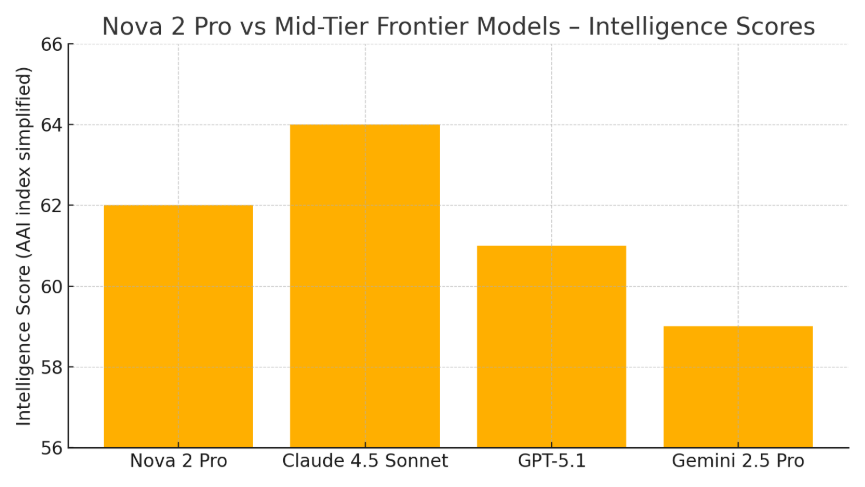
Nova 2 Pro performs on par with mid-tier frontier models at a significantly lower cost.
According to Amazon, Nova 2 Pro is equal or better on 10 out of 16 benchmarks compared to Claude Sonnet 4.5, equal or better on 8 out of 16 benchmarks compared to GPT-5.1, equal or better on 15 out of 19 benchmarks compared to Gemini 2.5 Pro, and equal or better on 8 out of 18 benchmarks compared to Gemini 3 Pro Preview.
3) Nova 2 Omni
Nova 2 Omni is Amazon’s first Any-to-Any model. Omni is not a replacement for Nova 2 Lite or Pro. It is a broader multimodal engine designed for workflows where text, images, video, and speech need to be processed together. For teams that only need strong reasoning or scale, Lite and Pro remain the more efficient options.
For a complete breakdown of Omni’s multimodal abilities, including Any-to-Any processing, visual editing, and speech understanding, you can read our dedicated Nova 2 Omni guide.
Nova 2 Cost and Performance Comparisons
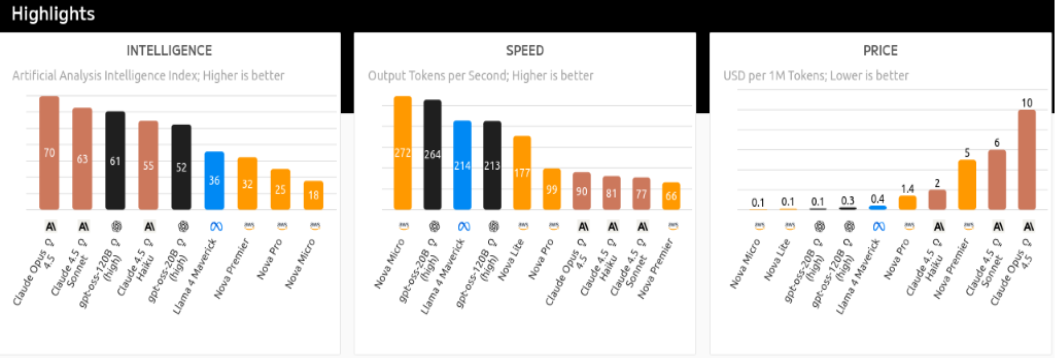
Cost remains one of the strongest arguments in favor of Nova 2. The charts below show how Nova 2 compares when running full reasoning workloads, which typically include retrieval, summarization, and multiple inference hops.
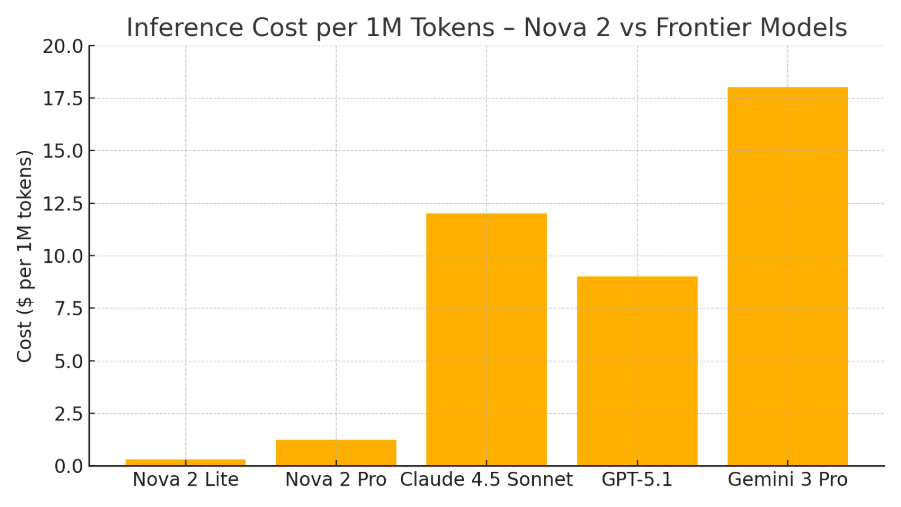
Nova 2 is materially cheaper to run for full reasoning pipelines.
Beyond raw cost, enterprises measure models on throughput, latency, and their ability to handle workloads consistently. The following comparison helps illustrate where Nova 2 stands relative to other frontier models. Nova 2 improves throughput while reducing cost.
Nova 2 Pro competes directly with mid-tier frontier models at lower cost.
Should I upgrade to Nova 2 from Nova
The biggest question we hear from teams already on Nova 1 is simple: does Nova 2 justify the upgrade?
The table below summarizes the improvements that matter most in real deployments.
Speed Comparison
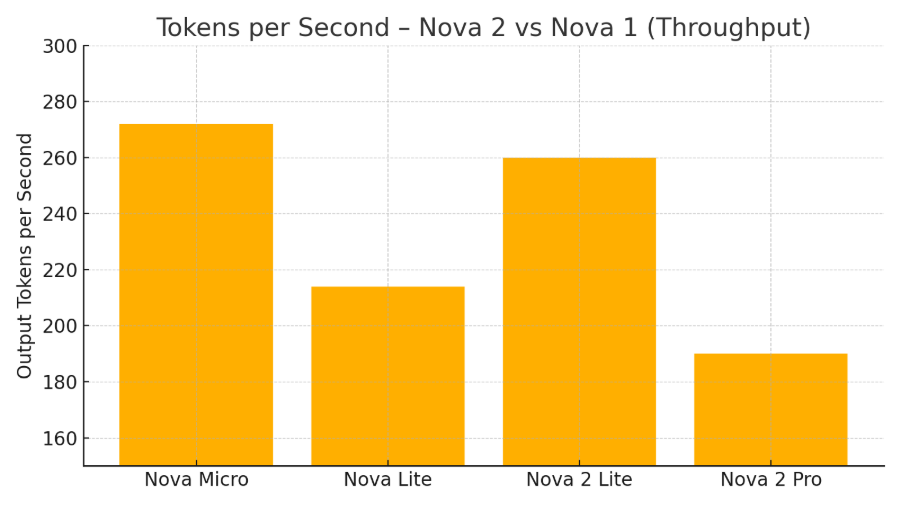
Nova 2 improves throughput while reducing cost.
How Nova 2 enhances enterprise ops
Nova 2 gives teams something they didn’t have before: a set of models that can actually support the kind of workloads enterprises want to run on AWS today. The performance gains, longer context windows, and stronger multimodal abilities matter, but what matters more is how steadily the models behave when they’re pulled into real systems. That reliability is what turns a model into working infrastructure.
The three-model family also makes planning easier. Teams that care about scale can start with Lite. Workflows that depend on deeper reasoning or multimodal analysis have Pro. And for organisations exploring Any-to-Any intelligence, Omni is already proving useful enough to move beyond experimentation.
What we’re seeing with early pilots is simple: Nova 2 lowers effort. It reduces the amount of orchestration, retries, and guardrails needed to keep a workflow stable. That is where the long-term value sits - less engineering overhead, clearer cost control and a smoother path from prototype to production.
If you want to understand which Nova 2 model fits your workload - or how to integrate them into an existing AWS setup - connect with us at GoML. We can help you evaluate options, design the right workflow, and get the system running in record time.
Why was Nova 2 needed?
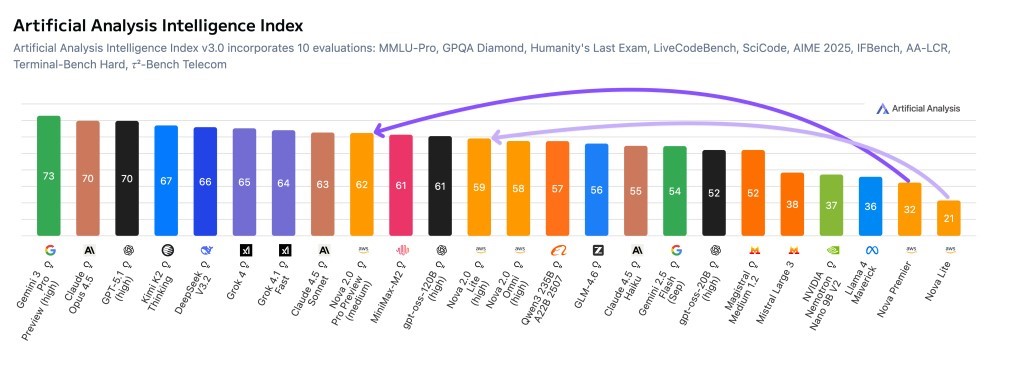
AWS introduced its Nova model family in 2024, but they have yet to become a top choice among developers. According to a July survey by Menlo Ventures, by midyear Anthropic—backed by Amazon—held 32% of the enterprise LLM market, followed by OpenAI at 25%, Google at 20%, and Meta at 9%. Nova models accounted for less than 5%, the firm noted. In response, AWS is positioning the newly upgraded Nova 2 series to shift that narrative.
However, Amazon Bedrock has also added 18 open weight models to Bedrock including models from Google, Nvidia, Mistral, Alibaba's Qwen and OpenAI.
“We think model choice is so critical. We've never believed that there was going to be one model to rule them all, but rather that there will be a ton of great models out there, and it's why we've continued to rapidly build upon an already wide selection of models,” said CEO Matt Garman.
Nova 2 Lite
Nova 2 Lite is a fast, cost-effective reasoning model for everyday workloads building upon Nova Lite.
How is it different from Nova Lite?
Limited complex reasoning was one of the cons of Nova Lite which Nova 2 Lite addresses by supporting extended thinking – more time for models to reason out before generating outputs.
It makes the model more accurate when tackling multi-step problems, from agent workflows and advanced math to complex planning and writing code. This might also give developers more precise control over the outputs – another drawback of Nova Lite.
First Impressions of Nova 2 Lite
Customers can dial up or down how much step-by-step thinking the model does, letting them choose between deeper intelligence or faster, cheaper responses—perfect for chatbots, document workflows, and automation tasks.
Benchmarking
According to Amazon, Nova 2 Lite equal or better on 13 out of 15 benchmarks compared to Claude Haiku 4.5, equal or better on 11 out of 17 benchmarks compared to GPT-5 Mini, and equal or better on 14 out of 18 benchmarks compared to Gemini Flash 2.5.
Nova 2 Pro
Nova 2 Pro is Amazon's most intelligent reasoning model that can process text, images, video, and speech – designed and positioned for highly complex workloads.
How is it different from Nova Pro?
The major difference is ability to be used as a teacher model, helping create smaller, specialized versions through knowledge distillation. Apart from that, one can presume that Nova 2 has better performance and speed. With a context window of 1M-tokens, Nova 2 Pro is more similar to Nova Premier than Nova Pro except for the pricing.
First Impressions of Nova 2 Pro
Nova 2 Pro appears to combine the general-purpose reasoning of Nova Pro with the distillation capabilities of Nova Premier into a single model with AWS probably simplifying the Nova family to make space for Omni.
Benchmarking
According to Amazon, Nova 2 Pro is equal or better on 10 out of 16 benchmarks compared to Claude Sonnet 4.5, equal or better on 8 out of 16 benchmarks compared to GPT-5.1, equal or better on 15 out of 19 benchmarks compared to Gemini 2.5 Pro, and equal or better on 8 out of 18 benchmarks compared to Gemini 3 Pro Preview.
This is a live page. We will continue adding more information about implementation, use cases, benchmarks, and technical notes as we explore Nova 2 in real world projects.
Meanwhile, we do have more information about Nova 2 Omni and the larger AWS AI ecosystem.