Artificial Intelligence has inevitably become the prime intelligence layer of modern enterprise software. Through solutions like Agentic AI, teams can retrieve enterprise knowledge, orchestrate workflows, invoke APIs, generate structured outputs, summarize complex datasets and increasingly act as intelligent interfaces between users and business systems making enterprise AI security a foundational concern from the very start, rather than an afterthought bolted on once these systems are already in production.
The flipside of this - as these capabilities expand, so does the attack surface.
Unlike traditional applications, AI systems do not execute predefined logic alone. They reason over natural language assembled from multiple sources - user queries, conversation history, retrieved documents, system instructions, metadata, API responses and workflow context. Every one of these components contributes to the model's understanding of the request. This flexibility is what makes modern AI applications remarkably capable, but it also introduces an entirely new class of security challenges.
One of the most significant ones among these challenges is of prompt injection.
Rather than exploiting software vulnerabilities, prompt injection attempts to manipulate the reasoning process of the language model itself. An attacker may hide malicious instructions inside a user prompt, an uploaded PDF, an email, a knowledge base article, or even content retrieved from an external system. The objective is not to compromise infrastructure directly, but to influence how the model interprets its context - convincing it to ignore system instructions, reveal confidential information, manipulate downstream tool execution, or generate outputs that violate business policies.
When the GoML team began building enterprise AI platforms for our customers, it became immediately apparent that prompt engineering alone could never be treated as a security mechanism. Telling a language model to "ignore malicious instructions" is fundamentally different from enforcing a security policy. Prompts influence behaviour, but they do not establish trust boundaries.
This realization shaped every architectural decision we made.
Rather than attempting to solve prompt injection through increasingly complex prompt engineering, we designed our AI platform around a simple engineering philosophy:
Security should be enforced by architecture, infrastructure and governance - not by assuming the language model will always make the correct decision.
Everything else in our platform follows this principle.
Designing for the threat before designing the prompt
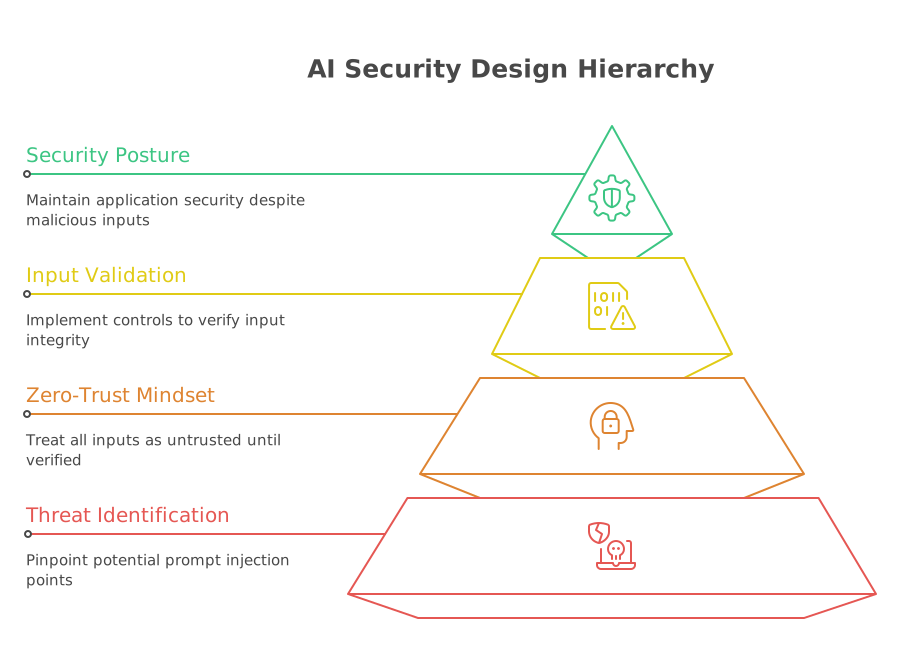
Before selecting models, building orchestration workflows or even writing system prompts, we begin by figuring out where prompt injection could realistically enter the system.
Unlike conventional applications, AI platforms assemble context from numerous independent sources. A single inference request may include authenticated user input, previous conversation history, retrieved knowledge base documents, OCR output extracted from uploaded files, structured business data, metadata generated during workflow execution, and system instructions maintained by the application itself. While each source serves a legitimate purpose, every external input also represents an opportunity for an attacker to influence the model's reasoning.
This observation fundamentally changed how we approached system design. Rather than classifying inputs as trusted or untrusted based solely on where they originated, we adopted a zero-trust mindset for everything entering the model's context - a core tenet of enterprise AI security. User prompts, uploaded documents, retrieved knowledge, external APIs, and dynamically generated content are all treated as untrusted until they have passed through the controls implemented by the application.
The objective is not to prevent malicious content from ever reaching the model-that is rarely practical in enterprise environments. Instead, the goal is to ensure that no single piece of content can alter the application's security posture or bypass controls that exist outside the model.
Enterprise AI security begins before the model is invoked
One of the earliest architectural decisions we made was that the client should never determine how the model behaves.
The responsibility of the client application is intentionally limited to communicating user intent. It does not construct system prompts, determine orchestration logic, define retrieval strategies, or control business workflows. Those responsibilities belong entirely to backend services operating within a controlled execution environment.
When a request reaches the platform, the backend authenticates the user, validates authorization, determines which enterprise resources are accessible, constructs the appropriate orchestration workflow, retrieves only the information the user is permitted to access, and finally assembles the prompt that is sent to the language model. By centralizing prompt construction on the server, we ensure that business logic, system instructions, and security policies remain under application control rather than becoming part of the client surface that can be manipulated or reverse engineered.
This separation also provides operational flexibility. Prompt engineering can evolve independently of client applications, allowing improvements in model behaviour without requiring changes to frontend code or exposing implementation details.
Retrieval pipelines must assume every document is potentially malicious
Retrieval-Augmented Generation has become the foundation of many enterprise AI systems because it enables models to reason over organizational knowledge instead of relying solely on pre-trained information. However, retrieval also introduces one of the largest attack surfaces for prompt injection, making it a critical focus area for enterprise AI security.
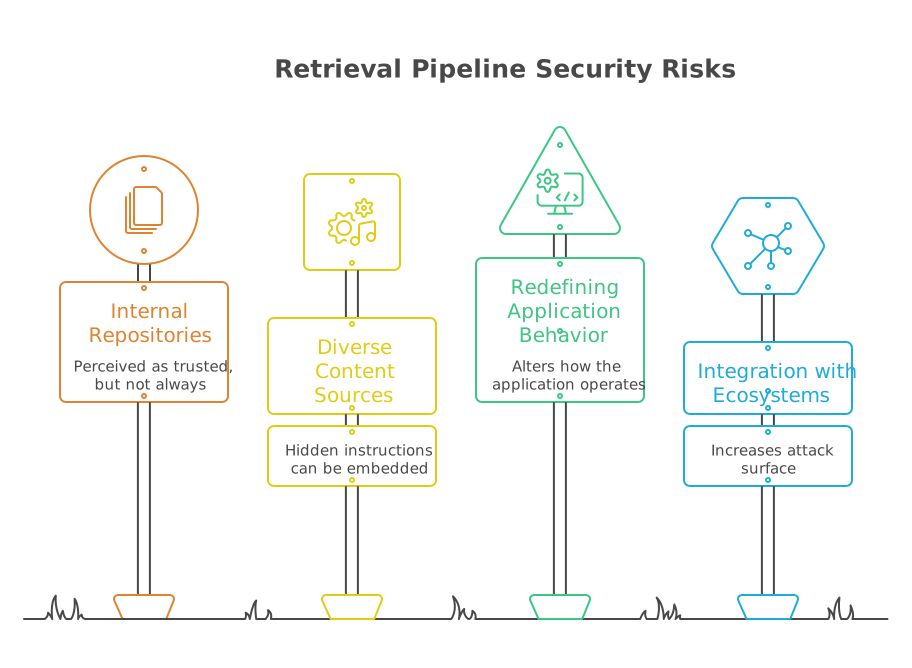
Documents are often perceived as trusted because they originate from internal repositories. In reality, enterprise content is created by people, imported from external systems, processed through OCR pipelines, synchronized from collaboration platforms, or uploaded directly by users. Any one of these sources may contain hidden instructions specifically crafted to manipulate downstream AI systems.
Our retrieval pipeline therefore makes no assumptions about the intent of the content it processes. Every retrieved artifact is treated as information to support reasoning-not as instructions capable of redefining application behaviour. By separating knowledge from control, the retrieval layer enriches model responses without becoming a mechanism for altering how the application operates.
This distinction becomes increasingly important as AI systems integrate with larger and more diverse enterprise knowledge ecosystems.
The language model never owns authorization
One of the most common misconceptions in enterprise AI development is the belief that a sufficiently engineered prompt can enforce access control. In practice, authorization is not a conversational problem-it is an infrastructure responsibility, and infrastructure is where enterprise AI security must live.
Within our platform, every authorization decision is completed before information reaches the model. Backend services determine who the user is, which tenant they belong to, what resources they may access, and which operations they are permitted to perform. The language model never evaluates these permissions, nor does it decide whether sensitive information should be disclosed.
This architectural boundary significantly reduces the impact of prompt injection. Even if an attacker successfully persuades the model to reveal information belonging to another user or organization, that information simply does not exist within the context available to the model. The request fails not because the prompt resisted manipulation, but because the surrounding architecture never exposed unauthorized data in the first place.
Every model invocation is protected by enterprise AI security controls
Prompt engineering alone cannot provide the consistency required for enterprise governance. Every inference request within our platform therefore passes through centralized security controls before reaching the underlying foundation model.
Using AWS Bedrock Guardrails, we apply consistent policies across every LLM interaction rather than selectively protecting only high-risk workflows. These controls enforce organizational requirements for content moderation, sensitive information handling, topic restrictions, and response validation while remaining independent of prompt engineering itself - reinforcing enterprise AI security at every layer of the stack.
Because these policies exist outside the prompt, they continue protecting the application even as prompts evolve to improve user experience or support new business capabilities. Security policies become part of platform governance rather than individual prompt implementations.
Secrets should never become part of AI context
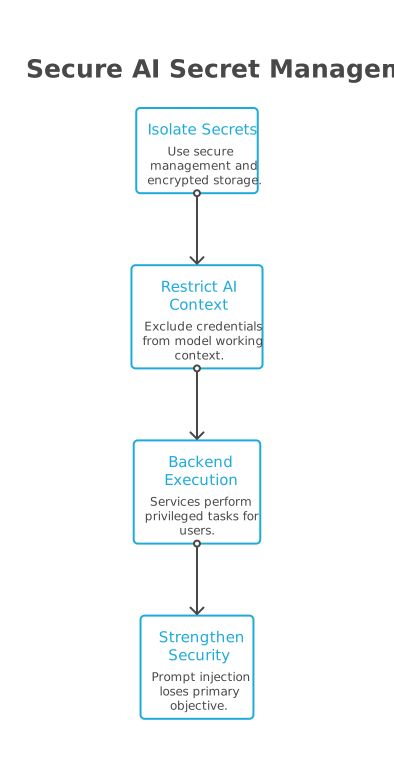
Prompt injection frequently aims to expose credentials, configuration details, API keys, or privileged operational information. Rather than attempting to teach the model not to reveal these assets, we remove the possibility entirely.
Sensitive information remains isolated within backend infrastructure using secure secret management, encrypted storage, least-privilege IAM policies, and controlled service-to-service authentication. Language models never receive long-lived credentials or privileged configuration as part of their working context. Backend services perform privileged operations on behalf of authenticated users, while the AI layer operates only on the information necessary to complete the requested task.
By treating secret management as an infrastructure concern rather than an AI concern, prompt injection loses one of its primary objectives, and enterprise AI security is strengthened as a result.
Enterprise AI security is a continuous engineering practice
Building a secure AI platform does not end once the application is deployed. New attack techniques continue to emerge as language models evolve, requiring security controls to evolve alongside them.
Our development lifecycle incorporates continuous Vulnerability Assessment and Penetration Testing (VAPT), adversarial prompt evaluation, infrastructure security reviews, and AI-specific security testing conducted by dedicated cybersecurity teams. We intentionally attempt to override system prompts, manipulate retrieval pipelines, expose hidden instructions, influence tool execution, retrieve unauthorized information, and bypass established guardrails. These exercises help validate that the surrounding architecture-not just the language model-continues enforcing the intended enterprise AI security boundaries.
The outcome is a continuous feedback loop in which security findings directly inform future architectural improvements.
Architectural property in enterprise AI security
One of the most valuable lessons we've learned while building enterprise AI systems is that prompt engineering and security solve fundamentally different problems.
Prompt engineering improves how a model behaves. Enterprise AI security determines what a model is allowed to access, influence, and execute.
Treating prompts as a security boundary inevitably creates fragile systems because prompts can be interpreted, ignored, or manipulated. True resilience comes from designing architectures where identity, authorization, secret management, infrastructure governance, retrieval pipelines, guardrails, and continuous validation work together to protect the application regardless of how individual prompts are interpreted.
As AI applications become increasingly autonomous and integrated into critical business workflows, this distinction becomes more important than ever. The most secure AI systems are not those with the most sophisticated prompts, but those built on architectures where enterprise AI security is enforced independently of the model itself.
Stay connected with all things AI and ML engineering with the GoML blog. Check out our other posts for more.
FAQs
Q1: Do these security layers increase response time?
Some latency is introduced by authorization checks and guardrail scans. Since these processes run alongside prompt assembly rather than after model inference, the effect on end-user response time is usually minimal across most enterprise workloads.
Q2: Is this architecture limited to AWS?
No. The core principles, including zero-trust context, backend authorization, and isolated secrets, are cloud-agnostic and work across different LLM providers and open-source models. AWS Bedrock Guardrails is the tool GoML uses in this implementation, but it can be replaced with another guardrail service.
Q3: How are new prompt injection threats handled after deployment?
Security controls are managed through infrastructure and governance rather than embedded in the prompt. When new threats emerge, teams can update guardrail policies, authorization rules, and backend controls without rewriting or redeploying the core application logic.
Q4: Does stronger security make the AI less useful?
No. Access decisions are made before data reaches the model, so users still receive natural and relevant responses within their authorized scope. The security controls operate in the background and do not disrupt the user experience.