Artificial intelligence is changing how airlines manage ground operations. While developing a conversational AI copilot for TripAI, we saw how AI can support teams during the taxi-out phase, a short but important part of a flight that affects fuel use, emissions, departure delays, and on-time performance.
As air traffic grows, taxi-out planning has become more demanding. Ground teams must respond to changing conditions such as runway availability, congestion, weather, and aircraft queues within minutes. A conversational AI copilot brings relevant operational data into one place and helps teams make faster, well-informed decisions while maintaining the high safety standards expected in aviation.
Why TripAI needed more than a static decision framework for AI in aviation
As TripAI's airline partners scaled, dispatchers and pilots increasingly needed fast, dependable answers about when Single Engine Taxi Out (SETO) could be safely applied. The organization had strong operational data and decades of aviation expertise behind it, but without a connected intelligence layer, it leaned heavily on static standard operating procedures and manual judgment calls. This made it difficult to consistently capture safe SETO opportunities or diagnose why usage dipped across specific fleets, stations, or time periods.
The team also needed a way to make Engine-Out Taxi-Out (EOTO) behavior explainable rather than anecdotal. Without a unified evaluation system, insights stayed buried in load sheets, weather reports, and disconnected logs, limiting the organization's ability to build lasting, trend-level understanding of its own ground operations.
Samar Khan, founder and CEO of Trip.ai, explained in a recent goLive episode with Rishabh Sood, founder and CEO at GoML, that fuel is one of the largest single costs airlines carry, and that even a one-to-three percent improvement translates into meaningful savings, especially on larger, older aircraft. His vision for TripAI was to build a platform powered by AI in aviation that could put that kind of data-driven insight directly at the fingertips of airline teams, letting them query sustainability, aircraft, and operational information the way they'd ask a colleague, not dig through a report.
Meeting that goal meant building an agentic, conversational analyst purpose-built for taxi-out decisions, one that could deliver clear, audit-ready guidance while surfacing trends no manual review could catch at scale, proving out a practical, working model of AI in aviation.

Why GoML was the right partner for AI in aviation at TripAI
The GoML team built TripAI's solution on Amazon Web Services (AWS), using Amazon SageMaker, Amazon ECS, and AWS Lambda. The architecture allows airlines to add new fleets, airports, and data sources without major infrastructure changes, making it easier to expand as operational needs grow.
Having worked with AWS for more than a decade at Thomson Reuters and Capgemini, Khan wanted a partner with strong cloud expertise and consistent execution. TripAI brought deep flight operations knowledge, while GoML focused on building reliable AI systems, secure cloud infrastructure, and scalable deployment. Using its AI Matic framework, pre-built MLOps components, agent-based workflows, and AWS-native architecture, GoML helped deliver the platform efficiently while meeting the project's technical and operational requirements.
What was built for TripAI
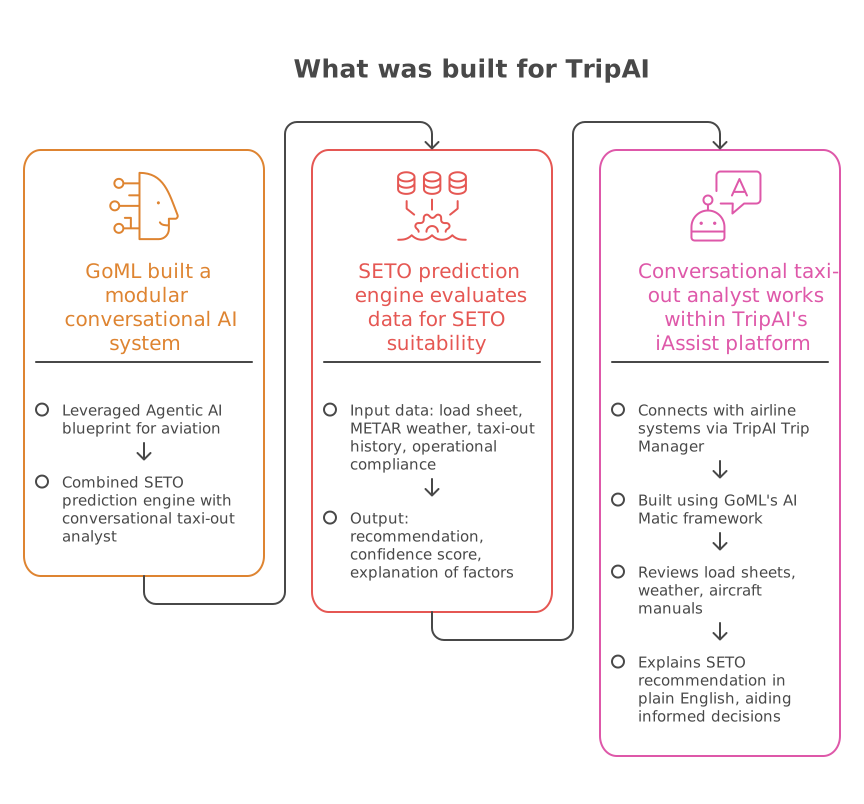
GoML built a modular conversational AI system with the help of Agentic AI blueprint for aviation that combines a SETO prediction engine with a conversational taxi-out analyst.
The SETO prediction engine evaluates load sheet data, METAR weather reports, taxi-out history, and operational compliance records to determine whether a SETO operation is suitable for a flight. It provides a recommendation, a confidence score, and a clear explanation of the factors behind its assessment.
The conversational taxi-out analyst works within TripAI's iAssist platform and connects with airline systems through the TripAI Trip Manager. Built using GoML's AI Matic framework, it reviews load sheets, weather conditions, and aircraft manuals to explain in plain English whether SETO is recommended for a specific flight and why, helping operational teams make informed decisions quickly.
Results of applying AI in aviation to taxi-out operations
- 28% more feasible SETO opportunities identified
- ~35% reduction in manual analysis effort
- Built and implemented in roughly 3 weeks
"Know your data, know your problem statement," Samar Khan advised founders navigating similar journeys, adding that strategic thinking, not just AI enthusiasm, is what separates a working product from a stalled proof of concept.
Watch the complete conversation between Samar Khan and Rishabh Sood in the full goLive episode to learn more about how the collaboration unfolded.
The picture of success for AI in aviation at TripAI
The system now gives airline operations teams a repeatable way to ask why a taxi-out decision was made and trust the answer. It points toward a broader shift for AI in aviation: treating taxi-out not as a fixed cost, but as a controllable lever for fuel savings and emissions reduction. Khan's closing message to founders was to build on the right partnerships and to let data, not assumptions, tell its own story before layering AI on top of it.
Keep an eye on the GoML blog to stay current on the latest developments in AI and ML engineering.