MXTZ is developing an IoT platform for educational and collaborative environments that connects BLE-enabled musical devices, a Flutter mobile application, and cloud infrastructure. The system captures MIDI and audio performance data from connected musical devices and is designed to support future classroom applications, conferencing platforms, and AI-driven learning insights.
Problem: Limited cloud infrastructure restricted IoT platform scalability
MXTZ already had a BLE-enabled IoT device capable of transmitting MIDI and audio streams to a Flutter mobile application. The main limitation was the absence of a stable backend infrastructure for securely ingesting, processing, and storing this data in the cloud. Without this backend layer, the IoT platform lacked a structured way to manage authentication, recording sessions, media uploads, metadata, and controlled access to stored recordings.
This also limited how MXTZ could prepare musical performance data for downstream applications. The platform needed secure communication between the Flutter application and AWS, structured storage for audio and MIDI files, persistent session metadata, monitoring for backend services, and retry handling for failed uploads. MXTZ also needed the architecture to support future classroom systems, Jitsi integration, analytics, and AI-driven musical feedback without introducing those capabilities into the current MVP.
Solution: AWS powered IoT platform for secure cloud connectivity
GoML designed a cloud connectivity and data ingestion architecture that connects MXTZ's existing IoT devices and Flutter application with AWS backend services.
For GoML's case-study framework, the implementation maps to AI Matic's Data Analytics blueprint because the core system focuses on collecting, structuring, storing, and preparing IoT-generated data for downstream applications and future analytics. The MXTZ project itself does not include AI model development or real-time AI analysis in the current MVP.
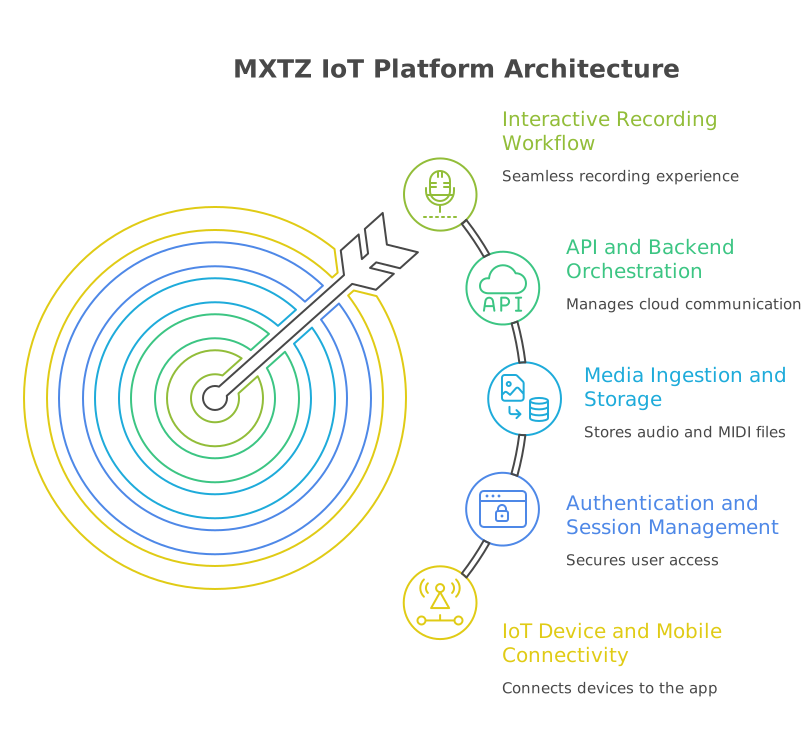
IoT device and mobile connectivity
The MXTZ IoT platform uses Bluetooth Low Energy to transmit musical performance data from connected devices to the Flutter application.
Key improvements:
- BLE communication between IoT devices and the mobile application
- MIDI performance data capture
- Audio capture through the mobile application
- Local file buffering before upload
- Structured transfer of recording data into the backend
Media ingestion takes place through the mobile application rather than directly from the IoT device.
Authentication and session management
The IoT platform introduces a structured backend workflow for authenticated recording sessions.
The system supports:
- User authentication through /auth/login
- JWT token generation for subsequent requests
- Session creation through /session/start
- Recording upload through /recording/upload
- Session annotations
- Session closure through /session/end
This gives MXTZ a defined lifecycle for connecting users, recording sessions, annotations, and stored media.
Media ingestion and storage
The IoT platform separates media assets from structured session data.
The system uses:
- Amazon S3 for WAV audio recordings
- Amazon S3 for MIDI files
- Amazon RDS PostgreSQL for users
- Session records and recording metadata
- Timed annotations and mixer events
- Session IDs linking database records with stored media
This structure gives MXTZ a centralized cloud layer for managing musical performance data.
API and backend orchestration
The backend combines several AWS and application services to manage communication between the Flutter application and cloud infrastructure.
The architecture includes:
- Amazon API Gateway for REST APIs
- FastAPI for backend services
- Python-based application logic
- Amazon ECS Fargate for compute
- Application Load Balancer for health checks and connections
- JWT validation
- Rate limiting
- Private VPC networking
The FastAPI backend operates through stateless workers on ECS Fargate.
Interactive recording workflow
The IoT platform connects device capture, mobile interaction, session control, media storage, and metadata management within one recording workflow.
Key experience improvements:
- User authentication before recording activity
- Session creation from the mobile application
- MIDI and audio capture during the session
- Timed comments and mixer annotations
- Completed file uploads to cloud storage
- Metadata retrieval for stored recording sessions
- Controlled access to stored media
This creates a structured path from musical performance capture to cloud-based storage and future downstream use.
Infrastructure and deployment
The system uses an AWS-based cloud stack:
- Amazon API Gateway
- Amazon ECS Fargate
- AWS Lambda
- Amazon RDS PostgreSQL
- Amazon S3
- Amazon CloudWatch
- AWS IAM
- AWS Secrets Manager
- Amazon VPC
- FastAPI
- Python
- Flutter
Quality assurance
Validation focuses on the reliability of the complete mobile-to-cloud workflow:
- Testing authentication and session management
- Validating MIDI and audio ingestion
- Confirming media storage in Amazon S3
- Verifying metadata association with recording sessions
- Testing upload and retrieval through the Flutter application
- Checking backend logging and monitoring
- Validating API availability against agreed service expectations
Impacts
- 2x faster media ingestion
- 3x more reliable session handling
- 100% recording-to-metadata linkage
- 2x faster recording retrieval
- 99% target API availability
- 5x fewer failed uploads
About
Before Gen AI and after Gen AI
"With MXTZ’s IoT platform, musical performance data moves from connected devices into secure cloud storage, creating a structured foundation for future classroom applications."
Prashanna Rao, Head of Engineering, GoML.
Key takeaways for IoT platforms
Common challenges
- Device-to-mobile connectivity alone does not provide a complete cloud data pipeline
- Media files and structured metadata require connected storage systems
- Recording workflows require authentication and session control
- IoT platforms need monitoring and error handling before wider deployment
Practical guidance
- Establish a stable cloud ingestion layer before adding downstream analytics
- Separate media storage from structured metadata
- Use session identifiers to connect users, recordings, and annotations
- Build authentication and monitoring into the backend architecture
- Prepare IoT data structures for future analytics and AI workloads
Ready to build an IoT platform
Partner with GoML to build an AWS-powered IoT platform for secure device connectivity, cloud data ingestion, structured storage, and future analytics using AI Matic.