Numeraxial is building an investment analytics platform that combines centralized market data, portfolio analytics, reinforcement learning, and AI-driven financial analysis. The platform supports multiple asset classes and is designed for institutional, professional, and retail investors. GoML integrated Numeraxial’s existing services into a scalable AWS-based architecture and added an AI Analyst for natural-language financial queries. The platform also uses Amazon SageMaker for reinforcement learning-based portfolio optimization.
Problem: Isolated services limit investment analytics scalability
Numeraxial’s existing platform had several functional services, but the architecture lacked unified integration and production-ready deployment. Important capabilities such as centralized market data, screening, predictive models, and AI-driven financial analysis were incomplete or unavailable. Market and portfolio data also needed to move consistently between analytics and RL workloads. Without a centralized market data layer, downstream services risked fetching and processing the same information independently.
Portfolio calculations and RL training added further computational overhead, making caching and reusable model outputs important for controlling repeated processing. Numeraxial also wanted investors to interact with the platform through natural-language questions. Supporting queries such as security analysis, portfolio performance, technical analysis, or optimization required an AI layer capable of converting user requests into structured calls across multiple financial services instead of generating unsupported financial responses.
Solution: AI powered investment analytics platform on AWS
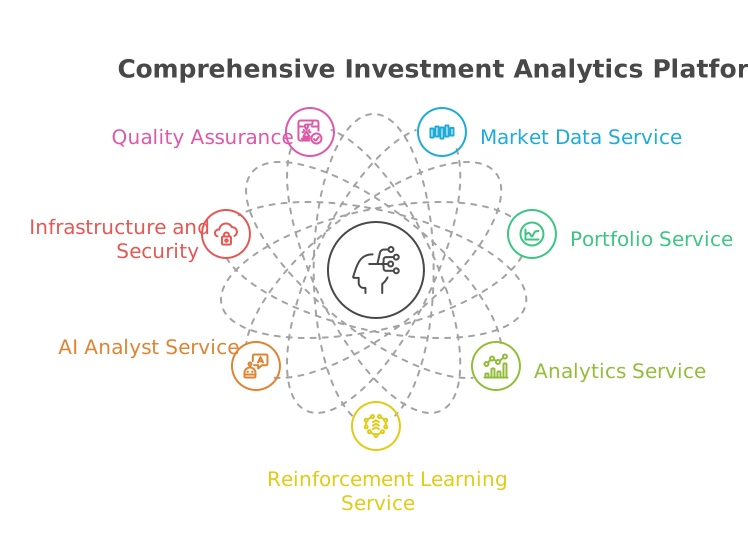
GoML transformed Numeraxial’s existing architecture into an integrated investment analytics platform connecting Market Data, Portfolio, Analytics, Reinforcement Learning, and AI Analyst services. The implementation aligns most closely with GoML’s AI Matic platform, additional reinforcement learning and conversational AI capabilities for financial analysis.
The architecture centralizes market data, exposes portfolio and quantitative analytics through standardized APIs, runs RL optimization through Amazon SageMaker, and uses Amazon Bedrock to support natural-language financial analysis.
Investment analytics market data foundation
GoML built the Market Data Service as the central data layer for the platform. Downstream services access financial information through standardized APIs instead of maintaining separate data-fetching logic.
The service supports:
• Equities, ETFs, bonds, cryptocurrencies, forex, indices, and options data
• EODHD integration as the primary configurable data source
• Historical and scheduled market data ingestion
• Latest and historical price APIs
• Asset metadata and symbol validation
• Yield curve and options data
• Automated scheduled refreshes for prices, fundamentals, crypto, bonds, options, and precomputed indicators
The documented seeded environment covers more than 1,200 instruments and options underlyings across multiple asset classes.
Automated investment analytics data refresh
GoML added scheduled synchronization workflows so market data stays updated without manual ingestion.
• The implementation includes weekday price and options updates, daily cryptocurrency OHLCV synchronization, fundamentals updates, monthly bond refreshes, and precomputed analytics jobs.
• This creates a common financial data layer for portfolio calculations, analytics, AI queries, and RL optimization.
Portfolio investment analytics and caching
GoML integrated the Portfolio Service with the Market Data and Analytics services so users can create portfolios, manage holdings, and retrieve calculated investment information through standardized APIs.
Key capabilities include:
• Portfolio creation and management
• Holdings addition, update, and removal
• CSV and XLSX portfolio upload
• Current positions and market values
• Portfolio KPIs
• Sector and asset-class allocation
• Portfolio growth analysis
• Portfolio and benchmark comparison
The service also uses caching for commonly requested investment analytics. Positions, KPIs, allocations, growth, and comparison results use four-hour cache windows, with automatic invalidation when relevant holdings or portfolios change.
Quantitative investment analytics
GoML structured Numeraxial’s existing Analytics Service as an independent microservice connected to the Market Data and Portfolio services.
• The service provides the quantitative layer required by portfolio analysis, the AI Analyst, and RL optimization workflows.
• The delivered analytics architecture covers portfolio performance, returns, risk and statistical measures, attribution, growth analysis, and asset-specific analytics while keeping calculations available to downstream services through APIs.
Reinforcement learning for portfolio optimization
GoML transformed Numeraxial’s RL pipeline into an asynchronous investment optimization service running through Amazon SageMaker GPU workloads.
Users submit portfolio or ticker inputs, training and trading periods, model selections, rebalance windows, and other parameters. The service immediately returns a job ID while SageMaker runs the optimization in the background.
The RL service supports 10 algorithms:
• PPO
• A2C
• SAC
• TD3
• DDPG
• TRPO
• TQC
• ARS
• RecurrentPPO
• CrossQ
A recommendation engine ranks suitable models based on dataset size, trading period, portfolio size, and rebalance frequency.
Caching and RL model reuse
GoML added two levels of caching to reduce unnecessary SageMaker GPU processing.
• Identical requests reuse completed results directly without creating another SageMaker job.
• Requests with the same training configuration but different trade periods reuse Phase 1 model weights.
• Phase 1 reuse typically reduces the repeated workflow to around 50% of the original runtime.
• A force-retrain option remains available when a fresh model run is required.
AI Analyst for natural-language investment analytics
GoML built an AI Analyst service that lets users ask financial questions in natural language and converts those requests into structured workflows across Market Data, Portfolio, Analytics, and RL services.
Example queries include asking for a stock’s current price, requesting technical analysis, identifying underperforming portfolio positions, comparing company fundamentals, or reviewing bond opportunities.
The service supports:
• Synchronous chat API responses
• Server-Sent Events for streamed AI responses
• Multi-turn conversation context
• Tool calls across financial services
• Structured responses for tables and charts
• Portfolio-aware financial questions
• Market, security, technical, fundamental, and earnings analysis
• RL-based portfolio optimization requests
Instead of returning only plain text, the API produces structured response blocks for paragraphs, tables, charts, lists, and financial callouts so a frontend can render analytical outputs consistently.
Investment analytics infrastructure and security
The AWS architecture combines API-based orchestration with separately deployable financial services. The architecture diagram on page 7 shows API Gateway and orchestration connected to Market Data, Portfolio, AI Analyst, and RL services, with Amazon Bedrock supporting AI analysis and Amazon SageMaker handling RL workloads.
Security and access controls include:
• RS256-signed JWT authentication for user-facing portfolio APIs
• Tenant and permission claims for scoped access
• Internal service keys for backend-to-backend communication
• Role-controlled RL access for CIO and Quant Analyst users
• AI Analyst guardrails for off-topic, harmful, prompt-injection, and jailbreak requests
Investment analytics quality assurance
Testing focused on validating the complete investment analytics workflow across data, analytics, AI, and reinforcement learning services.
• End-to-end service integration
• Market and portfolio data flow validation
• Portfolio analytics computation testing
• RL output validation
• Authentication and tenant-level access checks
• API input and error validation
• Cache invalidation and repeated-request handling
• AI Analyst tool and structured-response testing
Delivery: AI Matic for investment analytics
GoML used the Data Analytics blueprint as the delivery foundation for Numeraxial’s investment analytics platform, adding centralized market data, portfolio analytics, reinforcement learning-based optimization, and an AI Analyst for natural-language financial queries.
The AWS stack includes Amazon Bedrock for AI Analyst reasoning, Amazon SageMaker for RL workloads, ECS/Fargate and AWS Lambda for service deployment, Aurora Serverless for market data, DynamoDB and Redis for caching, Amazon S3 for outputs, API Gateway, and EventBridge for scheduled jobs.
AI Matic delivery metrics
- Average TTFV: 15 days
- Average person-days saved: 9 days
Impact
- 1,200+ instruments and options underlyings represented in the documented seeded market-data universe
- Up to 10,000 instruments targeted for portfolio simulation and optimization workflows
- 10 reinforcement learning algorithms supported for portfolio optimization
- 35+ investment and risk metrics available per portfolio or instrument in detailed RL outputs
- Around 50% of the original RL runtime required when Phase 1 model weights can be reused for a changed trading period
About
Before Gen AI and after Gen AI
“With Numeraxial’s investment analytics platform, GoML connected market data, portfolio intelligence, quantitative analytics, reinforcement learning, and natural-language financial analysis into one AWS-based architecture.”
Prashanna Rao, Head of Engineering, GoML.
Key takeaways for investment analytics platforms
Common investment analytics challenges
• Financial data remains fragmented across services and asset classes
• Portfolio calculations create repeated processing without effective caching
• RL optimization requires scalable compute and reusable model workflows
• Natural-language financial interfaces need trusted downstream data and structured calculations
Practical guidance for investment analytics
• Centralize market data before connecting analytics and AI services
• Keep quantitative calculations inside dedicated analytics services
• Use asynchronous infrastructure for computationally intensive RL workloads
• Cache portfolio calculations and reusable model outputs
• Use AI to orchestrate financial services rather than replacing deterministic financial computations
Ready to build an investment analytics platform
Partner with GoML to build scalable investment analytics, portfolio optimization, and AI-driven financial analysis systems with AI Matic.