Elixia Inc. is developing a next generation fuel delivery scheduling software platform for Shell to modernize fuel replenishment and logistics planning across its retail network. The system replaces semi-automated scheduling with an intelligent optimization engine that predicts demand, generates replenishment orders, and optimizes delivery routes. The platform is designed to prevent stockouts, reduce transportation costs, and improve fleet utilization across Shell’s fuel distribution network.
Problem: manual fuel scheduling slows fuel delivery operations
Fuel retail networks rely on timely deliveries to keep stations operational. Shell manages many outlets that require constant monitoring of fuel levels and replenishment planning. Semi-automated systems still require planners to review inventory, forecast demand, and assign vehicles manually.
This manual process slows operations, increases logistics costs, and can lead to fuel stockouts. As Elixia expanded its platform for Shell, a scalable fuel delivery scheduling software solution became necessary to automate order generation and optimize delivery routes.
Solution: intelligent fuel delivery scheduling software with order generation and route optimization
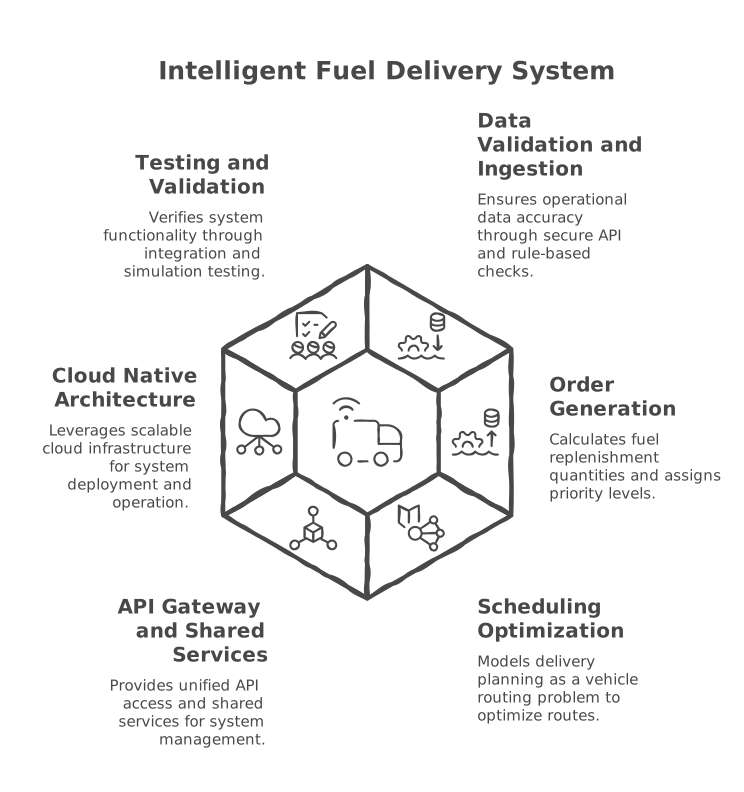
GoML built a modular microservices architecture for fuel delivery scheduling software using the data analytics boilerplate. The system validates operational data, generates fuel replenishment orders based on inventory thresholds, and produces optimized delivery schedules through unified API endpoints.
Data validation and ingestion service
The platform receives operational data from Elixia through a secure API. Incoming data such as outlet inventory, depot stock, and vehicle details are validated against predefined schemas.
Rule based checks flag anomalies before records move to the order generation workflow.
Order generation service for fuel replenishment
The system calculates fuel replenishment quantities using inventory levels and forecasting inputs.
Business rules apply buffer stock and dead stock limits to estimate stockout time for each outlet. Orders receive priority levels such as Critical, High, or Normal and are returned through an API as structured JSON.
Scheduling optimization engine for delivery routing
The optimization engine models delivery planning as a vehicle routing problem. It evaluates orders and available vehicles to generate efficient delivery routes.
The solver enforces hard constraints such as vehicle capacity, time windows, and product segregation while applying soft constraints to improve route efficiency and fleet balance.
API gateway and shared services
All services are exposed through a unified API gateway. Secure REST APIs support order generation and scheduling workflows with JWT based authentication.
Shared services provide logging, monitoring, health checks, rate limiting, and API documentation using Swagger.
Cloud native architecture
The platform runs on a scalable cloud infrastructure. Python microservices are deployed on AWS using ECS and Fargate, while API Gateway manages external access.
PostgreSQL stores operational data and scheduling outputs.
Testing and validation
GoML tested the full scheduling pipeline including data validation, order generation, and route optimization.
Integration tests confirmed API compatibility with Elixia’s platform, while simulation testing verified route feasibility and constraint enforcement.
Impact
- 40% faster fuel order generation based on outlet inventory levels
- 30% reduction in delivery distance through optimized routing
- 35% faster scheduling through API driven fuel delivery scheduling software
About
Before Gen AI and after Gen AI
“With the fuel delivery scheduling software integrated into Elixia’s logistics platform, Shell can automate replenishment planning and optimize delivery routes while reducing operational costs.”
Prashanna Rao, Head of Engineering, GoML
Key takeaways for fuel logistics platforms
Common challenges
- Fuel distribution networks require constant monitoring of outlet inventory levels
- Manual delivery scheduling increases transportation costs
- Complex operational constraints make route planning difficult
- Fuel stockouts occur when replenishment planning is delayed
Practical guidance
- Implement fuel delivery scheduling software to automate replenishment planning
- Use vehicle routing optimization to reduce fleet usage and travel distance
- Expose logistics workflows through APIs for platform integration
- Validate operational data early to prevent downstream scheduling errors
Ready to build fuel delivery scheduling software for logistics platforms
Partner with GoML to accelerate the development of fuel logistics and distribution optimization systems using AI Matic.