Elixia operates a leading Transportation Management System serving large logistics fleets across India. With more than 85,000 vehicles connected to the platform, the Transportation Management System supports complex logistics workflows including fleet operations, billing, compliance management, and real time telematics. The platform manages operational data across Amazon RDS at approximately 31 GB, MongoDB at around 26 GB, and unstructured logistics documentation stored in AWS S3.
Problem: scaling transportation management system and cargo space optimization
The Transportation Management System faced growing pressure from increasing delivery volumes and complex logistics operations. The existing infrastructure lacked the scalability and performance needed to handle large delivery batches efficiently.
The cargo layout engine also lacked realistic 3D modeling, limiting visibility into vehicle cargo space, and reducing loading efficiency. The platform required scalable infrastructure and a modern 3D cargo visualization module to support large fleet operations.
Solution: upgrading the transportation management system and 3D cargo visualization
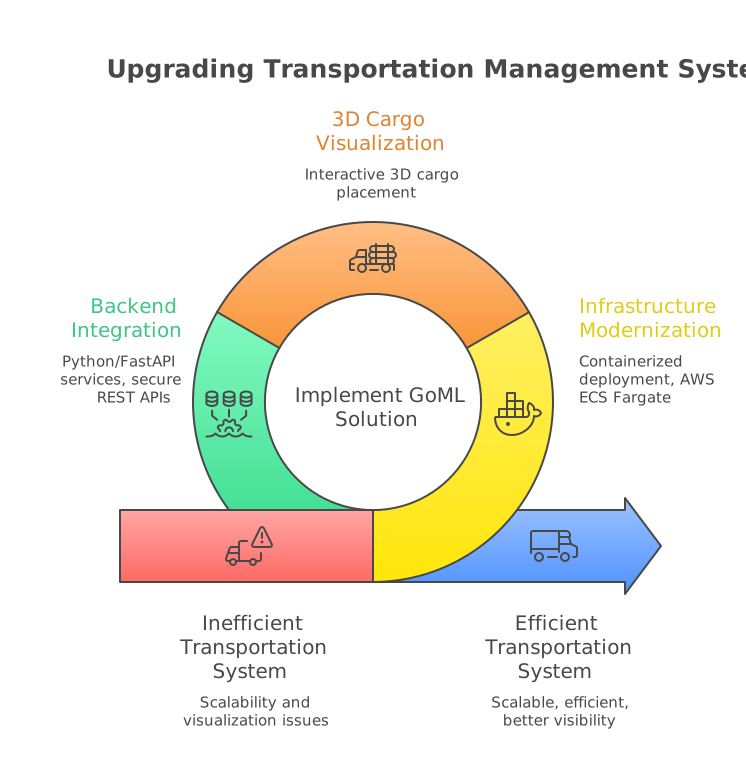
GoML designed and delivered a modular upgrade plan to improve Transportation Management System scalability, operational efficiency, and cargo layout visualization.
The solution runs on GoML’s AI Data Analytics boilerplate, using containerized infrastructure, scalable cloud architecture, and a 3D cargo modeling module integrated with the Transportation Management System optimization engine.
Infrastructure modernization
GoML redesigned the Transportation Management System with Docker based container deployment and replaced Beanstalk with an AWS ECS Fargate cluster behind a load balancer.
This enables automatic scaling, efficient resource usage, and reliable performance during high demand.
3D cargo layout visualization
GoML introduced a 3D cargo layout module integrated with the Transportation Management System optimization outputs. The module converts input and output JSON into interactive 3D visualizations of cargo placement inside vehicles.
Users can rotate the model and view delivery details such as order ID and cargo attributes on hover or click. This improves visibility into cargo space utilization and supports better loading decisions.
Backend and system integration
The Transportation Management System uses backend services built with Python and FastAPI to support optimization workflows and platform integration.
Secure REST APIs connect logistics applications with optimization modules and 3D cargo visualization services. The infrastructure runs on AWS using ECS Fargate, ECR, CloudWatch, IAM roles, and S3.
Impact
- 40% improvement in operational efficiency through containerized infrastructure and auto scaling
- 50% faster dispatch validation using interactive 3D cargo visualization
- 30% better vehicle cargo space utilization through spatial cargo modeling
- 35% reduction in infrastructure management effort using serverless container orchestration
About
Before Gen AI and after Gen AI
“With this Transportation Management System infrastructure upgrade and 3D cargo modeling platform, we created a scalable logistics system that improves delivery optimization performance and cargo planning visibility for large fleet operations.”
Prashanna Rao, Head of Engineering, GoML
Key takeaways for transportation management system platforms
Common challenges
- Transportation Management Systems struggle with growing delivery workloads
- Optimization engines require scalable compute infrastructure
- Operations teams lack visibility into vehicle cargo space utilization
- Manual infrastructure management increases operational complexity
Practical guidance
- Use containerized architecture to scale Transportation Management System workloads
- Adopt serverless container orchestration for better compute efficiency
- Build 3D cargo visualization to improve dispatch planning
- Expose optimization services through secure APIs for integration across logistics platforms
Ready to modernize your transportation management system infrastructure?
Partner with GoML to build scalable transport management system platforms with optimized delivery planning and cargo visualization using AI Matic.