Plumbata is a construction technology company developing AI-powered software for labor intelligence and contract performance on large engineering and construction projects. Founded by industry professionals with decades of experience delivering major infrastructure and mining developments, the company focuses on improving how construction teams understand labor agreements, capture field activity, and measure contract performance.
Plumbata’s platform combines structured contract intelligence with field observations and project data to provide actionable insights on labor compliance, cost exposure, and operational performance. One core component of the platform, Pactum, converts complex collective bargaining agreements into structured, computable datasets that can be analyzed and applied across projects.
Problem: Union agreement complexity limits scalable contract automation management
Construction firms depend on collective bargaining agreements that often exceed 600 pages and vary significantly by trade, region, and union local. These agreements define labor rates, overtime rules, geographic zones, and shift premiums that directly impact project costs.
Historically, these documents were interpreted manually by contract specialists who needed to parse hundreds of pages of legal and operational language to identify applicable rates and conditions. This process consumed days of effort, limited scalability, and increased financial risk. Contractors frequently marked up base union rates by 20 to 30 percent, exploiting gaps in contract visibility and inconsistent interpretation.
As demand for Plumbata's services grew, manual workflows could no longer support reliable, scalable contract interpretation or modern contract automation management.
Solution: AI-powered contract automation management platform
GoML designed and delivered an MVP version of Pactum, Plumbata's AI-powered contract automation management platform, using GoML's Agentic AI blueprint.
The platform automates:
• document ingestion
• AI-driven data extraction
• rule interpretation
• structured contract calculations
This enables Plumbata's engineering and construction clients to interpret labor agreements in minutes instead of days. The structured data generated by Pactum also powers Plumbata's broader platform for field data capture, labor analytics, project intelligence, and contract automation management.
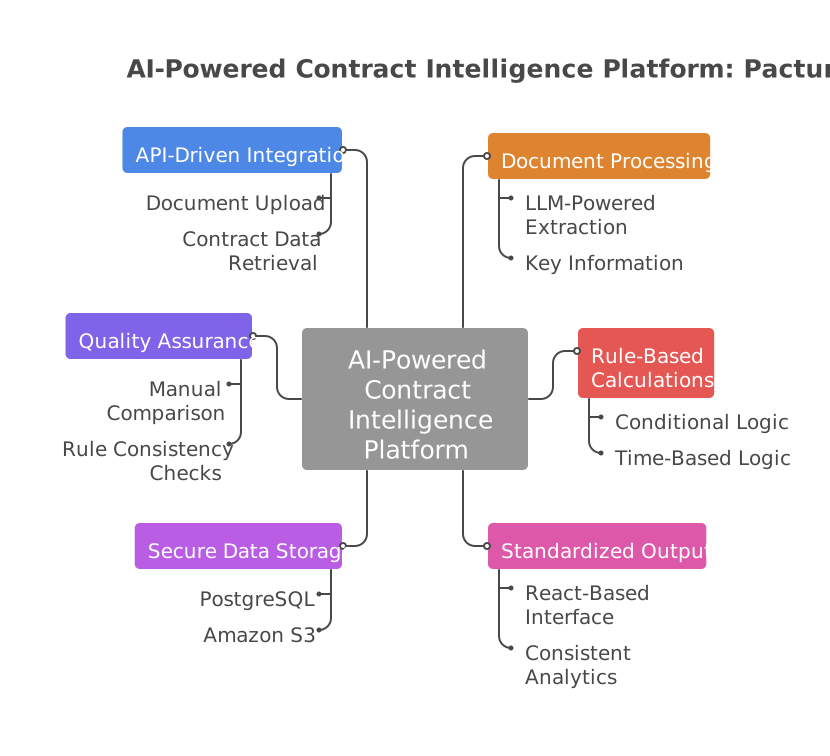
Document processing for contract automation management
The platform ingests both text-based and OCR-required PDFs and extracts 28 predefined features from multi-local union agreements using LLM-powered document intelligence.
Key extracted information includes:
• wage rates
• classifications
• geographic zones
• effective periods
• overtime thresholds
• shift-based rules
The platform converts unstructured PDFs into structured, validated contract datasets that can be queried and analyzed programmatically, forming the foundation for contract automation management.
Rule-based calculations
A built-in rule engine applies conditional and time-based logic to extracted contract data.
This includes:
- overtime calculations
- premium shifts
- regional adjustments
- classification-based rate triggers
Rules are configurable and defined by Plumbata, ensuring consistent interpretation across agreements and jurisdictions.
Standardized outputs and user interface
Extracted contract data is normalized into a standardized schema across unions and regions, enabling consistent analytics across multiple agreements.
A React-based interface allows users to:
- upload agreements
- review extracted contract terms
- validate outputs during the MVP stage
Secure data storage and management
The platform stores agreements, extracted rates, and rule structures in PostgreSQL, while source documents are retained in Amazon S3 for traceability and audit support.
Metadata includes:
- union locals
- geographic coverage
- effective dates
- contract structure identifiers
Quality assurance and validation
The platform includes multi-stage validation workflows to ensure reliability.
These include:
- manual comparison during model development
- rule consistency checks
- confidence scoring
- automated flagging of ambiguous clauses
This validation layer strengthens trust in the platform’s contract intelligence outputs.
API-Driven integration
RESTful APIs support:
- document upload
- contract data retrieval
- rate queries
- rule application
- bulk processing
The APIs are designed to integrate with Plumbata’s broader labor intelligence systems and future platform components.
Impact
- Up to 95% reduction in manual contract review time
- 65% improvement in accuracy of rate and rule interpretation
- 60% faster preparation for labor cost analysis and contract planning
- 3× improvement in scalability of contract analysis
As more agreements are structured within the platform, the underlying dataset becomes increasingly valuable for benchmarking, analytics, and AI-driven insights across projects and jurisdictions.
About
Before and after Gen AI
“With Plumbata’s Pactum platform, we transformed complex union agreements into reliable, real-time contract intelligence.”
Prashanna Rao, Head of Engineering, GoML
Key takeaways for construction firms
Common challenges
- Manual contract workflows do not scale
- Inconsistent interpretation increases cost risk
- Lack of structured data limits decision-making
Practical guidance
- Adopt AI-powered contract intelligence platforms
- Automate rule interpretation and application
- Design systems with validation and auditability
Ready to modernize contract operations?
Partner with GoML to accelerate the development of production-ready AI systems with AI Matic.