BoundaryCare is an assistive technology platform supporting individuals with long-term cognitive challenges, including people with Alzheimer’s and developmental disabilities. The platform already provided biometric tracking, alerts, reminders, and caregiver support for independent living and employment.
Problem: Manual support limits AI job coach scalability
Job coaches often spend 3 to 6 months providing daily in-person support while individuals learn workplace tasks. This model requires significant coach involvement and makes supported employment difficult to scale across more candidates. BoundaryCare wanted an AI job coach system where coaches could translate their knowledge into structured workflows after 2 to 3 weeks of initial shadowing, then support individuals more remotely.
The existing platform supported monitoring and reminders, but job coaches still needed a structured way to define detailed job routines, timings, task steps, help pathways, exceptions, and escalation rules. Coaches are non-technical users, so requiring them to manually create JSON schemas or workflow logic would add complexity. The AI job coach also needed strong workflow validation, patient-level access controls, version management, and deterministic execution so generated Activities could run predictably.
Solution: Conversational AI job coach for workflow creation
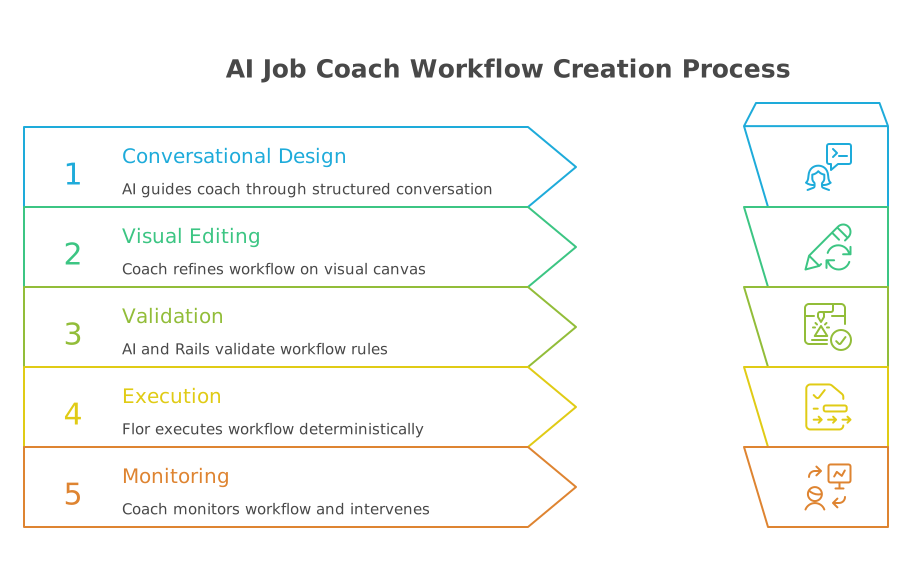
GoML extended BoundaryCare’s platform with an Activities capability that enables job coaches to create individualized support workflows through conversation or a visual canvas. The solution used GoML’s AI Matic platform as the delivery foundation, supporting structured conversations, context management, and AI-assisted workflow generation. The delivery introduced a Python LangGraph AI service for conversational workflow design and integrated Flor into the existing Rails platform for deterministic execution.
AI job coach conversational experience and context management
The AI job coach Builder agent guides coaches through structured conversations covering the candidate, workplace, tasks, support requirements, barriers, help-seeking behavior, and timing.
Example input: Build a room-cleaning activity with timed steps, visual instructions, reminders, and coach escalation if the candidate needs support.
Key capabilities:
• Natural language workflow creation
• Structured questions and quick replies
• Conversation history across sessions
• Patient bio-aware questioning
• PDF, DOCX, and media inputs
• Conversational workflow updates
• Apply or discard generated schemas before publishing
The Builder follows defined stages such as background, needs and challenges, hypothesizing, generation, and editing before producing the Activity schema.
AI job coach Activity generation and visual editing
The AI job coach converts conversation data into structured Activity JSON. Coaches can then apply the generated schema to the React Flow canvas and make manual adjustments before validation and publishing.
The visual Activity Builder supports:
• Activities, Action Sets, and individual Actions
• Nested Action Sets
• Instant and delayed workflow paths
• Duration configuration
• Feedback options
• Expiry behavior
• Notifications and escalation paths
The canvas also supports larger Activities, with rendering optimizations designed for workflows containing around 100 to 200-plus nodes.
AI job coach workflow validation and version management
GoML implemented AI job coach workflow rules across three layers:
• Frontend validation while coaches edit the Activity
• Agent validation before generated schemas reach the canvas
• Rails validation before publishing
These checks cover workflow structure, Start and End rules, nesting, outputs, OnExpiry paths, durations, and invalid cycles.
Published Activities are immutable. Coaches can create new drafts, restore previous versions, validate changes, and publish a new default version without modifying earlier published workflows.
AI job coach with deterministic workflow execution
The AI job coach supports Activity design, while published workflows run through Flor rather than through generative AI. Activity JSON is compiled into Flor DSL for deterministic execution.
Execution supports:
• Complete, Skip, and Need Help feedback
• Timed expiry handling
• Coach notifications
• Pause, resume, and cancel controls
• Workflow branching
• Activity scheduling
• Candidate position adjustment
This architecture keeps the AI job coach focused on workflow creation while runtime behavior follows predefined workflow rules.
AI job coach live monitoring and coach intervention
Job coaches can review historical execution or monitor an Activity while it is running.
• ActionCable sends new execution events to the interface and updates the candidate’s position on the workflow canvas.
• If a candidate becomes stuck, the AI job coach interface allows the coach to select another Activity node and move the candidate back to that point.
• The execution records the reset and continues from the selected step.
AI job coach infrastructure and deployment
The AI job coach solution was integrated with BoundaryCare’s existing AWS environment and deployed through Amazon EKS.
• Rails remains the system of record for patient information, Activities, schedules, and execution state.
• The Python service handles AI-assisted workflow design through the Builder and Optimizer agents.
• Security includes JWT authentication, role-based candidate access, controlled S3 storage, audit logs, TLS, and authenticated internal APIs.
Delivery: AI Matic for AI job coach
GoML used the Conversational AI blueprint as the delivery foundation for BoundaryCare’s AI job coach. The blueprint supported structured conversations, context management, AI-assisted workflow creation, and iterative refinement, while the implementation added Builder and Optimizer agents, deterministic Activity schema generation, visual workflow editing, workflow validation, scheduling, live playback, and coach-controlled workflow adjustments. The source documents describe these capabilities, although they do not explicitly name the AI Matic blueprint.
The AWS AI infrastructure includes Amazon Bedrock for AI-assisted workflow generation, Amazon EKS for application deployment, Amazon S3 for documents and media, Amazon RDS PostgreSQL/PostGIS for platform and agent data, Redis for queues and session operations, and AWS-integrated security and monitoring for controlled deployment.
AI Matic delivery metrics
- Average TTFV: 20 days
- Average person-days saved: 9 days
Impact
- 83%+ reduction in in-person coaching time, from up to 6 months to under 1 month
- 30 minutes or less for AI job coach workflow creation.
- 90%+ accuracy between job coach input and generated workflow schemas
- Conversational workflow updates for task timing and other Activity parameters
- Remote workflow monitoring, adjustment, and replay through the AI job coach interface
About
Before Gen AI and after Gen AI
“With the AI job coach, BoundaryCare converts job coach knowledge into structured workflows while keeping coaches in control of workflow creation, publishing, and execution.”
Prashanna Rao, Head of Engineering, GoML.
Key takeaways for building an AI job coach
Common AI job coach challenges
• Long periods of in-person coaching are difficult to scale
• Non-technical users need simpler workflow creation
• AI-generated workflows require strict validation before execution
Practical guidance for an AI job coach
• Use conversational AI to capture job coach knowledge
• Keep workflow execution deterministic after AI-assisted design
• Combine conversation with visual workflow editing
• Maintain human control over publishing and workflow changes
Ready to build an AI job coach
Partner with GoML to build a scalable AI job coach and workflow automation system with AI Matic platform.