We’re very early in AI. We believe there is no singular point of view on AI that will survive the test of reality in 3 years beyond the obvious view that AI-first software will be a substantially larger market than it is today. Within the broad scope of the statement, multiple first-principles, architectures, models, tools and approaches will compete. One dimension is the choice of closed weight (popular today) versus open weight (emerging).
Some enterprises must take a long-term point of view:
- Do they believe closed weight models are approaching a capability plateau? For instance, is GPT 5.4 delivering substantially better outcomes for your enterprise needs compared to GPT 5.2?
- Are token costs inflating in unpredictable ways? It’s near impossible to reliably predict and engineer token consumption globally. In our experience, model-by-model token engineering is the way to go. Every new model introduces variability.
- What is your expectation of steady state? We’d argue that no enterprise can truly know this today.
The Case for Open Weight Models
But there is a case to be made for open weight models (in limited contexts).
We believe AI product teams should move from closed-weight models to open-weight LLMs only when they need:
- Control over deployment
- Fine tuning
- Protection from long-term API cost concerns
Provided that these three factors outweigh any current benefit from ease of building, flexibility in switching, and rate of pace of improvement in closed weight models.
Open Weight and AWS
For teams that are already on AWS, or planning to move to AWS, choosing an open weight model is a legitimate engineering choice.
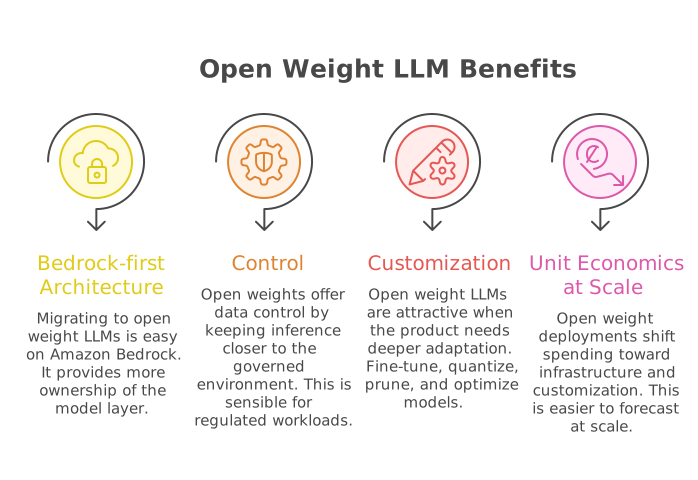
Bedrock-first architecture
If you are on Amazon Bedrock, migrating to open weight LLMs is easy. If your enterprise wants more ownership of the model layer inside your cloud architecture, you should consider open weight. However, that matters only when your application needs:
- to fit enterprise VPC boundaries
- region-specific controls
- internal security policies dictate the level of model control
Control
For teams on AWS, one of the strongest arguments for open weights is data control. Enterprises can keep inference closer to your governed environment instead of sending sensitive prompts and outputs through a third-party hosted API boundary. Again, that is a sensible approach only for highly specialized and regulated workloads (for instance, where HIPAA is a factor).
Customization
Closed weight models are the strongest choices when speed of iteration and adoption matter. Open weight LLMs become more attractive when the product needs deeper adaptation. With open weights, enterprises on AWS can fine-tune, quantize, prune, and optimize models for domain-specific workflows.
Remember, though, that should be an approach that you’ve thought through for a medium term. You need to commit to a base open weight model and invest in specialized talent who can customize on tools like Amazon SageMaker. Often, that would involve working with external partners like GoML because of the difficulty of hiring and training specialized talent.
Unit Economics at Scale
From a cost perspective, closed weight models allow you to consider AI as per-token expense. Open weight deployments shift spending toward infrastructure and customization that is easier to forecast at scale. The tradeoff is worth it only when you:
- Forecast high and growing usage
- Expect strict latency targets
- Want to insulate from vendor pricing changes and API limits
- Can hire and retain specialized AI and ML talent
Healthcare and Open Weight Models
GoML’s point of view is that healthcare is probably the first industry that will switch to open weight models at any scale.
Many healthcare companies that have already piloted and tested AI have already identified the following unacceptable risks:
- Patient data privacy
- Clinical accuracy
- Cost scalability
Closed models limit architectural control and force health systems to transmit sensitive information across third-party API boundaries. Healthcare IT is still subject to strict HIPAA compliance, localized data sovereignty, and specialized medical performance requirements.
That makes a case for healthcare IT to incorporate open weight LLMs and customizable models hosted entirely within their secure cloud:
Control: Healthcare companies can achieve full data isolation within AWS VPCs, utilizing Bedrock’s enterprise-grade, HIPAA-eligible security.
Specialization: Deep fine-tuning on proprietary medical records and institutional protocols via Nova Forge or custom weighting using SageMaker.
Scale: Predictable costs optimized for high-throughput healthcare workflows that are aligned with how healthcare IT systems operate.
Deployment Flexibility: Deployable across private Bedrock endpoints, SageMaker, and local hospital edge hardware.
Operationalize this approach with AI Matic by GoML and build secure, scalable, and fully customized AI systems directly within your cloud.