Document processing and workflows pertaining to them within enterprises play a crucial role in several sectors including finance, insurance, health care, law, etc. In spite of this importance, most companies still rely on manual document processing supplemented by brittle script-based processes and disconnected point-solutions that are almost impossible to scale. This is a source of substantial delays, inefficiencies, risks and costly engineering resources spent repeatedly building up similar processes for each document application scenario.
AI Matic offers a way out of this situation with its Intelligent Document Processing platform. It is based on a principled and well-designed framework for document ingestion, document data extraction, assisted document structuring using language models and document workflow processing.
AI Matic's IDP solution isn't a black box tool like most others youfind today. Instead, it is an engineering framework consisting of multiple clearly identifiable architectural layers, extensible document data extraction capabilities, agnostic orchestration of language models and built-in governance for enterprise-grade deployment. This whitepaper explains the architecture, design philosophy and engineering concepts underlying the IDP framework developed by AI Matic.
The enterprise document processing challenge
Organizations of any significant size are constantly producing and receiving documents. This includes files like invoices, agreements, compliance documents, insurance claims, accounting statements, employment forms and regulatory documents - which contain structured data which need to be extracted, verified and processed in their operational applications. The cost associated with processing such documents manually is quite well-known. However, the cost involved in automating these documents is seldom discussed.
Why existing approaches fall short
Most document automation initiatives follow a recognizable pattern. A team evaluates an OCR vendor, builds a proof-of-concept extraction pipeline, demonstrates promising results and then encounters the same set of structural problems as the initiative moves toward production:
- Extraction logic is tightly coupled to a single vendor or document format, making it brittle when formats change or new document types are introduced.
- Output schemas are hardcoded into endpoint logic, creating a maintenance burden whenever business requirements evolve.
- LLM integration, where it exists, is typically embedded directly into application code rather than managed through a structured orchestration layer.
- Security controls, authentication, rate limiting, and operational instrumentation are added late in the delivery cycle, often under time pressure, and inconsistently across projects.
- Each new document workflow effectively starts from scratch, compounding the total engineering cost across an organization's AI initiatives.
The core problem is not that document AI technology is unavailable. More so, it is that the surrounding engineering infrastructure required to make that technology production-grade is rebuilt from the ground up with every new project. AI Matic's IDP solution eliminates that repeated work by codifying it into a reusable platform foundation.
The scale of the problem
Industry data consistently shows that the transition from proof-of-concept to production is where most enterprise AI initiatives stall. Foundational work such as service scaffolding, data pipeline design, security configuration, and deployment packaging consumes most of the early project time. When this work is not reusable, every new initiative inherits the same overhead. The result is that engineering capacity is consumed by infrastructure rather than by the domain logic that differentiates a solution.
AI Matic was built to address this directly. The IDP solution pattern encodes the foundational engineering work once and makes it available to every engagement that builds on the platform.
AI Matic IDP: Platform architecture
The AI Matic IDP solution is structured around a layered architecture that separates document ingestion, extraction strategy, LLM orchestration, and operational infrastructure into explicit, independently evolvable components. This separation is not simply a code organization choice. It is a design principle that determines how quickly the platform can be adapted to new document types, new AI providers, and new enterprise deployment requirements.
Architectural layers
At runtime, a document submitted to the platform follows a clearly defined orchestration path. The API layer receives and validates the document, stages the file appropriately for the deployment environment, and builds a typed request. The orchestration layer coordinates extraction and optional LLM enrichment. The extraction layer applies the configured backend strategy. The LLM layer, when engaged, applies prompt-driven structuring to the normalized extraction output. Throughout this flow, the response contract remains stable regardless of which extraction or LLM strategy is active.
The normalized response contract
A critical design decision in the AI Matic IDP architecture is the normalization of the response envelope across all extraction strategies. Regardless of whether a document is processed through a managed cloud OCR service or a local library-based pipeline, the platform returns a consistent typed response containing document identity and metadata, extraction status, page-level content, table and form structures, summary fields, processing metrics, and optional structured LLM output.
This contract is the primary integration surface for downstream systems. Because the envelope does not change when the extraction strategy changes, enterprise teams can integrate once and swap or upgrade extraction backends without breaking their consuming services. This is a meaningful architectural advantage in environments where document types, volumes, and quality characteristics evolve over time.
Extraction pipeline design
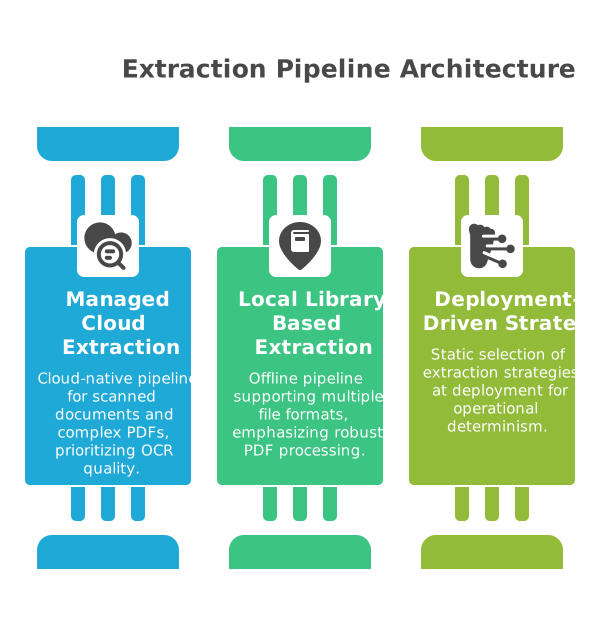
The extraction layer is designed around two complementary pipeline families, each suited to different document characteristics and operational requirements. Both families share the normalized response contract and are selected at deployment time through configuration rather than dynamic runtime switching.
Managed cloud extraction
Processing scanned documents, images, and complex multi-page PDFs where managed OCR quality is the priority, the platform provides a cloud-native extraction pipeline built on AWS Textract. Synchronous analysis is applied to image inputs. Multi-page documents are staged to secure S3 storage with server-side encryption before asynchronous analysis is initiated. The pipeline handles polling, timeout enforcement, result normalization, and optional cleanup of staged artefacts.
This pathway is particularly well-suited to document types that require high-fidelity structure detection including tables, form fields, and handwritten regions. The operational integration is designed to be consistent with enterprise security requirements: staging uses document-specific object keys, encryption is enforced by default, and temporary artefact lifecycle is configurable.
Local library-based extraction
For environments requiring offline capability, broader file format support, or extraction that is not dependent on external cloud services, the platform provides a library-based pipeline covering six document formats: PDF, images, DOCX, Excel, CSV, and plain text. Each format is handled by a dedicated extractor that applies format-appropriate parsing logic while producing the same normalized output envelope.
The PDF implementation warrants specific attention because of its engineering depth. Rather than performing simple text extraction, the platform validates file integrity using multiple parsing engines, processes pages in concurrent batches, extracts table structures and image metadata, and applies page filtering in accordance with the request contract. This design reflects the reality that enterprise PDF quality is highly variable, and robust processing requires multi-strategy validation rather than optimistic single-pass extraction.
Deployment-driven strategy selection
The platform does not attempt to dynamically mix extraction strategies within a single service instance. The active extraction strategy is selected at deployment time through configuration. This is a deliberate design choice: it keeps a given deployment operationally deterministic, simplifies debugging and observability, and avoids the complexity of runtime strategy negotiation. Organizations that need both managed and local extraction concurrently deploy separate instances and route workloads by document type or operational context.
The strategy per deployment pattern exemplifies a larger principle in the design of the AI Matic system: predictable and observable behavior during operation outweighs apparent flexibility when executing. This minimizes potential sources of failure.
LLM orchestration and structured output
LLM processing in the AI Matic IDP platform is an optional second stage, deliberately separated from the extraction core. This separation allows teams to deploy the platform in extraction-only mode, LLM-enriched mode, or to apply different LLM etiquette to different document workflows without restructuring the surrounding service architecture.
Provider abstraction
The LLM layer is designed to be portable across providers. The platform currently supports AWS Bedrock and OpenAI through a factory-based abstraction that exposes a consistent asynchronous interface to the orchestration layer. Provider-specific translation is confined to the adapter implementations, which means that prompt construction, output parsing, and higher-level orchestration logic are shared across providers. Adding a new provider requires implementing the adapter interface and registering it in the factory; no changes are required in orchestration or schema layers.
Prompt management and output shaping
The platform provides a structured prompt management subsystem rather than embedding prompt strings directly in endpoint code. Prompts can be selected by version, overridden per request, or extended with custom output format specifications. When a custom output format is supplied, the platform can translate that format into a JSON schema, inject it into prompt instructions, and where provider capabilities permit, request structured output directly from the model. When structured output is not natively supported by the active provider, the platform falls back to prompt-enforced JSON parsing.
This architecture addresses one of the most common failure modes in enterprise document AI: the inability to evolve output schemas without significant code changes. In the AI Matic platform, output evolution is managed through configuration and prompt conduct rather than through changes to core service logic. Business analysts and integration architects can modify the desired output structure without requiring a re-deployment of the extraction infrastructure.
Observability and cost control
Token usage is logged when available from the provider, providing the operational foundation for cost attribution and consumption monitoring. This is consistent with AI Matic's broader governance posture: instrumentation is built into the baseline rather than added after deployment. Organizations with requirements for chargeback, cost center attribution, or consumption-based governance can build on this foundation without retrofitting observability into their document AI workflows.
Enterprise readiness and operational controls
The AI Matic IDP platform is built for production deployment from the initial implementation. Operational controls that are frequently treated as afterthoughts in AI system development are part of the platform baseline. This reflects a core GoML engineering principle: demo-quality software and production-quality software are not the same thing, and the distance between them is where most AI initiatives lose time and credibility.
Deployment flexibility
The platform is clearly intended to handle the deployment of both containerized services as well as serverless functions. The same codebase can be used to deploy the platform in either method. The particular startup requirements for Lambda are taken care of in the application level itself. Thus, this provides the platform with flexibility in terms of deployment.
Health, readiness, and operational probes
The platform exposes liveness and readiness endpoints as first-class service components rather than optional additions. Readiness checks can optionally validate connectivity to dependent cloud services, providing a reliable basis for container orchestration, load balancer configuration, and deployment pipeline gating. These capabilities are present in the baseline and do not require post-deployment addition.
Request tracing and graceful shutdown
Request tracing is implemented at the middleware level. Each request carries a correlation identifier that is propagated through structured log output, providing the basis for end-to-end request observability. The platform also implements drain-mode shutdown, tracking in-flight requests and deferring process termination until active workloads are complete. These characteristics are the difference between a service that is survivable under operational pressure and one that is not.
Security and access controls
The platform provides a configurable security layer supporting API key authentication, bearer token validation, and JWT-based access control. Content-type allow-listing restricts accepted document formats to those explicitly configured for a deployment. Request rate limiting is available as a platform-level control, applicable without changes to business logic. These capabilities are engineered into the scaffold and activated through configuration, reflecting the principle that security architecture should not be deferred to late in the project lifecycle.
Scalability and enterprise architecture
Scalability in enterprise document processing is not solely a question of throughput. It encompasses the ability to extend the platform to new document types and AI providers, to maintain consistent engineering standards across multiple initiatives, and to evolve output requirements without architectural disruption. The AI Matic IDP platform addresses all of these dimensions.
Horizontal scaling
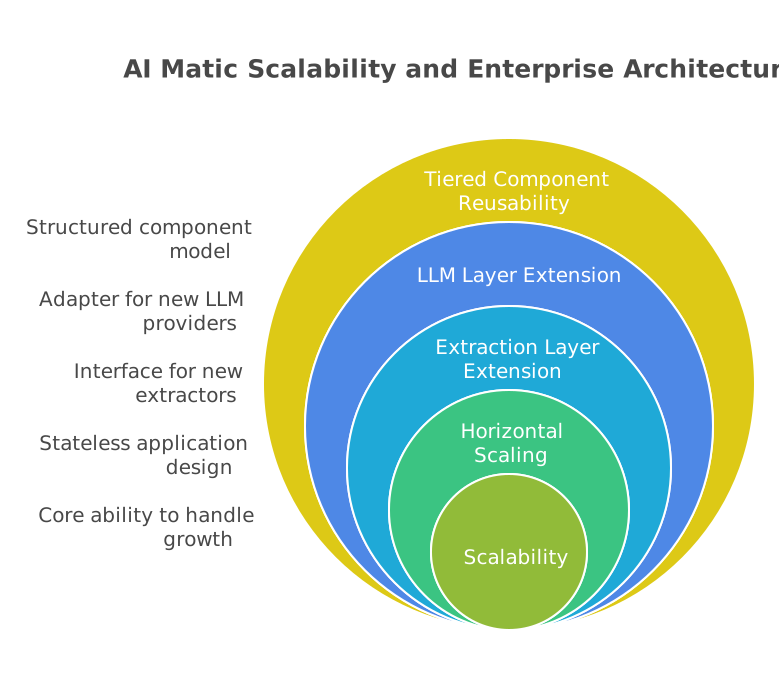
The platform is stateless at the application layer. Extraction and LLM processing are coordinated through the orchestration service without shared mutable state between requests. Temporary file handling accounts for serverless constraints, using environment-appropriate paths. Cloud service interactions are managed through singleton client instances with retry-aware configuration. These characteristics allow the platform to scale horizontally under load without architectural changes to the application.
Extending the extraction layer
When a new backend to do extractions is added, it needs to implement the BaseExtractor interface, along with being registered in the extraction factory. No other parts of the system are affected: the API contract, the orchestration code, the response schema, and the logging aspects remain untouched. This is precisely where we should add additional document intelligence providers like Azure Form Recognizer or Google Document AI.
Extending the LLM layer
Provider onboarding within the LLM layer proceeds in the same manner. A new provider needs to be onboarded by implementing an adapter and registering a factory. The generation of prompts, parsing of responses, and orchestration logic are independent of providers and do not need any updates. Thus, it is possible for the platform to be insulated from the effects of provider lock-in.
Tiered component reusability
The system establishes reusability in its three-layered component architecture. The first layer components, such as structured logging and general utilities, are reusable in all GoML-based projects without modification. The second layer components, like the base extractor interface, cloud client handling, authentication and rate-limiting, are reusable with project-specific configuration options. Finally, third-layer components constitute the assembly layer at which per-project work takes place.
The result is that the platform development effort put into one document AI project automatically helps to reduce both cost and risk in subsequent efforts. Standards, security practices, and operational instrumentation are leveraged by an organization’s AI program as a whole rather than being developed anew for each project.
Workflow transformation and real-world applicability
The practical value of the AI Matic IDP platform is best understood in terms of the document workflows it enables. The platform is intentionally generic at the architecture level, which means it can be applied to a wide range of document-centric business problems without changes to the surrounding infrastructure.
Representative document workflows
- Financial document processing: extraction of line items, counterparty identifiers, amounts, and dates from invoices, purchase orders, and remittance advices for automated matching against ERP records.
- Insurance claims intake: structured extraction from claim forms, supporting documentation, and adjuster notes to populate claims management systems and flag potential anomalies.
- Regulatory and compliance document review: extraction and classification from compliance filings, audit reports, and regulatory correspondence to support obligation tracking and remediation workflows.
- Contract lifecycle management: extraction of key terms, obligations, dates, and counterparty information from executed agreements to populate contract management systems.
- Healthcare document intake: structured extraction from clinical notes, referral letters, and patient documentation to support clinical pathway management and administrative workflows.
- Onboarding and KYC processing: extraction and validation of identity documents, supporting declarations, and customer-submitted forms against configured acceptance criteria.
Engineering impact
The acceleration the platform provides is directly attributable to the structured, reusable architecture. Extending the platform for a specific document workflow requires a fraction of the engineering effort that building an equivalent service from the ground up would demand.
This acceleration is not based on cutting corners. It reflects the fact that the platform has already absorbed the cost of engineering the non-differentiating infrastructure. The remaining work for any given initiative is use-case specialization, which is exactly where engineering effort should be concentrated.
Collaboration and ecosystem opportunities
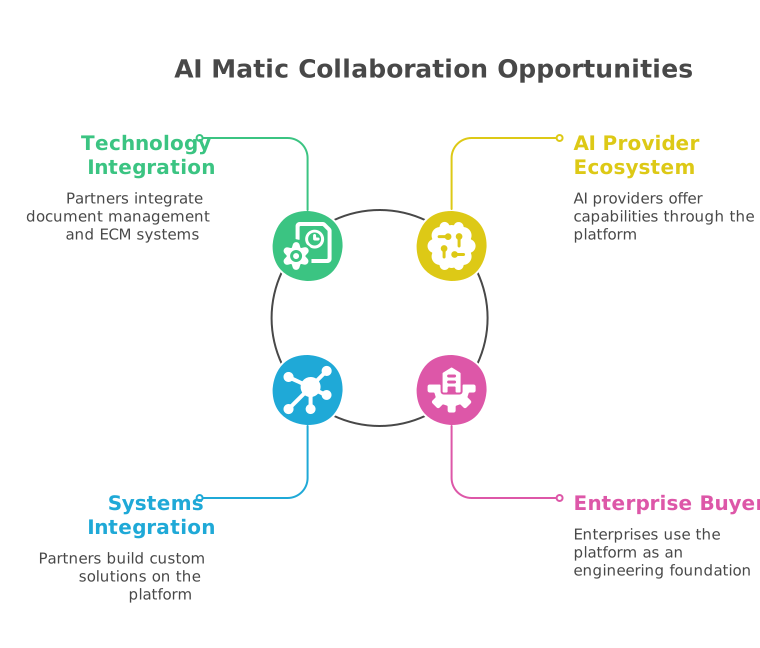
The AI Matic IDP platform is designed to serve as both a delivery accelerator for GoML engagements and a foundation for broader partnership and integration. Its layered architecture and explicit extension points make it well-suited to collaborative development across technology and systems integration partners.
Technology integration partners
Those organizations using document management systems, enterprise content management systems, and even business process automation applications will be able to interface with the AI Matic IDP through its reliable HTTP contract. Through its normalized response format, it is easier to achieve successful integration because it does not matter what document is being processed.
AI provider ecosystem
The provider-agnostic LLM abstraction creates a natural onboarding path for AI providers who wish to make their capabilities available within document processing workflows built on the platform. Provider integration is isolated to the adapter layer, and the prompt management and output shaping infrastructure is shared. This makes the platform an efficient distribution vehicle for AI capabilities that complement its extraction core.
Systems integration and enterprise delivery partners
For those working as systems integrators or enterprise delivery firms, AI Matic provides an attractive proposition in lieu of having to construct their own document AI stack. For our partners, the platform itself may serve as a delivery acceleration platform, which can be extended for particular industries or needs while retaining all the advantages of security architecture, operational rigour, and engineering best practices present in the baseline platform. GoML eagerly discusses possibilities for collaboration with any firm of engineers.
Enterprise buyer considerations
Enterprises evaluating the platform should consider it as an engineering foundation rather than a finished product. The value it delivers is not in replacing human expertise but in eliminating the low-value infrastructure work that prevents engineering teams from focusing on the domain-specific problems that differentiate a solution.
Strategic directions
The AI Matic IDP platform reflects the current state of an ever-evolving engineering investment. The GoML engineering R&D and practical knowledge gained from implementing enterprise document AI programs inform the platform's evolution roadmap. This architecture follows the same scalable engineering foundation used across the AI Matic Enterprise AI Platform, designed to accelerate enterprise AI deployment and operational scalability
A number of areas warrant active consideration for furthering the platform's development. Firstly, the extraction layer is intentionally modular, which allows us to add further managed providers easily within the context of our factory-driven strategy architecture model. This also holds true for our LLM orchestration layer, where we can leverage the increasing ability of the providers to support structured outputs as we evolve our approach to this aspect of the platform while maintaining the portability of the prompts and the output processing layer.
We are investing in observability capabilities, and while the existing instrumentation is robust, future iterations will allow us to do more in terms of attribution of costs, performance monitoring of models, and extraction quality control. This will become increasingly relevant as companies move from using the platform for a single use case deployment into a multi-workflow document AI program.
The multi-tiered component design model employed in structuring reusability across the present-day platform will keep on being developed through the creation of further use-case patterns based on the AI Matic platform. Any new pattern for solutions adds value to the component library within the platform and drives down the price tag on future endeavors. This is what happens when the development strategy favors platforms, and this is one of the greatest sources of GoML value.
The dedication to AI Matic on GoML’s side is not a one-off decision for developing a particular product but an engineering project which has been developed based on practical experience. With each new project that GoML takes up, the previous investments in its engineering processes ensure that a better base is provided than before.
.jpg)